
Hormones and Hearing: Menopause and Auditory-Cognitive Aging


What’s New About Getting Older?
Kathy Pichora-Fuller's column “What’s new about getting older?” delves into all aspects of ageing and hearing ranging from health policy developments to neurophysical research on the aging auditory brain.
Menopause has emerged as an important health topic (Dalvi, 2024). It is now recognized that sex hormones and the menopause transition not only affect reproductive health, but health more broadly (Bauer et al. 2026). There is mounting evidence concerning how hormonal changes and treatments may be linked to the onset of significant health conditions such as cardiovascular disease, type II diabetes, and cognitive decline. The importance of considering menopause in health care is receiving global and national recognition. According to the World Health Organization (2026) “social, psychological and physical health support during the menopausal transition and after menopause should be an integral part of health care” and “menopause can offer an important opportunity to reassess one’s health, lifestyle, and goals.” The Canadian Menopause Society (2026) and the Canadian Government (2025) are working to promote improvements in healthcare during menopause. Menopause is not a topic covered in the curricula of most health professionals, yet most health professionals work with women who are experiencing a range of physical, mental and social health issues that may be important to consider to promote healthy aging. Could some of the associations between hearing loss and age-related health issues (falls, cognitive decline, depression or loneliness) be influenced by menopause? Should audiologists be alert to how menopause may be influencing auditory aging and help-seeking for and up-take of audiologic rehabilitation?
Sex-related Differences in Auditory Aging
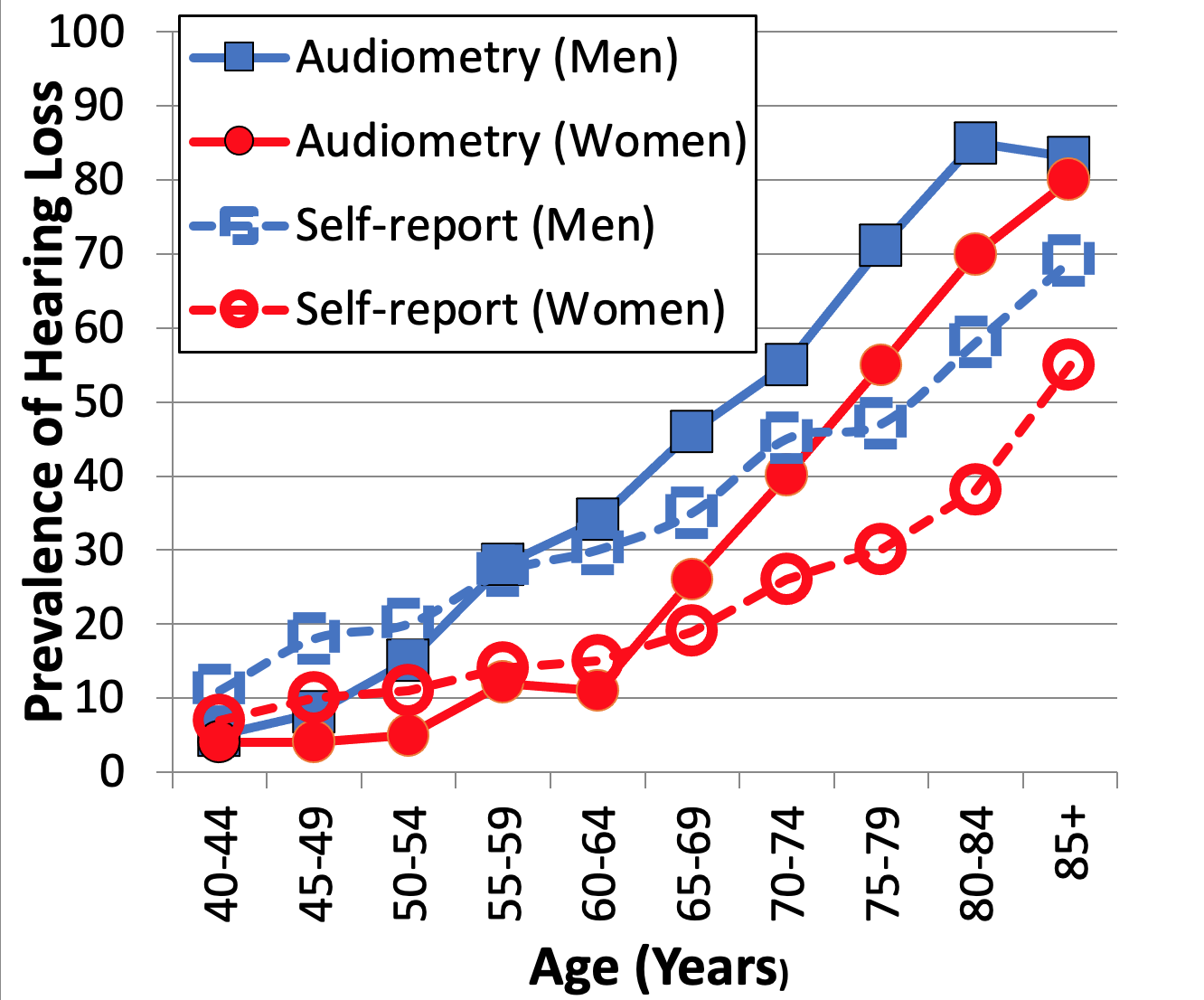
The typical pattern of age-related elevations in high-frequency audiometric thresholds in the population differs between sexes. Overall, hearing loss develops sooner in males than in females. As shown in Figure 1 (adapted from Bainbridge and Wallhagen, 2014), for both sexes, the prevalence of self-reported hearing problems exceeds the prevalence of audiometric loss until about 60 years of age when prevalence is similar regardless measurement criteria. After 60 years of age for men and after 65 years of age for women, the prevalence of hearing loss based on audiometry exceeds prevalence based on self-reported hearing problems. Interestingly, the prevalence of hearing loss begins to increase markedly after 55 years of age in men, but not until after 65 years of age in women. The biggest sex-related differences in prevalence occur between 55 and 65 years of age.
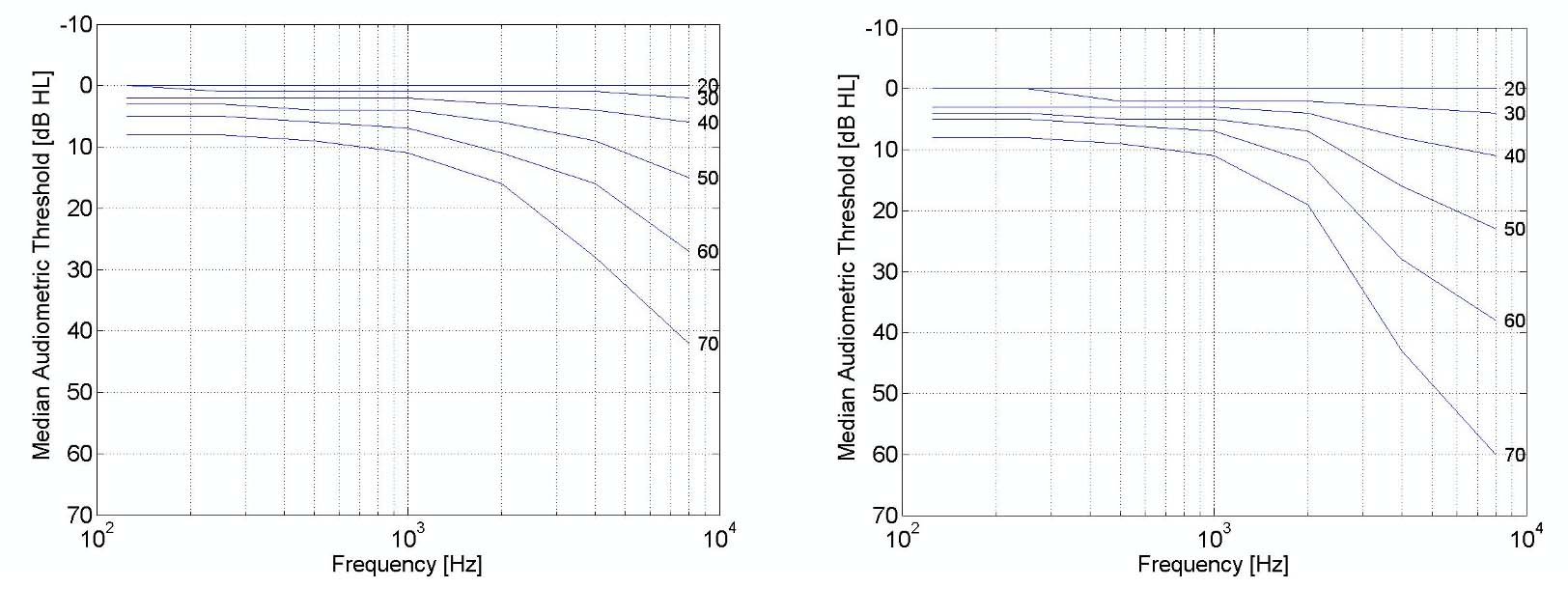
The sex-related difference in age-related threshold elevations is also illustrated in the median audiometric thresholds for the population reported by the International Organization for Standardization (Figure 2). Similar data, including higher frequency measures, have been reported across multiple countries (Jin et al. 2024). Prevalence data based on the Canadian Longitudinal Study on Aging is also similar (Mick et al., 2021).
Noise exposure may account for the earlier manifestation of hearing loss in aging men. Another possibility, however, is that changes in the levels of sex hormones in peri-menopause affect hearing (for a review see Reavis et al. 2023; Pichora-Fuller, 2023). For example, in those 45-55 years of age, pre-menopausal women had significantly better extended high-frequency audiometric thresholds compared to post-menopausal women (Zhang et al., 2018). Furthermore, studies in animal models found that hormone replacement therapy with an estrogen and a progesterone can harm hearing whereas therapies with estrogren alone can help hearing (Coleman et al, 1994; Price et al., 2009). In contrast, studies in post-menopausal women found that those taking either type of hormone replacement therapy orally had a higher risk of hearing loss, with risk being higher in those who treated for over 10 years, compared to those who were never treated (Curhan et al., 2017). Tinnitus may also be a symptom associated with menopause (Chen et al., 2018). Person-centered audiologic rehabilitation could improve as we gain a better understanding of how menopause may affect auditory aging at the population and personal levels.
Sex-related Differences in Cognitive Aging
Of those who develop Alzheimer’s Disease, the most common type of dementia, about 2/3 are female and 1/3 are male (Alzheimer Society of Canada, 2022). Sex-related differences in the prevalence of dementia may reflect the greater longevity of women and the greater risk of other causes of earlier mortality in men. The effects of hormones and health changes during menopause may be an important factor under-pinning sex-related differences in cognitive decline and dementia. Canadian researchers are leading research to refine our understanding of how types of menopause and hormone therapies affect brain health (Gravelsins & Galea, 2025; Puri et al., 2025). An overview of their findings using data from the Canadian Longitudinal Study on Aging was presented recently in an excellent webinar that explored the effects of age of menopause, genetics, and type of hormone treatment on different cognitive domains (Gravelsins & Galea, 2026). They found that transdermal (but not oral) administration of estradiol was beneficial for episodic memory (but not executive function) with corresponding changes observed using brain imaging, but these benefits were observed specifically in those with early age menopause who were carriers of the APOE4 gene associated with AD. There were also long-term benefits found for older women with a history of past hormone replacement therapy.
Considering Menopause in Person-Centered Audiologic Rehabilitation for Women
As outlined above, there are sex-related differences in auditory aging, including audiometric thresholds and self-reported hearing loss. Hormonal changes in menopause may also affect tinnitus (Tinnitus UK, 2026). Menopause affects many aspects of health beyond reproductive health. Importantly, some homone treatments may affect auditory aging and/or cognitive aging in some individuals. Furthermore, the intersection of auditory aging and cognitive aging may differ between males and females as suggested by research examining the cognitive performance of older Canadians with mild cognitive impairment (Grant & Phillips, 2025) who concluded that “The findings suggest that mild cognitive impairment may be over-estimated in females with hearing loss when a simple screening test is used and highlight the importance of using comprehensive measures to assess cognition in older adults, especially those with hearing loss”. Of the many considerations beyond audiometric thresholds that may influence the help-seeking and benefit from audiologic rehabilitation, it seems that menopause is yet another factor that may be worth thinking about. While more research is needed to work out the complex interplay of menopause with healthy aging, audiologists can begin listening to their clients with new awareness that menopause may be part of the hearing health context for women.
References
- Alzheimer Society of Canada (2022). Sex and gender differences in dementia; chapter 4 Landmark Study. https://alzheimer.ca/ns/sites/ns/files/documents/CHAPTER%204_ASC_People_REPORT2_13680_ENG_WEB-FINAL%20%281%29.pdf
- Bainbridge, K. E., & Wallhagen, M. I. (2014). Hearing loss in an aging American population: extent, impact, and management. Annual Review of Public Health, 35, 139–152. https://doi.org/10.1146/annurev-publhealth-032013-182510
- Bauer, K. R., Mainstone-Cotton, L., Spector, A., Zokaei, N. (2026). Hering and cognition across the menopause transition. Trends in Cognitive Sciences. https://doi.org/10.1016/j.tics.2026.02.001. Available online 11 March 2026. https://www.sciencedirect.com/science/article/pii/S1364661326000264
- Canadian Menopause Society (2026). Advancing Mature Women’s Health. https://www.canadianmenopausesociety.org/
- Chen, H. C., Chung, C. H., Chen, V. C. F., Wang, Y. C., & Chien, W. C. (2018). Hormone replacement therapy decreases the risk of tinnitus in menopausal women: a nationwide study. Oncotarget, 9(28), 19807–19816. https://doi.org/10.18632/oncotarget.24452
- Coleman, J. R., Campbell, D., Cooper, W. A., Welsh, M. G., Moyer, J. (1994). Auditory brainstem responses after ovariectomy and estrogen replacement in rat. Hearing Research, 80(2), 209–215. https://doi.org/10.1016/0378-5955(94)90112-0
- Curhan, S. G., Eliassen, A. H., Eavey, R. D., Wang, M., Lin, B. M., & Curhan, G. C. (2017). Menopause and postmenopausal hormone therapy and risk of hearing loss. Menopause, 24(9), 1049–1056. https://doi.org/10.1097/GME.0000000000000878
- Dalvi S. A. (2024). Menopause: Why is Everyone Talking About it Now?. Journal of Obstetrics and Gynaecology of India, 74(3), 196–200. https://doi.org/10.1007/s13224-024-02033-0
- Government of Canada (2025). Women and Diversity Health: Guide to Menopause. https://www.canada.ca/en/department-national-defence/services/benefits-military/health-support/women-diversity-health/health-guide/wdh-menopause-guide.html
- Grant, N., & Phillips, N. A. (2025). Sex differences in the relationship between hearing status and cognitive performance in individuals with mild cognitive impairment. Alzheimer's & Dementia, 21(Suppl 3), e098695. https://doi.org/10.1002/alz70857_098695
- Gravelsins, L., & Galea, L. (2025). One size does not fit all: how type of menopause and hormone therapy matters for brain health. The British Journal of Psychiatry : The Journal of Mental Science, 226(6), 369–382. https://doi.org/10.1192/bjp.2025.52
- Gravelsins, L., & Galea, L. (2026). Association between menopause age and estradiol-based hormone therapy with cognitive performance in cognitively normal women in the Canadian Longitudinal Study on Aging. Webinar, February 24. https://www.clsa-elcv.ca/17702-2/
- International Organization for Standardization. Acoustics—Statistical distribution of hearing thresholds related to age and gender. Geneva: International Organization for Standardization; 2017. ISO 7029:2017.
- Jin, I. K., Lee, D., Jeong, Y., Seo, Y. J., Kong, T. H., Suh, M. J., Cho, W. H., Lee, H. J., Choi, S. J., Cha, D., Park, K. H., & Oh, S. H. (2024). Trends in Distributions of Hearing Threshold Levels by Ages: A Comparison of the ISO 7029 and Newly Available Country-Specific Data. Journal of Audiology & Otology, 28(1), 1–9. https://doi.org/10.7874/jao.2023.00626
- Mick, P. T., Hämäläinen, A., Kolisang, L., Pichora-Fuller, M. K., Phillips, N., Guthrie, D., & Wittich, W. (2021). The prevalence of hearing, vision, and dual sensory loss in older Canadians: An analysis of data from the Canadian Longitudinal Study on Aging. Canadian Journal on Aging = La revue canadienne du vieillissement, 40(1), 1–22. https://doi.org/10.1017/S0714980820000070
- Pichora-Fuller, M. K. (2023). What about sex, gender, hearing and aging? The Canadian Audiologist, 10(2). https://canadianaudiologist.ca/what-about-sex-gender-hearing-and-aging/
- Price, K., Zhu, X., Guimaraes, P. F., et al. (2009). Hormone replacement therapy diminishes hearing in peri-menopausal mice. Hearing Research (1-2), 252, 29–36. https://doi.org/10.1016/j.heares.2009.02.010
- Puri TA, Gravelsins LL, Alexander MW, et al. (2025). Association between menopause age and estradiol-based hormone therapy with cognitive performance in cognitively normal women in the CLSA. Neurology, 105(6), e213995. https://doi.org/10.1212/WNL.0000000000213995
- Reavis, K. M., Bisgaard, N., Canlon, B., Dubno, J. R., Frisina, R. D., Hertzano, R., Humes, L. E., Mick, P., Phillips, N. A., Pichora-Fuller, M. K., Shuster, B., & Singh, G. (2023). Sex-linked biology and gender-related research is essential to advancing hearing health. Ear and Hearing, 44(1), 10-27. doi: 10.1097/AUD.0000000000001291
- Tinnitus UK (2026). Tinnitus and menopause: Can menopause cause ringing in the ears? https://tinnitus.org.uk/understanding-tinnitus/living-with-tinnitus/tinnitus-and-menopause/
- World Health Organization (2026). Menopause Fact Sheet https://www.who.int/news-room/fact-sheets/detail/menopauseZhang, J., Zhang, T., Yu, L., Ruan, Q., Yin, L., Liu, D., Zhang, H., Bai, W., Ren, Z. (2018). Effects of ovarian reserve and hormone therapy on hearing in premenopausal and postmenopausal women: A cross-sectional study. Maturitas, 111, 77–81. https://doi.org/10.1016/j.maturitas.2018.01.019
- Zhang, J., Zhang, T., Yu, L., Ruan, Q., Yin, L., Liu, D., Zhang, H., Bai, W., & Ren, Z. (2018). Effects of ovarian reserve and hormone therapy on hearing in premenopausal and postmenopausal women: A cross-sectional study. Maturitas, 111, 77–81. https://doi.org/10.1016/j.maturitas.2018.01.019