

Access Points: Beyond Hearing Aids: Why Communication Inclusion Became My Life’s Mission — And Why Audiologists Are Essential Partners


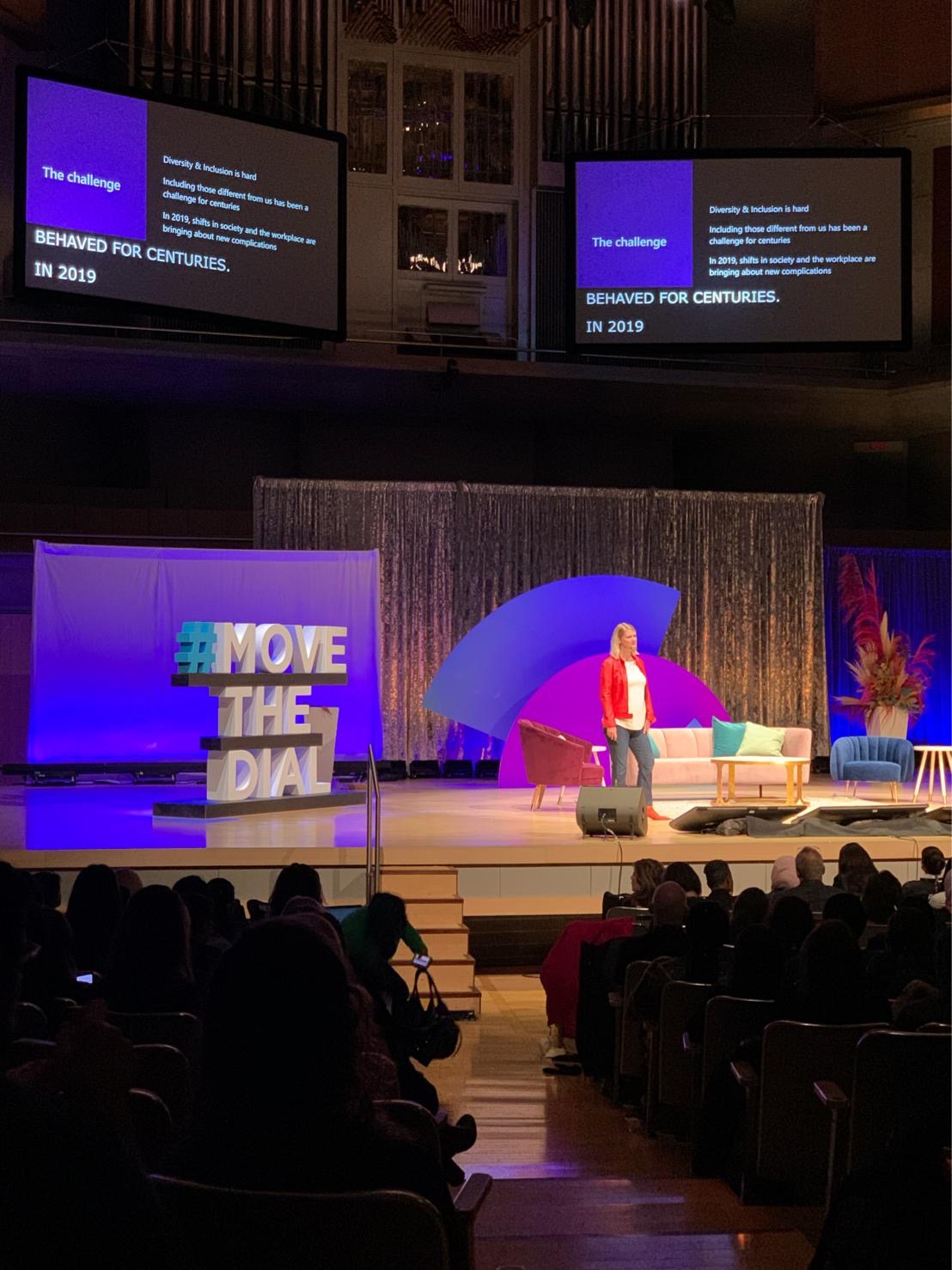
I was sitting in a darkened theatre in Toronto, watching a speaker I had been excited to hear for months. My hearing aid was perfectly fitted. I could hear sounds. But I could not understand a single word.
The acoustics were terrible. The speaker paced while talking. There was no captioning, no visual access to the words being spoken. I watched everyone around me laugh at jokes I could not catch, nod at points I could not follow, and take notes on insights I could not access. And I felt that familiar isolation — the kind that settles in your chest when you realize you are in a room full of people and completely alone.
This was not a new experience. I have congenital bilateral sensorineural profound hearing loss and have worn hearing aids since I was three years old. I have had excellent audiological care throughout my life. My devices work beautifully — when the environment supports them. That night in the theatre, something shifted. I had spent over three decades as an accessibility advocate and disability rights lawyer, fighting for the rights of thousands of Canadians with disabilities, writing policy, challenging discrimination in courtrooms and boardrooms, and pushing institutions to do better. And yet I had never consistently had equal access to communication myself. The advocate who had spent thirty years opening doors was still standing outside too many of them. I was tired of it.
The Uncomfortable Truth About Hearing Aid Success
Here is what audiologists know but do not always say out loud: your clinical work is only as effective as the environments your patients navigate.
You can fit the most sophisticated devices. Program them with precision. Provide excellent aural rehabilitation. Monitor outcomes meticulously. But if your patient walks into a workplace with poor acoustics, attends a conference without captioning, sits in a classroom where the teacher will not use the FM transmitter, or goes to a community event designed for aesthetics rather than sound quality, your work is undermined. Not because you failed clinically. But because hearing aids are only part of the communication access equation.
Your clinical work is only as effective as the environments your patients navigate. Hearing aids are only part of the communication access equation.
The formula is straightforward: premium hearing aids in an accessible environment produce full participation. Premium hearing aids in inaccessible environments lead to frustration and exclusion. The devices are necessary. They are not sufficient.
The Research That Reframes the Conversation
I have used captioning since the 1970s — complete with the decoder box connected to the television and the inelegant captions of that era. In 2019, I focused my research on captioning and subtitles, not just for people with hearing loss, but for everyone. What I found confirmed what decades of lived experience had already taught me.
According to a 2019 study by Verizon Media and Publicis Media, up to 80 per cent of people who use captions do not have hearing loss. They use them for comprehension, in noisy environments, when watching content in a second language, or simply because captions enhance engagement and retention. Baby Boomers with undiagnosed hearing loss, people with auditory processing disorders, individuals with ADHD, English language learners, and anyone in a reverberant or noisy space — all benefit from visual access to spoken words.
Captioning is the communication equivalent of the curb cut. Originally designed for wheelchair users, curb cuts are now used by parents with strollers, delivery workers, travellers with luggage, and cyclists — people who never thought of themselves as the intended beneficiaries of an accessibility feature. The same principle applies to captioning. When Netflix introduced subtitles as a standard feature rather than a special accommodation, engagement increased across all demographic groups. Universal design benefits everyone. Communication inclusion is not an accommodation for a minority. It is an intelligent design for the majority, and audiologists are uniquely positioned to make that case.
From Frustration to Action
In the summer of 2019, I founded HearVue, a Canadian social enterprise with a straightforward mission: to educate organizations about communication accessibility through captioning and universal design. The philosophy is simple — diversity is a fact, inclusion is an act. Organizations talk about diversity constantly. They count demographics and create charts. But diversity without inclusion is just numbers. Inclusion requires intentional design, resources, and commitment. If you do not intentionally include, you will unintentionally exclude.
Between September 2019 and March 2020, HearVue introduced live captioning to over a dozen events that had never experienced it before. My first event was held before none other than Michelle Obama. The response was consistent: people without hearing loss approached me afterward to say they had understood everything and had not realized how much they had been missing in noisy or reverberant venues. Parents of children with auditory processing disorders sent grateful messages. English language learners reported greater confidence and engagement.
Then March 2020 happened. The pandemic shut down live events, but did not shut down the mission. HearVue pivoted to virtual accessibility consulting. As the world moved online, the need for captioning became even more apparent. Zoom fatigue is worse without captions. Virtual meetings exclude participants unless captioning is enabled. The pandemic proved what I had always argued: communication inclusion is not optional. It is essential.
HearVue is now a consultancy, continuing to advance communication inclusion while expanding into broader accessibility strategy. The shift reflects a broader realization: I spent decades fighting barriers after they had already been built — in courts, at tribunals, through policy committees, and in accommodation processes that should never have been necessary. HearVue is proactive rather than reactive. The goal is not to remediate exclusion after it has caused harm. The goal is to design inclusion so thoroughly into the environment that exclusion becomes structurally impossible.
Why Audiologists Are Essential Partners
Audiologists see the gap between device success and communication access every single day. You fit hearing aids that work beautifully, only to watch your patients struggle in inaccessible environments. You provide FM systems that sit unused because teachers do not understand their importance. You conduct follow-ups in which patients report that devices help them hear better — but they still cannot participate fully.
You are uniquely positioned to bridge clinical care and systemic advocacy. When you recommend captioning for workplace meetings, you are extending your clinical expertise into environmental design. When you explain to school administrators why acoustic treatment matters as much as assistive technology, you are advocating for accessible spaces. When you write accommodation letters that specify CART alongside device recommendations, you are acknowledging what the research confirms: hearing aids are necessary but not sufficient.
When you write accommodation letters specifying CART alongside device recommendations, you acknowledge that hearing aids are necessary but not sufficient. This is comprehensive audiological care — clinical excellence plus systems advocacy.
This is not a departure from audiological practice. It is the natural extension of it. Comprehensive audiological care means following the patient beyond the fitting room and into the environments where their hearing actually matters. A patient who leaves your clinic with optimally fitted devices and returns six weeks later, frustrated and disengaged, has not experienced a clinical failure. They have experienced an environmental one. The clinical and lived outcomes are two distinct measures—and audiologists who track both will serve their patients more fully than those who track only one.
What This Looks Like in Practice
For individual patients, include captioning in accommodation letters alongside device recommendations. Explain that hearing aids and captioning are complementary, not alternatives. Educate patients about their right to communication access under provincial and territorial Human Rights Codes and the Accessible Canada Act — many do not know these protections exist, and knowing changes how they advocate for themselves.
For organizations, audiologists are credible voices on acoustic design, captioning integration, and communication access planning. When an audiologist explains that a workplace’s open-concept floor plan undermines the effectiveness of every hearing aid in the building, that carries professional authority that a general accessibility consultant cannot replicate.
For the profession, integrating communication inclusion into audiology education would produce graduates equipped to address both the clinical and the environmental dimensions of hearing. Developing professional resources on communication access — beyond device recommendations — would serve patients whose barriers are not audiological but architectural.
The Business Case
Organizations frequently resist captioning due to perceived costs. The data tells a different story. Studies show 40 per cent better retention with captions. Event feedback scores consistently improve when captioning is provided. Live captioning for a professional event typically costs between $150 and $300 per hour — a fraction of most audio-visual budgets. Automated captioning on platforms such as Zoom and Microsoft Teams is available at minimal or no additional cost, though accuracy is generally lower than CART in professional settings.
The legal case is equally clear. The Accessible Canada Act requires communication accessibility for federally regulated organizations. The Ontario Human Rights Code requires accommodation to the point of undue hardship — and at $150 to $300 per hour, captioning rarely constitutes undue hardship. Proactive accessibility reduces human rights complaints, improves talent retention among employees with disabilities, and signals organizational values in ways that matter to prospective employees and clients.
The question is not whether organizations can afford captioning. It is whether they can afford the exclusion, the liability, and the loss of talent that come with it.
The Missing 27 Per Cent
Eight million Canadians live with disabilities. They are in every workplace, every classroom, every conference room, every waiting room. They are your patients. They are also your colleagues, your clients, and the people designing the systems that govern all of our lives. Communication inclusion affects everyone — but it is essential for millions.
What I have learned in thirty years of advocacy, and what the research confirms, is that the most effective accessibility is the kind that disappears. When captioning is on, when acoustic design is built in, when communication access is the default rather than the exception, no one has to ask. No one has to explain themselves. No one has to wait while a special provision is arranged. Everyone participates.
That is the goal. Not accommodation. Universal design that builds the room for everyone from the start.
Audiologists cannot build every room. But you can change what happens in them — one patient, one accommodation letter, one conversation with an employer at a time. Clinical excellence matters enormously. So does knowing that your work extends beyond the device and into the world your patient returns to every day.
I have spent thirty years making that argument in courtrooms and policy committees. I have also lived it — in every darkened theatre, every inaccessible conference, every room that was beautifully designed for hearing people and not designed for me. That night in Toronto was not the last time I sat in a room I could not fully access. But it was the night I stopped accepting that as inevitable.
Both matter. Both are your work. Both are what comprehensive audiological care looks like. And for the eight million Canadians whose access to communication depends on the environments they navigate every day, the work has never been more urgent.