
Distinguishing Scientific Facts from Fiction? It is important, but most people can’t tell.


From the Labs to the Clinics
Renowned auditory researcher Dr. Robert Harrison brings us up to date on information and research from the Labs. Appropriately titled “From the Labs to the Clinics”, Bob is involved in laboratory and applied/clinical research, including evoked potential and otoacoustic emission studies and behavioural studies of speech and language development in children with cochlear implants. For a little insight into Bob’s interests outside the lab and the clinic, we invite you to climb aboard Bob’s Garden Railway.
One of the fundamental pillars of any scientific or healthcare field is that it be based on facts and real evidence. Methods of disease prevention, diagnosis, and treatment should be based on what is known to work or at least to have a high probability of effectiveness. I think that we would all agree on that. Or would we? For most of my academic career I have lived with the assumption that scientists and healthcare professionals should only embrace evidence-based facts. As a scientist I have lived with the gold-standard of carrying out research studies with strict conditions, such as the formulation of an hypothesis, testing with controlled experiments, with adequate subject numbers and verified research techniques. The data collected is analysed with methods that can yield statistically significant results. This is followed by a peer review verification process which means that before publication of results, other scientists in the field review the work and accept (or not) the results.
Without being too hyperbolic, and without straying too much into politics, I believe we are rapidly moving away from the gold-standards outlined above. At all levels of the scientific process various irregularities appear to be creeping in, ranging from sloppiness (to be kind) to dishonesty (to be less kind). Some “research papers” are based on inadequate experimental methods or cherry-picked case reports. The publishing of scientific data is becoming a shambles, with the proliferation of predatory journals that offer, for a price, to publish literally anything. Some people make up the data, and nobody will know because the papers are not peer reviewed. The corruption is attractive because many individuals, or companies, or political groups, can benefit (with fame or fortune) from fraudulent facts. In education, college and university promotions and academic careers can be fuelled with useless publications. In the drug industry, false claims can sell ineffective cures and make profits.
As more and more instances of this confusion about what is fact and what is fiction, there is a growing distrust of science. Consider for example the belief that autism results from of MMR (measles, mumps and rubella) vaccination [ref 1]. This untruth is resurfaced at the US Center for Disease Control (CDC) under its new management. From the administration (not the scientists) of this once revered institution have a denial that COVID vaccines work, and that mRNA derived vaccines can kill. The men at the top (including you know who) call vaccination a big-pharma “con-job” and are actively working to restrict hepatitis B and even polio immunizations. Often, when confronted to verify false claims “officials” cite the testimony of “an expert” rather than meta-analyses (systematic reviews) of published papers from multiple scientific teams. For the lay public “facts” given by people in authority are often good enough because, and I repeat the title of this post, most people cannot distinguish scientific facts from fiction. They do not know of, or understand the scientific process.
I have written previously in this column my experiences in regions of Israel (from the Negev in the south, to Golan Heights to the north) where I had Q and A discussions with residents who opposed nearby wind turbine installations [ref 2]. Some simply did not like the look of the “windmills’, but others would bring up conspiracy theories and even cite publications that confirmed for them that wind turbine noise can cause hearing loss, vertigo, cardiovascular disease, birth defects, and cancer etc. For these audiences I had to carefully explain where to find the best scientific evidence about such claims, and what sources were unreliable or untruthful [refs 3,4]. My presentations included the diagram below, showing the range of publication sources that can provide high quality evidence versus worthless opinion.
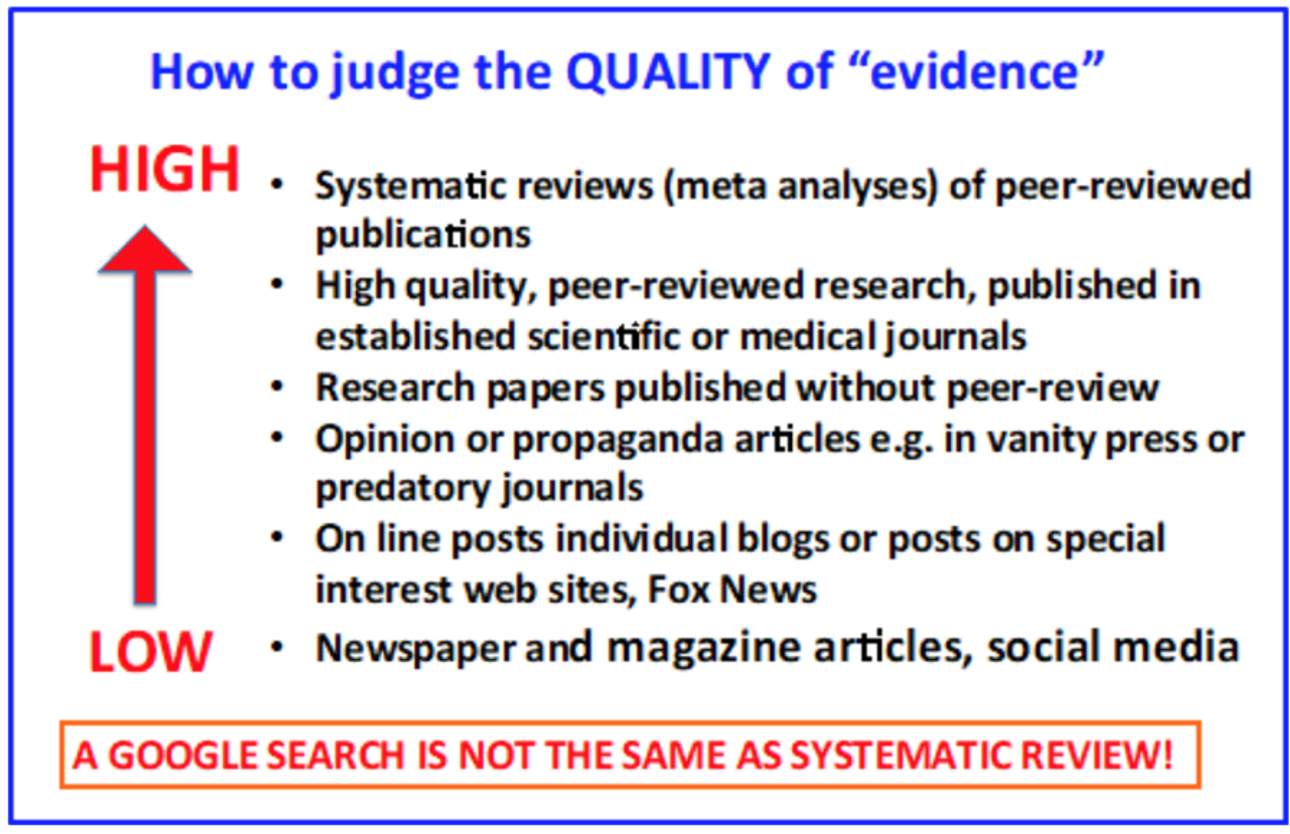
As hearing healthcare professionals, I am confident that you understand where good scientific evidence comes from, and where it can be found. If you have a question, do not rely solely on a Google search (with or without AI assistance). It is a good starting point but remember that the search algorithm does not evaluate the verity of its sources. Please go to the next (Google) step, Google Scholar [ref 5]. This is good, but it still lists non peer-reviewed publications. As a final “arbiter” consult Medline [ref 6] which will search only medical and scientific publications that are published in peer-reviewed journals.
I have a genuine worry that as more online sources of information proliferate (podcasts, social media channels, self-published opinions on YouTube and TikTok) the less informed society will be about real evidence and scientific truths. It is important that the lay public know how to get at the facts. Please spread the message!
References
- [1] DeStefano F, Shimabukuro TT. (1019) The MMR Vaccine and Autism. Annu Rev Virol. 2019 Sep 29;6(1):585-600. doi: 10.1146/annurev-virology-092818-015515.
- [2] Harrison R.V. et al. (2015) co-author of: Council of Canadian Academies (2015): Understanding the Evidence: Wind Turbine Noise. Ottawa: The Expert Panel on Wind Turbine Noise and Human Health, Council of Canadian Academies. ISBN 978-1-926522-07-4
- [5] Harrison RV (2022). The Health Effects of Noise: NIMBYism, Greed, and Conspiracy Theories. Canadian Audiologist 2022 Vol 9 issue 3. (Not peer reviewed)
- [4] Harrison RV (2024) Distinguishing Scientific Facts from Fake News in Audiology. Canadian Audiologist Volume 11 issue 5. (Not peer reviewed)
- [5] Google Scholar. https://scholar.google.ca/
- [6] Medline. https://www.nlm.nih.gov/medline/medline_home.html