
Universal Design for Hearing: Advancing Accessibility Across Canada


Introduction
Hearing loss is one of the most prevalent chronic conditions in Canada and globally, yet hearing accessibility remains inconsistently addressed across workplaces, educational settings, and community environments. The World Health Organization (WHO) estimates that over 1.5 billion people worldwide live with some degree of hearing loss, with nearly 430 million requiring rehabilitation services (WHO, 2021). In Canada, approximately 4.7 million adults report hearing difficulties, representing nearly one in five Canadians, with prevalence increasing substantially with age (Statistics Canada, 2022).
Despite its prevalence, hearing loss continues to be addressed primarily through an individual, medicalized lens, with solutions focused on personal amplification rather than environmental or systemic change. This approach fails to address the widespread communication barriers that affect people who identify as hard of hearing or Deaf, as well as those with auditory processing difficulties, temporary hearing challenges, multi-lingual learners, and older adults. A “universal design for hearing” offers a framework for addressing these barriers at a population level by embedding accessibility into environments, systems, and services from the outset.
Universal Design and Accessibility in Canada
Universal design refers to the design of environments and systems to be usable by the widest possible range of people, without the need for individual adaptation. This concept aligns closely with the social model of disability, which recognizes that disability arises not solely from impairment, but from barriers within the physical, social, and attitudinal environment. In contrast to accommodation-based approaches, universal design shifts responsibility away from the individual and toward the systems that shape participation and inclusion.
Accessibility is an important part of DEI (Diversity, Equity, Inclusion) principles because it ensures that people of all abilities can participate, contribute, and belong in every space. In many organizations and frameworks, DEI has expanded to IDEA (the “A” stands for Accessibility) to reflect this essential connection.
In Canada, this perspective is reflected in federal and provincial accessibility legislation. The Accessible Canada Act (2019) aims to achieve a barrier-free Canada by 2040 and identifies communication and information as key priority areas. Provincial legislation, such as the Accessibility for Ontarians with Disabilities Act (AODA) or the Nova Scotia Accessibility Act, similarly addresses accessibility across employment, education, customer service, and information and communications. While physical accessibility has received considerable attention, hearing-related barriers remain under-recognized and inconsistently addressed.
Communication barriers are among the most frequently reported challenges in workplaces and educational environments, particularly in meetings, training sessions, and informal interactions. These barriers often stem from a lack of assistive listening technology, poor acoustics, excessive background noise, a lack of visual supports, and inconsistent communication practices. Because hearing barriers are frequently invisible, they are less likely to be proactively addressed, resulting in increased listening effort, fatigue, reduced participation, and inequitable outcomes.
Universal Design for Hearing
The application of universal design principles to hearing accessibility has been advanced by the work of Canadian audiologist and researcher Dr. Mary Beth Jennings and colleagues at the National Centre for Audiology. Their work extended universal design beyond physical access to include auditory and communication environments, emphasizing that reliance on individual accommodations or personal technologies alone is insufficient.
Universal design for hearing focuses on optimizing acoustic environments, reducing background noise and reverberation, minimizing listening effort, and ensuring that access to auditory information does not depend on disclosure of disability or complex technology. Importantly, research has demonstrated that poor acoustic conditions increase listening effort and fatigue for individuals with and without hearing loss, while improvements to the auditory environment benefit all users. These findings support the need for preventive, design-based approaches rather than reactive accommodations needed for someone in a communication crisis.
Hearing-Related Barriers Across Environments
Hearing-related barriers occur across a wide range of settings, including workplaces, classrooms, healthcare facilities, and community spaces. Excessive noise, poor room acoustics, lack of captioning or visual supports, lack of ASL/LSQ interpreters, and inaccessible communication technologies contribute to reduced speech intelligibility and increased cognitive load. The WHO estimates that unaddressed hearing loss results in nearly US$1 trillion in global costs annually due to impacts on productivity, education, healthcare, and social participation.
In educational settings, children require a more favorable signal-to-noise ratio than adults to understand speech, making classroom acoustics particularly critical. In community and healthcare environments, lack of communication access has been associated with reduced patient safety, poorer health outcomes, and decreased civic participation. These barriers affect not only individuals with diagnosed hearing loss, but also those experiencing situational hearing difficulties, such as in noisy environments or during periods of illness or stress.
Reducing Barriers in the Workplace
Workplace communication is a frequent source of hearing-related barriers. Meetings, training sessions, and collaborative work often occur in acoustically challenging environments, increasing listening effort and fatigue. Acoustic interventions, including sound-absorbing materials, noise control strategies, and thoughtful spatial design, can significantly improve speech intelligibility and reduce cognitive load.
Assistive listening technologies, such as hearing loop systems, FM/DM sound field systems, infrared systems, Bluetooth/Auracast, meeting room cameras, and real-time captioning, play an important role in supporting communication access. Participants must always use permanent microphones that can connect directly to users' hearing aids and/or cochlear implants. Captioning, in particular, has become increasingly common in virtual and hybrid work environments and has been shown to improve comprehension, retention, and engagement for a wide range of users. Inclusive communication practices, such as providing written agendas (especially before a meeting), supporting turn-taking, and summarizing key points, further reduce barriers and support equitable participation.
Reducing Barriers in Educational Settings
In educational environments, universal design for hearing is closely aligned with inclusive pedagogy and academic success. Excessive classroom noise and poor acoustics negatively affect speech perception, attention, and learning outcomes. Sound-field amplification systems have been shown to improve speech clarity and attention for all students, not just those with identified hearing loss.
Visual and multimodal supports, including captioned videos and accessible learning management systems, are consistent with universal design for learning principles and benefit a diverse student population. Instructor training including consistent microphone use, repetition of questions, and clear communication practices reduce inequities related to hearing access and listening effort.
Reducing Barriers in Community Environments
Community environments play a central role in social participation and access to services. In healthcare settings, lack of communication access has been linked to increased risk of medical error, reduced patient satisfaction, and poorer health outcomes. Universal design strategies, such as hearing loops at service counters, captioning at public events, and visual alerts alongside auditory announcements, improve access and safety for all community members.
Staff training and clear signage are essential to ensure that accessibility features are effectively implemented and utilized. Research consistently demonstrates that assistive listening systems are underused when staff are unfamiliar with their operation or when users are unaware that they exist. For a list of universal symbols of access: https://accessible.canada.ca/creating-accessibility-standards/can-asc-21-outdoor-spaces-draft/annex-c-normative-public-information-symbols
The Canadian Academy of Audiology has created a number of accessibility resources for professionals and the public on how to reduce barriers. For more information, please visit: https://canadianaudiology.ca/accessibility-resources/
The Canadian Hard of Hearing Association has a “Get in the Hearing Loop” program with many resources on how to improve accessibility in your community. For more information, please visit: https://getinthehearingloop.ca/
https://getinthehearingloop.ca/our-partners/
Universal Design for Hearing Project
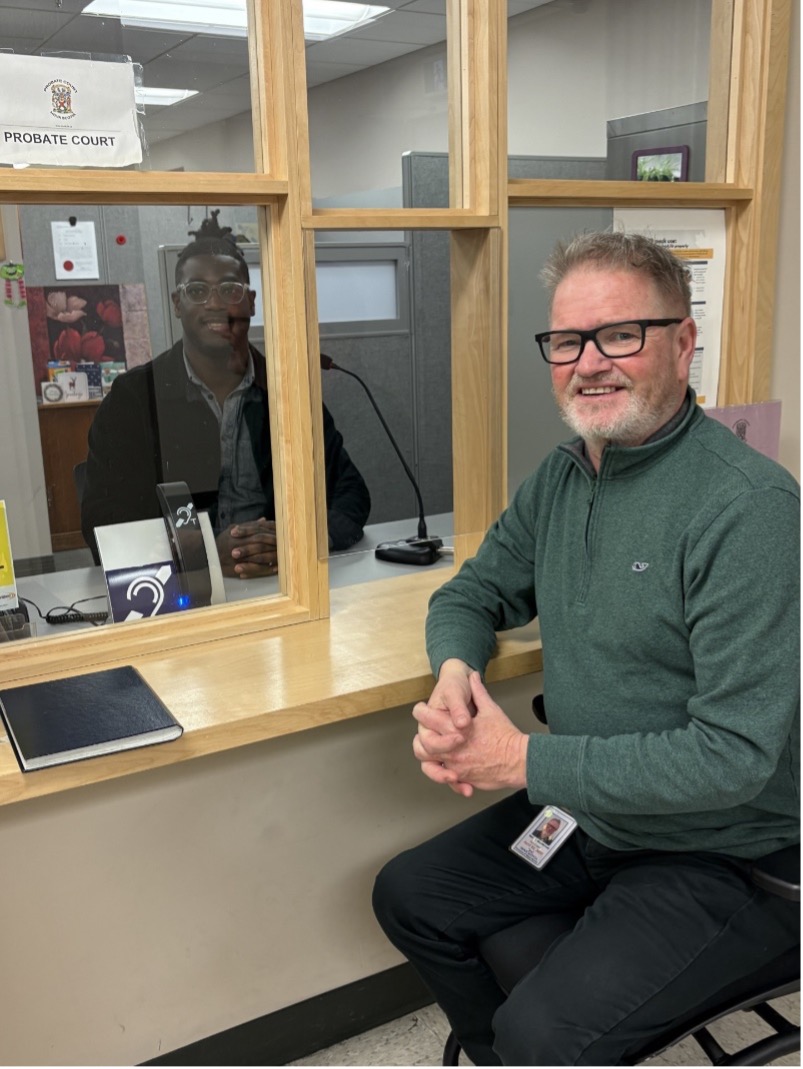
In 2025, Nova Scotia’s Department of Justice launched a province-wide accessibility initiative in partnership with Accessible Hearing Solutions (AHS). AHS is an audiologist-owned business solely focused on reducing barriers for organizations that use a universal design for hearing lens, and is an official technology partner of the Canadian Hard of Hearing Association. The project installed counter hearing loops at public service desks in all provincial courthouses; places where critical legal information is exchanged every day.
For people who use hearing aids or cochlear implants equipped with telecoils, the loops transmit sound directly from the staff member’s microphone into their device, reducing background noise. Each system also includes an amplified handset, allowing participants who experience hearing difficulty but do not wear hearing aids to listen more clearly and privately. A visitor no longer needs to disclose a hearing loss, request special assistance, or move to a separate room. Instead, they simply choose the option that works best for them and participate more fully in the conversation.
This initiative exemplifies universal design for hearing by embedding accessibility into the environment rather than offering it as an accommodation. The technology benefits a wide range of users including older adults, people with temporary hearing challenges, multi-lingual users, and people with auditory processing difficulties, without singling anyone out. By making clear communication the default, Nova Scotia’s courthouse hearing loop project demonstrates how inclusive design can strengthen access to justice for everyone.
Implications for Audiologists
Universal design for hearing has important implications for the scope and practice of audiology. While individual assessment, amplification, and aural rehabilitation remain essential components of care, these interventions alone are insufficient to address the broader communication barriers experienced by people living with hearing loss. A continued reliance on a predominantly medical and device-focused model, risk overlooking the environmental and systemic factors that contribute to participation restrictions across the lifespan.
Audiologists are uniquely positioned to extend their role beyond the clinic by applying their expertise in acoustics, auditory perception, listening effort, and communication demands to real-world environments. This includes consulting on the design and evaluation of workplaces, classrooms, healthcare facilities, and community spaces to identify barriers related to noise, reverberation, distance, and visual access. By shifting attention from “fixing the listener” to optimizing the listening environment, audiologists can support access for a much broader population, including individuals who may not identify as having a hearing loss.
Universal design for hearing also aligns with a public health approach to hearing care. Addressing communication barriers at a systems level can reduce fatigue, improve participation, and mitigate downstream impacts of hearing loss, such as social isolation, reduced productivity, and inequitable educational and employment outcomes. From this perspective, audiologists can contribute to accessibility planning, policy development, and interdisciplinary collaboration with architects, educators, employers, disability organizations, and policymakers.
Incorporating universal design principles into audiology practice may require changes in university-level training, service delivery models, and advocacy with national professional and provincial/territorial audiology regulators. This could include increased emphasis on environmental assessments, consultation services, education and training for non-clinical stakeholders, and advocacy for hearing accessibility within existing accessibility legislation and standards. As accessibility requirements expand federally and provincially/territorially, audiologists have an opportunity to play a more visible role in shaping hearing-supportive environments rather than responding reactively to access complaints.
Ultimately, universal design for hearing challenges the profession to move farther outside the booth and to view hearing accessibility as a shared societal responsibility rather than an individual burden. By integrating universal design principles into their clinical, consultative, and advocacy roles, audiologists can contribute meaningfully to creating inclusive workplaces, schools, and communities across Canada.
Conclusion
Hearing accessibility is not a niche issue, but an important public concern with significant social, educational, and economic implications. Universal design for hearing provides a framework for addressing communication barriers at their source by shifting the focus from individual accommodation to environmental and systemic change. As supported research, including the work of Dr. Mary Beth Jennings, addressing hearing access at the design stage is both practical and necessary. The ultimate goal is to reduce the onus on individuals with hearing loss who face the never-ending demand to ask for communication accommodations from others. Advancing universal design for hearing is essential to creating workplaces, schools, and communities that support full participation.
References
- Accessible Canada Act, S.C. 2019, c. 10. (2019). Government of Canada.
- Canadian Association of the Deaf. (2015). Universal design. https://cad-asc.ca/issues-positions/universal-design/
- CAST. (2018). Universal design for learning guidelines version 2.2. http://udlguidelines.cast.org
- Jennings, M. B., Shaw, L., Hodgins, H., Kuchar, D., & Scovil, C. (2010). Universal design for hearing: Considerations for examining hearing demands and developing hearing-friendly workplaces. AudiologyOnline.
- Jennings, M. B. (2009). Hearing accessibility and assistive technology use by older adults: Application of universal design principles to hearing. In L. Hickson (Ed.), Hearing care for adults: The challenge of aging (pp. 249–254). Phonak.
- Statistics Canada. (2022). Hearing loss of Canadians, 2019. Government of Canada. https://www150.statcan.gc.ca/
- World Health Organization. (2001). International classification of functioning, disability and health (ICF). WHO.
- World Health Organization. (2021). World report on hearing. WHO. https://www.who.int/