The Effect of Shooting Glasses on Earmuff Attenuation Measured with Acoustic Test Fixtures and Firearm Impulses

This page as PDF

FROM: Spectrum – A Publication of the National Hearing Conservation Association

(VOLUME 41, ISSUE 2, August 2024). Used with permission

Firearm users are faced with conflicting or inaccurate information when choosing personal protective equipment.  While both ballistic safety glasses and hearing protection are recommended for use with firearms, product labeling does not reflect potential changes in performance when using both devices simultaneously.  Safety glasses are designed to protect the eyes from projectiles (e.g., sparks, bullet shavings), and hearing protection, such as earmuffs, reduces the amplitude of potentially hazardous impulse noise.  Product labeling for earmuffs only reports measured NRR values for noise reduction when worn in isolation in continuous noise.  However, safety glasses worn in combination with earmuffs introduces a leak between the cushion of the earmuff and the head, where the temple of the glasses slips underneath the cushions (Figure 1).  Royster et al. (1997) reported that safety glasses, when worn with earmuffs, lowered the noise reduction rating by about 9 or 10 dB for human subjects.  Murphy and Tubbs (2007) reported that safety glasses reduced the attenuation of peak impulse level between 10 and 15 dB, when measured with an acoustic test fixture (ATF). 

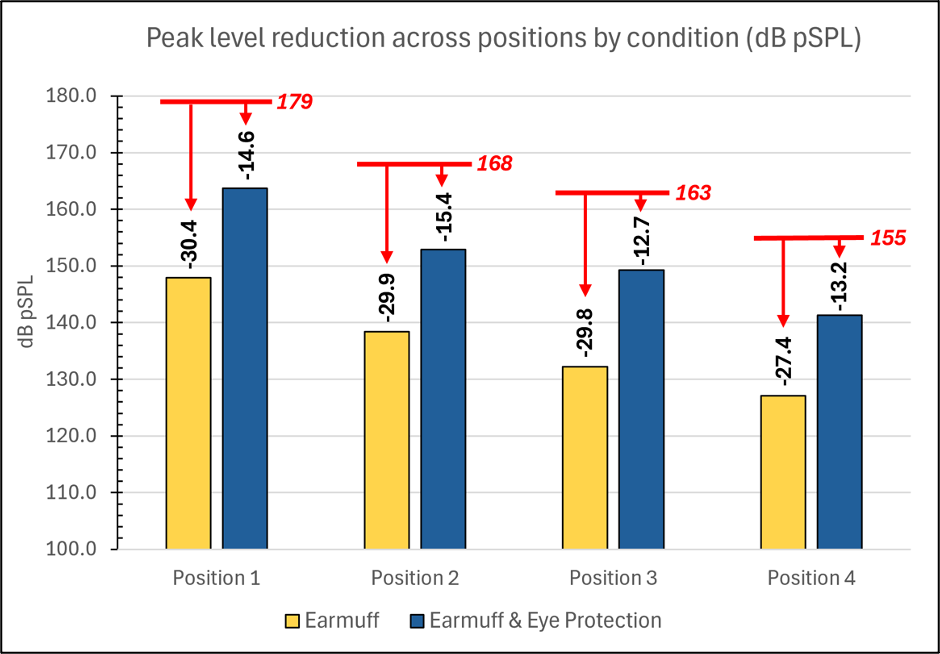
We selected a popular model of earmuffs, sold as a combination of earmuffs, earplugs, and ballistic safety glasses, to test with firearm impulses and a GRAS 45CB ATF.  Four positions relative to the firearm muzzle were identified, yielding levels between 155 and 179 dB pSPL as produced by a .300 caliber Browning A-Bolt rifle (Figure 2). Impulse peak levels were reduced from -27.4 dB of attenuation when only wearing earmuffs, to -13.2 dB with earmuffs and safety glasses at the position furthest from the muzzle (155 dB peak level) and -30.4 dB of attenuation (earmuffs only) to -14.6 dB (earmuffs and safety glasses) at the position closest to the muzzle (179 dB peak level) (Figure 3).  The spectrum of the Impulse Insertion Loss (IIL) was less than 10 dB below 400 Hz for earmuffs alone, and negligible for the earmuffs and glasses condition. At high frequencies, the leak due to the safety glasses reduced the Impulse Insertion Loss by 15 to 25 dB.
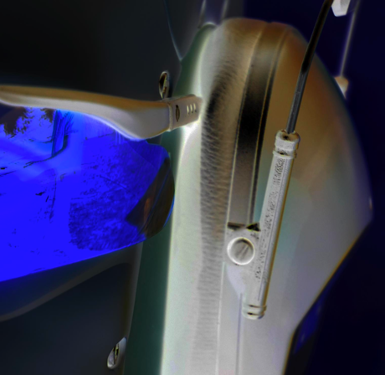
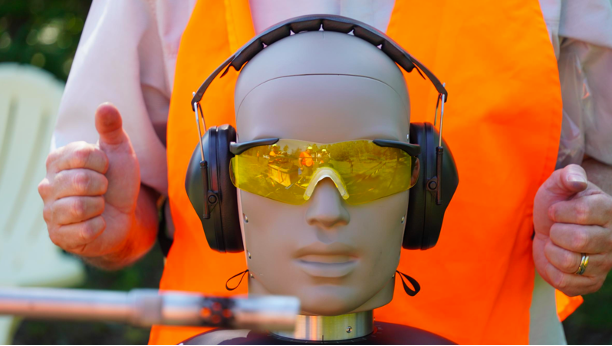
Figure 1. Close-up view of deformation of the earmuff cushion from the ballistic safety glasses resulting in an acoustic leak.

Figure 2. Earmuffs and ballistic safety glasses positioned on the acoustic test fixture (Position 1, 179 dB pSPL). The muzzle of the .300 caliber Browning A-Bolt rifle is shown in the foreground.

Figure 3.  Peak reduction for earmuff-only and earmuff + eye protection conditions at all four measurement positions (Position 1 is closest to the firearm muzzle. Position 4 is furthest from the firearm muzzle). 

Dual protection (earmuffs and earplugs) is advisable when firing high-powered firearms.  Alternatives to the traditional safety glasses are available with either magnetic connections or straps that do not deform the earmuff’s cushion. Hearing conservation programs need to account for the deleterious effect of protective eyewear on earmuffs, and additional studies with broad combinations of earmuffs and eyewear are needed to establish the range over which eyewear can be expected to compromise earmuff attenuation. 


References

  • Murphy, W. J., and Tubbs, R. L. (2007). “Assessment of Noise Exposure for Indoor and Outdoor Firing Ranges,” J. Occup. Environ. Hyg. 4, 688–697. doi:10.1080/15459620701537390.
  • Royster, J. D., Berger, E. H., Merry, C. J., Nixon, C. W., Franks, J. R., Behar, A., Casali, J. G., et al. (1996). “Development of a new standard laboratory protocol for estimating the field attenuation of hearing protection devices. Part I. Research of Working Group 11, Accredited Standards Committee S12, Noise,” J. Acoust. Soc. Am. 99, 1506–1526. doi:10.1121/1.414729.

This page as PDF
About the authors

Donald Finan, PhD

Donald Finan, PhD. is a Professor of Communication Sciences & Disorders at the University of Northern Colorado. He received a PhD in speech physiology and neuroscience from Indiana University – Bloomington and has a BS in Speech Pathology and Audiology and a MS in Speech Pathology from Eastern Illinois University. His research interests include measurement of noise and associated auditory exposure, music induced hearing loss, technology use in clinical and research settings, and developing innovative tools and pedagogies for speech and hearing science instruction. He has served as one of the founders and the inaugural Coordinator for the American Speech-Language-Hearing Association’s Special Interest Group (SIG) 19, Speech Science. He was the NHCA Gasaway Lecturer for 2021. His favorite sound is the crunch of a mountain bike's tires on a secluded dirt trail.

Deanna Meinke, Ph.D., CCC-A

Deanna Meinke Ph.D., CCC-A is a Winchester Distinguished Professor Emeritus at the University of Northern Colorado and a senior scientist at Stephenson & Stephenson Research and Consulting (SASRAC). She received a Ph.D. in Audiology at the University of Colorado and obtained a master’s degree in Audiology from Northern Illinois University following completion of an undergraduate degree in communication disorders from Colorado State University. She is a recipient of the “Outstanding Hearing Conservationist” award from the National Hearing Conservation Association and the American Academy of Audiology recognized her with the “Jerger Career Award for Research in Audiology” in 2022. Her research is focused on the early detection and prevention of noise-induced hearing loss including the auditory risk of impulse noise, educational gaming to promote hearing health, and telehealth applications for a wireless automated hearing test system (WAHTS). She has served as past president of the National Hearing Conservation Association and is a Co-Director of the Dangerous Decibels® program. Her favorite sound is the call of the sandhill crane at dawn echoing through a mountain valley.

William J. Murphy, Ph.D.

Dr. William J. Murphy is a senior scientist with Stephenson and Stephenson Research and Consulting. In 2022, he retired as a Captain from the Commissioned Corp of the United States Public Health Service. His research is focused on measurement and evaluation of impulse noise, testing, rating, and fit-testing of hearing protection devices, and development of audiometric test methods to evaluate the hearing for an occupational setting. He is an active member of the National Hearing Conservation Association and a Fellow of the Acoustical Society of America. He is currently the chair for the ASA’s American National Standards Institute (ANSI) Accredited Standards Committee S3 for Bioacoustics and convener for the International Standards Organization TC43/SC1 Working Group 17 for hearing protectors.

Gregory A. Flamme, PhD

Gregory A. Flamme, PhD. is the Chief Operating Officer and Senior Scientist at Stephenson and Stephenson Research and Consulting (SASRAC). He earned graduate degrees in Audiology/Hearing Science at The University of Memphis and completed postdoctoral study in Epidemiology and Biostatistics at The University of Iowa. Prior to joining SASRAC, he held faculty positions at The University of Iowa and Western Michigan University. Dr. Flamme’s research interests involve the description and mitigation of auditory system hazards, risks, and damage. He lives in West Kelowna, British Columbia.

Stephen M. Tasko, Ph.D

Stephen M. Tasko Ph.D. is a senior scientist with Stephenson and Stephenson Research and Consulting and Associate Professor Emeritus in the Department of Speech, Language and Hearing Sciences at Western Michigan University. He earned a Bachelor of Science in Biology from the University of Guelph, a Master of Health Science in Speech Pathology from the University of Toronto and a Ph.D. in Communication Disorders from the University of Wisconsin-Madison. He also completed post-doctoral work in the Audiology and Speech Center at Walter Reed Army Medical Center. He has a wide range of research interests that include measurement of firearm noise, assessment and mitigation of hearing injury associated noise exposure, mechanisms of middle ear muscle function, and normal and disordered speech motor control. His favorite sound is the call of a loon on a northern Ontario lake.

Kristy Deiters, AuD

Kristy Deiters, AuD, is a clinical audiologist and researcher with a clinical doctorate in Audiology from Western Michigan University and a Bachelor of Arts degree in Marketing and Economics from Alma College. She is currently a senior scientist with SASRAC. Her research interests including changes in audiometric configurations over time, reliability of hearing thresholds over time, middle ear muscle contractions, fit testing, and age adjustment in hearing conservation programs.

Michael Stewart, MA, Ph.D., Professor Emertius Central Michigan University

Michael Stewart received his MA in audiology from Western Michigan University and his Ph.D. degree in audiology from Michigan State University. He has owned and operated a private practice in audiology specializing in hearing conservation services and audiological rehabilitation of the hearing-impaired for more than twenty years. He was a professor of audiology in the Department of Communication Disorders at Central Michigan University where he taught doctoral-level classes in audiology and conducted research in various aspects of recreational and industrial audiometry. He retired from CMU after more than 30 years of service.

James E. Lankford, Ph.D.

James E. Lankford, Ph.D. Northern Illinois University (retired), James Lankford is a professor emeritus from Northern Illinois University where he taught audiology classes for 31 years. He holds Ph.D. and M.S. degrees in audiology from the University of Oklahoma and a B.S. degree from Oklahoma Christian University. During the last 10 years of his tenure at NIU he was dean of the College of Health and Human Sciences. His principle interest in research for over 45 years has been on preventing noise-induced hearing loss. His current research is related to impulse noise levels from recreational firearms and hearing protector performance. He is a former president of the National Hearing Conservation Association and a former president of the Illinois Academy of Audiology.