

Sound Business Sense: Strategic Business Planning – Part I



No matter where it is, independent audiology practice is a rapidly expanding sector of the profession. The audiologists choosing this path are truly fostering the successful transition of audiology into an entrepreneurial business-oriented clinical profession. While there are still some issues, such as insurance, government regulations, and other hurdles, that limit practice to some extent, audiology is now taking its place alongside other clinical professions such as optometry, dentistry, chiropractic, nurse practitioners, and others. While quite different from these other professions, audiology has become a stand-alone professional business enterprise poised to treat the growing hearing-impaired population. Both successful and unsuccessful organizations share a fundamental element: Strategy.
What Is a Strategy?
A strategy for success and the basis for an entrepreneur creating a business plan. Strategy refers to a deliberate plan of action designed to achieve long-term goals by leveraging organizational strengths and addressing potential challenges. It is not a static blueprint but a dynamic approach that adapts to changing market conditions and stakeholder needs. An effective strategy requires a thorough understanding of both internal capabilities and the external business environment, enabling leaders of the new business to make informed decisions that steer their organization toward sustainable success.
The writings of the late Peter Drucker, well known as the “Father of Modern Management,” show that developing an effective strategy is a complex process. Cohen (2010) references Drucker’s perspective on strategic development as:
“The continuous process of making entrepreneurial (risk taking) decisions systematically in the present with the greatest knowledge of their futurity while organizing systematically the efforts needed to carry out these decisions through organized systematic feedback.”
According to Drucker, strategy formulation is an ongoing activity characterized by risk-based decision-making. These strategic choices are made in the present, informed by the best available insights about future circumstances, while acknowledging that the future will inevitably differ from today. Consequently, when addressing new business scenarios, Drucker asserts that a structured, comprehensive plan, such as a business plan, is essential for accounting for both seen and unforeseen variables. Furthermore, he emphasizes that all planning must incorporate systematic feedback mechanisms to enable timely adjustments if outcomes diverge from expectations. In organizational settings, leaders such as audiology clinic directors or private practice owners are responsible for articulating the strategic direction and overseeing its implementation.
Formulating strategy requires addressing several critical questions (Cohen, 2010):
- Which opportunities does the practice wish to pursue, and what level of risk is acceptable?
- What should be the scope and configuration of the business model, particularly in balancing specialization, diversification, and integration?
- What trade-offs between time, investment, internal execution, and potential external measures—such as mergers, acquisitions and joint ventures are acceptable in achieving organizational aims?
- Which organizational structures align best with economic conditions, available opportunities, and expected performance outcomes?
The Strategic Pre-planning Exercise
Before preparing a formal business plan, the entrepreneur should conduct informal strategic pre-planning sessions with colleagues, friends, family, and others. Start informally by discussing the idea and answering four key questions:
- What does the practice offer and what needs will it address?
- Who are the target customers and why would they choose this practice?
- How will the practice reach these customers?
- Where will the financial resources be obtained to launch and run the practice?
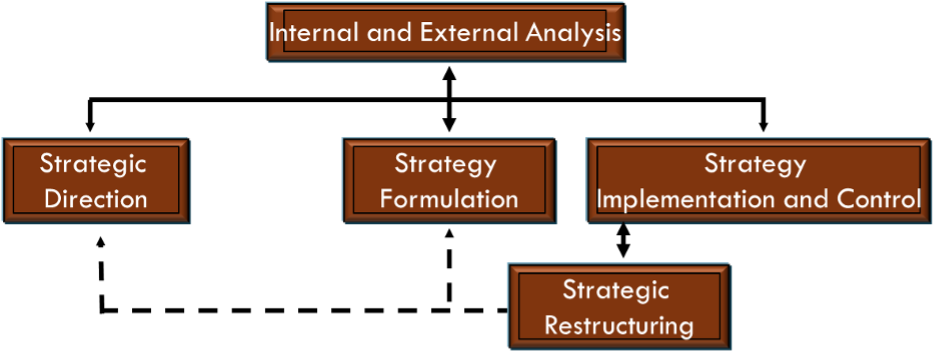
It is essential to establish direction for the practice by creating strategies intended to assist in achieving formulated goals, and then safely executing those strategies. Figure 1 presents a model useful for pre-planning a new or an expansion of an existing audiology practice. Originally presented by Harrison and St. John (2004), this model digests the pre-planning exercise by outlining operational and financial aspects of the proposed practice.
Internal and External Analysis
Pre-planning starts with an assessment of internal resources like staff, policies, equipment, location, space, and capital. Evaluating these controllable factors helps create a realistic plan for the formal business proposal. External factors, such as the economy, competition, suppliers, referral sources, and insurance companies, must also be analyzed, even though these are outside the practitioner’s control. Developing strong strategies to address these challenges is crucial for business success.
Strategic Direction
Part of pre-planning is determining the direction of the practice by asking, “What type of audiology practice do I want?” Consider whether to specialize in general audiology, hearing devices, pediatric or adult care, and which services to offer, such as balance assessment, ABR, device follow-up, or operative monitoring. The aim is to fill gaps or enhance current offerings in the market. When evaluating the target market based on cultural, ethnic, demographic, economic, technological, and legal factors, as well as competitors and referral sources, Drucker refers to this process as “looking out the window” (Cohen, 2010).
Strategic Formulation
Once the practice’s overall strategic direction is outlined, it is necessary to consider the methods for interfacing with the market, known as strategic formulation. Pre-planning decisions at this point include whether to incorporate marketing techniques such as print media, television, radio, and digital media (social media, websites, etc.). Physician marketing should be considered a must to establish a firm referral base. To get the “word” out that there is a new practice in town offering something unique and different is imperative.
The prospective practitioner will also need to develop a pricing strategy that is appropriate yet aggressive for the local market to position the brand within the marketplace. Decisions pertaining to patient centrism, risk management, and ethics must also be part of the refinement. All these factors correspondingly apply to the expansion of a practice, where the emphasis would most likely be on offering new procedures, additional staff, extended clinic hours, renovated office space, and/or additional clinic locations.
Strategic Implementation Control and Restructuring
Strategy implementation requires a final review of all necessary elements to bring the practice to market, including personnel, services, equipment, space, and financing. While one strategy may seem best during pre-planning, others may emerge during implementation and after the formal business plan is started, as market dynamics and practice trends evolve, requiring a revaluation of the strategy and a restructuring of the practice.
Conclusion
At this early stage of considering an audiology business, it is just a discussion of the concept, the market, and how the entrepreneur will go about turning their strategic vision into reality. Many business projects never get past this pre-planning stage. If the project progresses further, a formal business plan is essential to success. ……and that is for next time!
References
- Cohen, W. (2010). Drucker on Leadership. San Francisco, CA: Jossey-Bass.
- Harrison, J., & St. John, C. (2004). Foundations in Strategic Management 3rd Edition. Thompson-Southwestern.
- Traynor, R.M. (2026). Chapter 3 - Strategic Business Planning. In Strategic Practice Management, 4th Edition, (Traynor, R.M. & Taylor, B., Eds.) San Diego, CA: Plural Publishing.