
Audiology in the Classroom


Introducing Canadian Educational Audiologists: A professional network and learning community
For long term readers of Canadian Audiologist, you may recall that the column “Audiology in the Classrooms was first published in 2018”. There were several goals for including this content as a regular feature in the journal. These included, first and most importantly, providing a platform to facilitate collaboration between clinics, schools, and families so that students receive the support they need as quickly and seamlessly as possible. We also hoped to provide information about current issues that arise for students with hearing loss at school and their teachers, and to discuss how educational audiologists support students in classrooms. The first article opened with this question “what do audiologists who have no sound booth, no audiometer, no earmold impression materials, no hearing aid programming software, and an office that essentially resides in the trunk of their cars, do all day?” Educational audiology is a very different job from clinical audiology, and our numbers are small.
In most cases, it is a sole practice situation, without the benefits of a colleague in the next room. In fact, there is no “next room” at all; you are on the road most days, driving to schools. The questions that arise in educational audiology are sometimes technical (how do you verify a particular transmitter/receiver combination?), sometimes not (how can we support students when they don’t want to wear their remote microphone systems?). Still, they are always unique to this job. We can feel isolated and unsupported in our jobs, simply because we might be the only one on a school board. Recognizing this, in June 2019, Alberta educational audiologist Krista Yuskow started compiling a list of Canadian school-based audiologists for whom she had contact information, as a first step toward building a professional network. The initial list included 8 educational audiologists, with only 3 provinces represented – theydidn’t even know each other.
Krista and Pam Millett talked informally about ideas to provide collaboration opportunities for audiologists working in schools across Canada (working groups to address specific professional questions? Perhaps at a conference?). Then the pandemic hit and everything changed. COVID changed many things for all of us, but one of the positive outcomes for educational audiologists scrambling to figure out how to provide services in this new context was the creation of professional learning communities. For example, Ontario educational audiologists began meeting virtually monthly in the fall of 2020. Even after the pandemic subsided, these virtual cohorts continue to meet regularly to share updates, brainstorm solutions to troubleshooting questions, and share resources and success stories.
In the fall of 2023, Krista presented on Educational Audiology in Canada to Speech-Language Audiology Canada (SAC). She shared how drastically educational audiology services differ between provinces and even within school districts in the same city! Her list grew and began to show trends, for example, districts or even entire provinces where there wasn’t an educational audiologist or teacher of the deaf (such as Nunavut). Pam presented at the SAC conference in 2024, sharing educational challenges and outcomes for today’s deaf and hard-of-hearing students, and heard similar comments and frustrations from that audience.
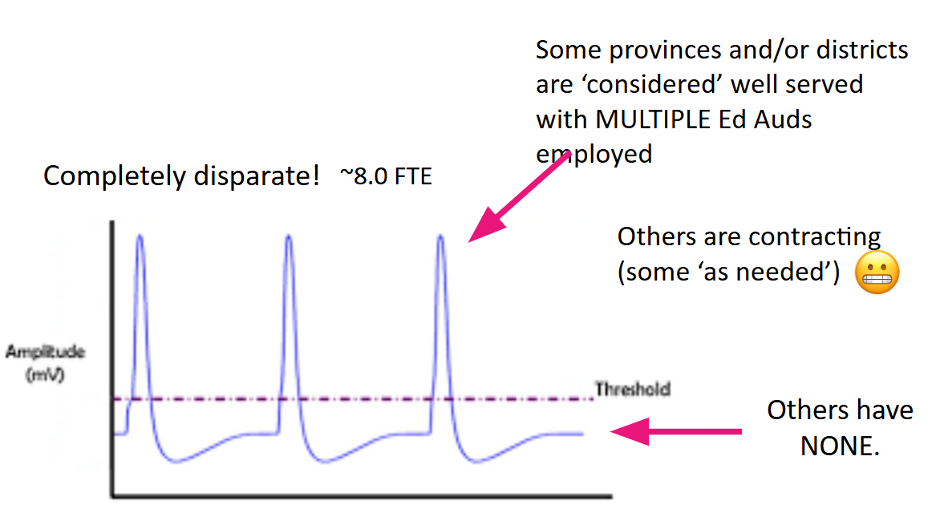
Looking at the data at that time (and the situation remains unchanged in 2026), it is clear that service provision is completely disparate across and within provinces. A very, very few jurisdictions have multiple educational audiologists employed in a single school district. More commonly, there is one educational audiologist in a school district, contracted as an outside consultant for perhaps a day a month or a day a week. In terms of full-time employment, one day a month works out to .05 of a full-time job. If you know that a particular school district “has” an educational audiologist, it is important to clarify what that means in terms of level of service being provided. For example, by 2023-2024, Krista’s list included 50 educational audiologists across Canada (with some pediatric audiologists, teachers of the deaf and educational audiology assistants participating in the group). It is important to realize that 50 audiologists do not equate to 50 full time positions.
In 2023 and 2024, Krista served first as President and then Past-President of the Educational Audiology Association (EAA). She found herself reflecting on the incredible humans she had met and the impactful work the EAA board of directors had accomplished, and was deeply inspired by the connections made and the advocacy work done. She also reflected on the need for resources that truly served the Canadian context. While the EAA provides tremendous value, the heavy reliance on US legislation (such as IDEA and 504 plans) means that Canadian professionals often have to adapt or discard resources that do not align with our provincial frameworks. The differences between the roles, responsibilities, and scopes of practice for American and Canadian audiologists are significant. In fact, through our national initiative, it has become clear that these vary from province to province as well.
Recognizing that Canadian educational audiologists needed a community and advocacy support tailored to their own reality on a national level, Krista turned a simple email list into a virtual educational audiology network.
By 2026, that “list” has now evolved into a formal organization, Canadian Educational Audiologists. We have moved beyond simple connection to active advocacy. Our goal is to champion the vital role of educational audiology across Canada by:
- Fostering collaboration among professionals, both in the field of audiology between clinical and educational audiologists) and interdisciplinary collaboration with speech-language pathologists and organizations for educators.
- Developing and sharing Canadian-specific resources for supporting students with auditory disorders in the classroom
- Increasing national awareness among educators, school staff, families, administrators, and provincial governments.
Ultimately, educational audiologists exist to ensure optimal listening and learning outcomes for all students who are deaf or hard of hearing. We are currently working with existing organizations to elevate Canada’s presence in the field of educational audiology and hope to make a difference in support services for students, families and teachers. If you have questions about Canadian Educational Audiologists, are an educational audiologist not on our list, or are interested in educational audiology, please reach out to Krista at krista.yuskow@epsb.ca for more informatio