
Optimizing Cochlear Implant Care: Current Advances and Future Directions
Understanding speech perception and speech production in cochlear implant users


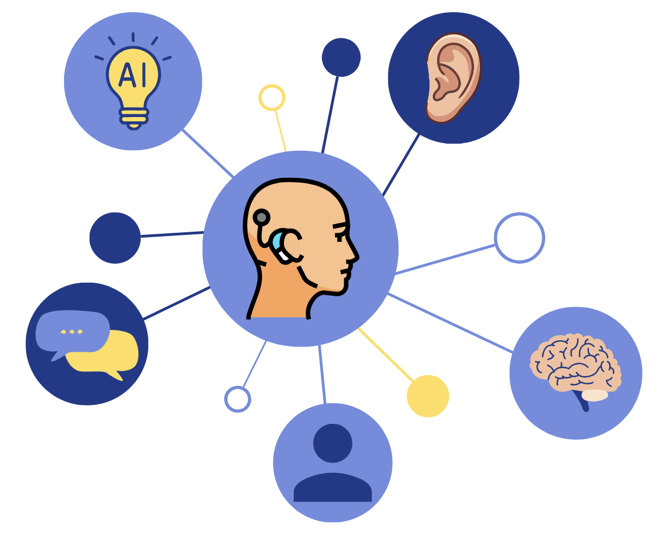
Cochlear implants (CIs) provide access to auditory information for individuals with significant hearing loss who do not benefit from conventional hearing aids. Although substantial hearing benefit is associated with CI use, speech perception and speech production outcomes remain variable across CI users. One key component of my research program is to better understand speech perception and its relationship to speech production.
My work on speech perception in CI users combines behavioral assessments with objective neurophysiological measures [1-3]. In adult CI users, I have shown that electrophysiological indices of speech discrimination, such as mismatch negativity (MMN) and P300, are closely associated with speech recognition performance. Importantly, CI users with good perceptual outcomes exhibit neural responses comparable to those of normal-hearing listeners, whereas poorer performers show altered cortical responses. These findings highlight the potential of electrophysiological measures as complementary tools to traditional clinical assessments, particularly for populations that are difficult to evaluate behaviorally.
Building on these findings, my research has also examined the relationship between speech perception and speech production. Across both pediatric and adult populations, we demonstrated that perceptual limitations are reflected in speech output, influencing the precision and stability of phonetic contrasts. Using acoustic, perceptual, and articulatory approaches—including ultrasound imaging of tongue movements—our research shows that, in children and adults with cochlear implants, reduced perceptual acuity is associated with smaller acoustic contrasts and greater variability in speech production [4, 5]. Although some CI users may achieve intelligibility levels comparable to their normal-hearing peers, particularly when implantation occurs early, variability remains substantial. In some cases, speech may appear relatively accurate based on perceptual judgment alone; however, detailed acoustic analyses reveal subtle differences that likely contribute to variability in intelligibility. Taken together, this body of work provides a comprehensive framework linking auditory perception, neural processing, and speech production in cochlear implant users, and establishes a foundation for extending outcome measures beyond laboratory tasks toward more functional and clinically relevant domains.
Enhancing Cochlear Implant Outcomes Through AI-Based Rehabilitation, Objective Programming, and Improved Access to Care
Rehabilitation tools
Our research team has been developing tools for the automated analysis of speech during reading, spontaneous speech production, and language tasks. The objective of PhonIA (https://phonia.io) is to provide automated, secure, and efficient tools to support healthcare, education, and rehabilitation professionals through advanced speech analysis [6, 7]. Preliminary validation studies have shown good agreement with clinician-based measures [6].
In both clinical and research settings, PhonIA facilitates standardized data collection and automates complex analyses. Beyond screening for learning and reading disorders, this technology is a valuable tool for longitudinal monitoring in rehabilitation, particularly for children with language and learning difficulties and for individuals with cochlear implants. The integration of automated performance metrics enables objective measurement of speech production, supports the documentation of progress over time, and provides quantifiable outcomes, including in telerehabilitation contexts. For clinicians working with cochlear implant users, PhonIA will generate an automated intelligibility score based on vowel and consonant production, providing an objective, clinically meaningful measure to support assessment and guide intervention. These advances highlight the potential of AI-driven tools such as PhonIA to support more objective, efficient, and accessible rehabilitation practices in clinical settings.
Objective programming
Our team is currently conducting several studies examining the impact of objective measures in cochlear implant (CI) programming. An alternative approach to setting stimulation levels relies on objective measures rather than solely on behavioral responses. In particular, we are investigating the use of electrically evoked stapedial reflex thresholds (eSRTs) to establish map profiles and evaluate their impact on speech intelligibility and sound quality following programming.
In parallel, we are also exploring the role of anatomy-based fitting strategies in optimizing CI performance. These approaches aim to better tailor stimulation parameters to individual cochlear anatomy, potentially improving auditory outcomes. Together, these strategies may improve both efficiency and consistency in CI programming across clinical settings, while supporting more precise and individualized care. They may be particularly valuable in patients who are difficult to assess using conventional behavioral methods.
Improved access to care
In a recent study [8], we retrospectively evaluated the impact of early cochlear implant (CI) activation (the day after the surgery compared to 4 weeks post-surgery before) in a cohort of 1,000 patients. The results demonstrate that early activation is safe, with no increase in postoperative medical complications compared to the conventional approach. Audiological outcomes were comparable between groups; however, patients in the early activation group reached auditory performance more rapidly.Importantly, early activation was also associated with a substantial reduction in the number of programming visits, thereby improving clinical efficiency and reducing the burden on patients, clinicians, and the healthcare system. Together, these findings support early activation as a promising approach to optimize resource utilization while maintaining high standards of safety and audiological performance. These results suggest that early activation may signal a shift toward more efficient, patient-centered CI care.
Remote rehabilitation
Building on advances in telehealth, our team is currently working on a study to evaluate the integration of remote sessions into cochlear implant (CI) rehabilitation. This project aims to assess not only the impact of hybrid (in-person and remote) rehabilitation on audiological outcomes, but also its feasibility and acceptability among both patients and clinicians, to better inform the integration of these practices into routine clinical care.By incorporating remote sessions into standard rehabilitation protocols, this approach seeks to increase flexibility, reduce travel burden, and improve access to specialized services, particularly for patients living in remote or underserved areas. This work may help define evidence-based guidelines for integrating remote care into CI rehabilitation pathways.
Ongoing studies
In addition to these projects, our team is conducting studies to better understand the development of social and cognitive skills in children with cochlear implants (CI). These studies seek to explore how auditory deprivation and restoration interacts with broader developmental domains, including communication, social functioning, and cognition.
Future research directions: Optimizing cochlear implant care — Five priorities for the next five years
- Develop validated tools with AI automated speech analysis (PhonIA)
Our team aims to further develop and validate automated tools for acoustic speech analysis. These tools will support both research and clinical practice by simplifying data collection, improving efficiency, and providing objective speech intelligibility measures for CI users. - Co-develop innovative rehabilitation models to improve access to care
While intensive post-implant rehabilitation improves outcomes, it places a significant burden on patients and their caregivers. In the coming years, our team aims to co-develop hybrid rehabilitation models in collaboration with CI users, caregivers, and clinicians. These models will integrate telerehabilitation approaches while ensuring that patients achieve optimal outcomes. In parallel, we will explore the integration of complementary rehabilitation strategies, such as music-based training, to support auditory processing and enhance engagement during rehabilitation. - Optimize cochlear implant programming through objective and individualized approaches
Our research aims to develop objective programming strategies to support more precise and individualized cochlear implant fitting. Approaches such as electrically evoked stapedial reflex thresholds (eSRTs) and anatomy-based fitting may improve the accuracy, efficiency, and consistency of programming, particularly in patients who are difficult to assess. - Develop ecologically valid assessment environments
There is a need to better capture real-world listening performance in CI users. Our team aims to develop more realistic auditory testing environments that reflect everyday listening conditions, allowing for a more accurate evaluation of functional hearing abilities. - Better understand social and cognitive development in children with hearing loss
My team will continue to investigate the development of social and cognitive skills in children with hearing impairment. A better understanding of these domains will help identify targeted interventions to support communication, social integration, and overall development.
Taken together, this body of work highlights the need to move beyond traditional approaches to cochlear implant (CI) care and toward more integrated, data-driven, and patient-centered models. By combining advances in auditory neuroscience, objective programming strategies, and innovative rehabilitation tools, including AI-driven approaches, it becomes possible to better understand and support the wide variability observed in CI outcomes.
Importantly, optimizing CI care is not only about improving auditory performance but also about enhancing accessibility, efficiency, and equity within healthcare systems. Approaches such as early activation, objective programming, and hybrid rehabilitation models offer promising avenues to reduce barriers to care while maintaining high clinical standards.
Looking ahead, integrating automated outcome measures, ecologically valid assessments, and remote care solutions has the potential to transform clinical practice and improve long-term outcomes for CI users. These innovations will also support clinicians in making more informed decisions and tailoring interventions to individual patient needs.
Ultimately, advancing cochlear implant care will require a shift toward more personalized and interdisciplinary approaches. By bridging research, clinical practice, and technological innovation, the next generation of CI services can better meet the complex needs of patients across the lifespan.
References
- Turgeon, C., Lazzouni, L., Lepore, F., & Ellemberg, D. (2014). An objective auditory measure to assess speech recognition in adult cochlear implant users. Clinical Neurophysiology, 125(4), 827-835. doi: 10.1016/j.clinph.2013.09.035. Epub 2013 Oct 24. PMID: 24209981.
- Turgeon, C., Champoux, F., Lepore, F., & Ellemberg, D. (2015). Deficits in auditory frequency discrimination and speech recognition in cochlear implant users. Cochlear implants international, 16(2), 88-94. doi: 10.1179/1754762814Y.0000000091.
- Turgeon, C., Hadid, V., Trudeau-Fisette, P., Knoth, I., Lepore, F., Lippé, S., & Ménard, L. (2025). Impact of visual and auditory deprivation on speech perception: an EEG study. Cerebral Cortex, 35(4), bhaf086.doi: 10.1093/cercor/bhaf086.
- Turgeon, C., Trudeau-Fisette, P., Fitzpatrick, E., & Ménard, L. (2017). Vowel intelligibility in children with cochlear implants: An acoustic and articulatory study. International Journal of Pediatric Otorhinolaryngology, 101, 87-96.doi: 10.1016/j.ijporl.2017.07.022.
- Turgeon, C., Trudeau-Fisette, P., Lepore, F., Lippé, S., & Ménard, L. (2020). Impact of visual and auditory deprivation on speech perception and production in adults. Clinical linguistics & phonetics, 34(12), 1061-1087. doi: 10.1080/02699206.2020.1719207.
- Rezgui J, Jobin F, Kechout Y, Turgeon C, Khomh F. (2024) Towards a Reliable French Speech Recognition Tool for an Automated Diagnosis of Learning Disabilities. SmartNets. doi: 10.1109/SmartNets61466.2024.10577676.
- Rezgui J, Jobin F, Rossier-Bisaillon A, Ross-Lévesque E, Ménard L, Chapdelain C, Khomh F, Martel-Sauvageau V, Turgeon C. (Soumis, 2026). Phonia Corpus: a Phonetically Transcribed French Speech Dataset Validated by Experts and Gold Units. Interspeech.
- Beaulieu O, LabadiN, HallakG, TrudelM, PhilipponD, CôtéM, Bussières R, Bergeron F & Turgeon C. (Submitted, Otology & Neurotology). Early Activation in Pediatric and Adult Cochlear Implant Users: Insights from 983 cases in Quebec.