
Exploring the Role of Music, Touch, and Emerging Technologies in Hearing Health


Research at the Multisensory and Auditory Perception Laboratory (MAPLab)

While hearing devices significantly improve audibility, they do not fully address challenges such as speech understanding in noisy environments1 or music perception.2-6 These unmet needs reflect a combination of technological limitations, peripheral alterations, and changes in central auditory processing linked to auditory deprivation.7-8 At the MAPLab, we aim to develop innovative rehabilitation strategies to mitigate the effects of hearing loss on the brain’s ability to process complex sounds and to study emerging technologies that could answer the needs of hard-of-hearing individuals.
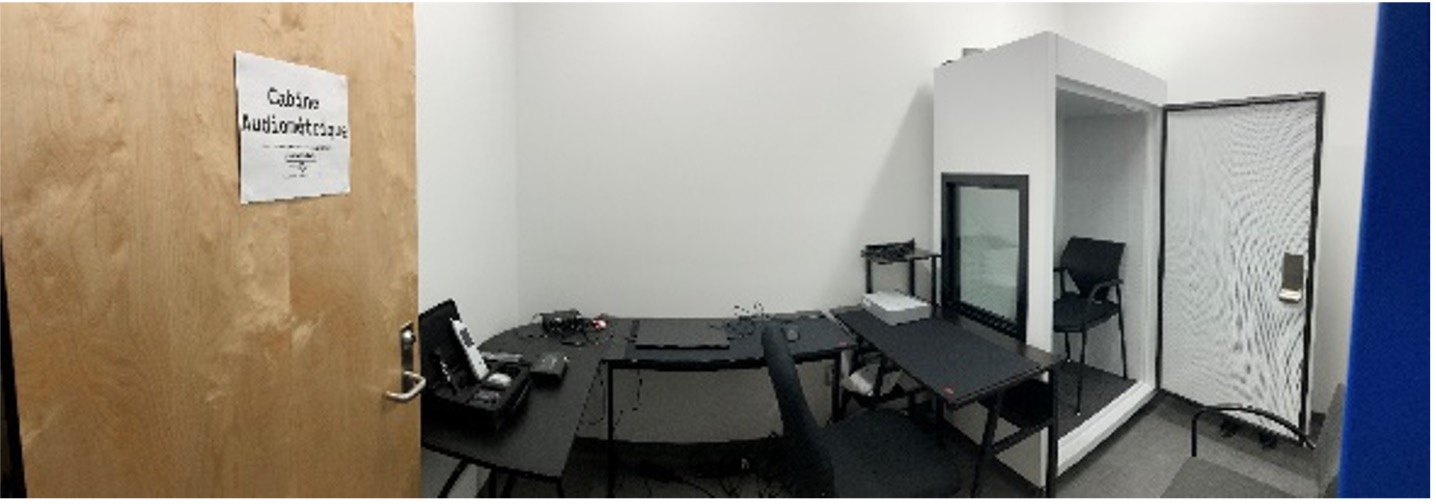
Toward integrating music into hearing rehabilitation: from exploration to validation
Music is a powerful tool for training the senses. Playing a musical instrument engages multiple sensory systems simultaneously: vision (score reading), touch (feeling the instrument’s vibrations), movement (producing musical notes), and, of course, hearing. This rich multisensory experience makes music a unique model for studying brain plasticity across the lifespan. Some of our research projects examine how extensive musical training shapes sensory processing related to hearing, vestibular function, and touch. These studies show that musicians exhibit enhanced performance in specific sensory abilities and improved integration across sensory modalities repeatedly engaged during instrumental practice.9-13
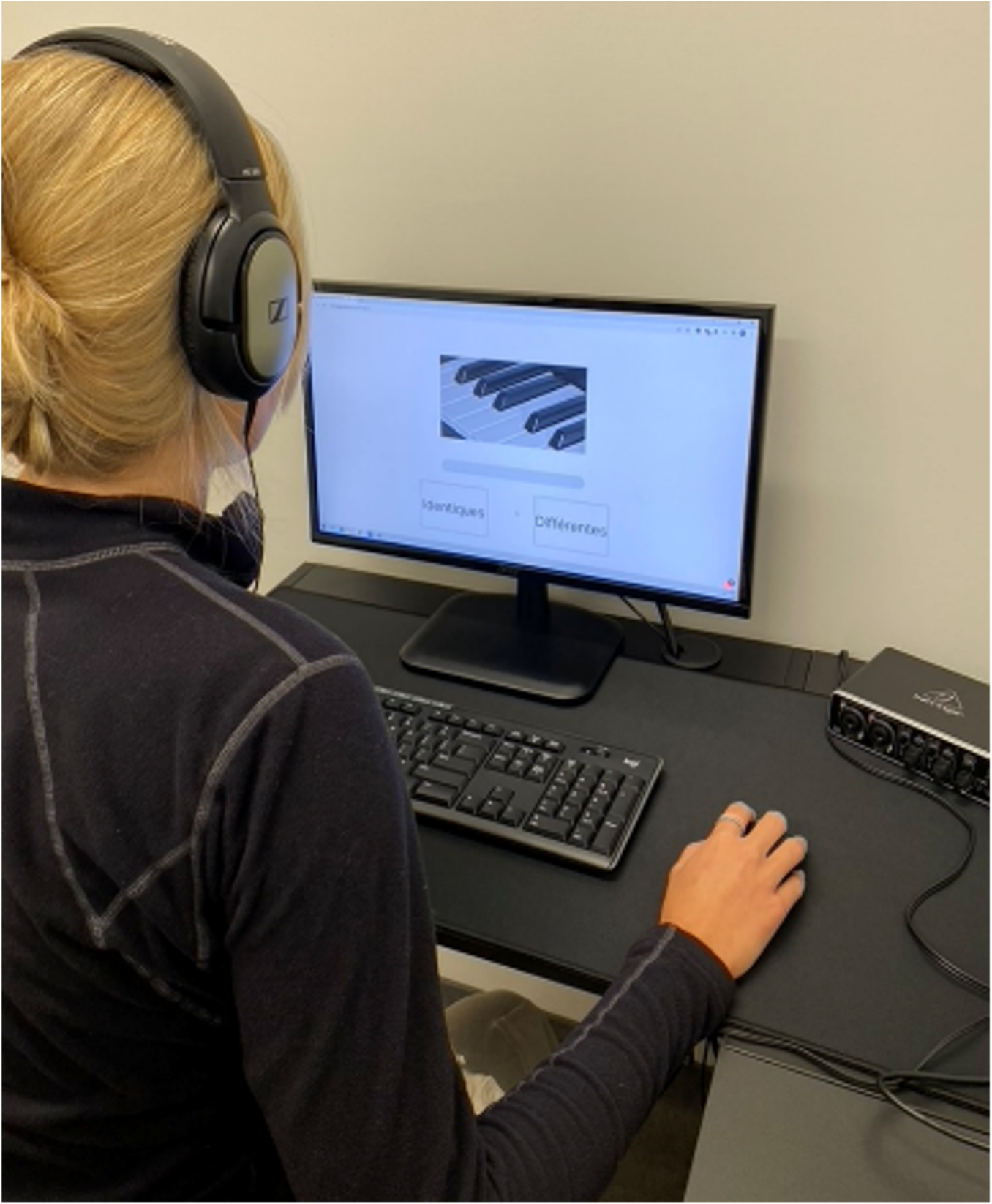
Previous research has shown that musical training can help preserve certain auditory abilities with age, particularly in professional musicians.14-16 However, it has remained unclear whether these benefits extend beyond professionals and how musical experience, aging, and hearing loss together influence music perception in older adults. In our recent study,17 we examined 77 adults aged 60 to 90 with varying levels of musical expertise and hearing thresholds ranging from normal hearing to clinically significant hearing loss. Participants completed tasks assessing their ability to discriminate rhythm, melodies, and different musical instruments. An important and concerning finding emerged early in the study: although many participants believed they had no hearing difficulties, nearly three‑quarters were found to have an objective hearing loss in at least one ear based on audiometric testing. Despite this, only about one-third reported wearing hearing aids daily. This underscores how easily hearing loss can go unnoticed and emphasizes the importance of promoting early hearing assessment. Moreover, our results showed that individuals with musical experience consistently performed better across all music perception tasks, independent of age and hearing loss severity. Greater musical experience was associated with higher accuracy in music perception tasks.
In contrast, hearing loss was associated with poorer performance in participants with no musical background. Together, these findings indicate that musical experience is associated with preserved music perception in older adults, even in the presence of age‑related hearing loss. This supports the potential role of musical training as a complementary approach in auditory rehabilitation and healthy auditory aging18. Preliminary results from an ongoing longitudinal research project suggest that this may be the case, although final conclusions will be drawn once the study is completed.
Vibrotactile gloves for supporting auditory processing
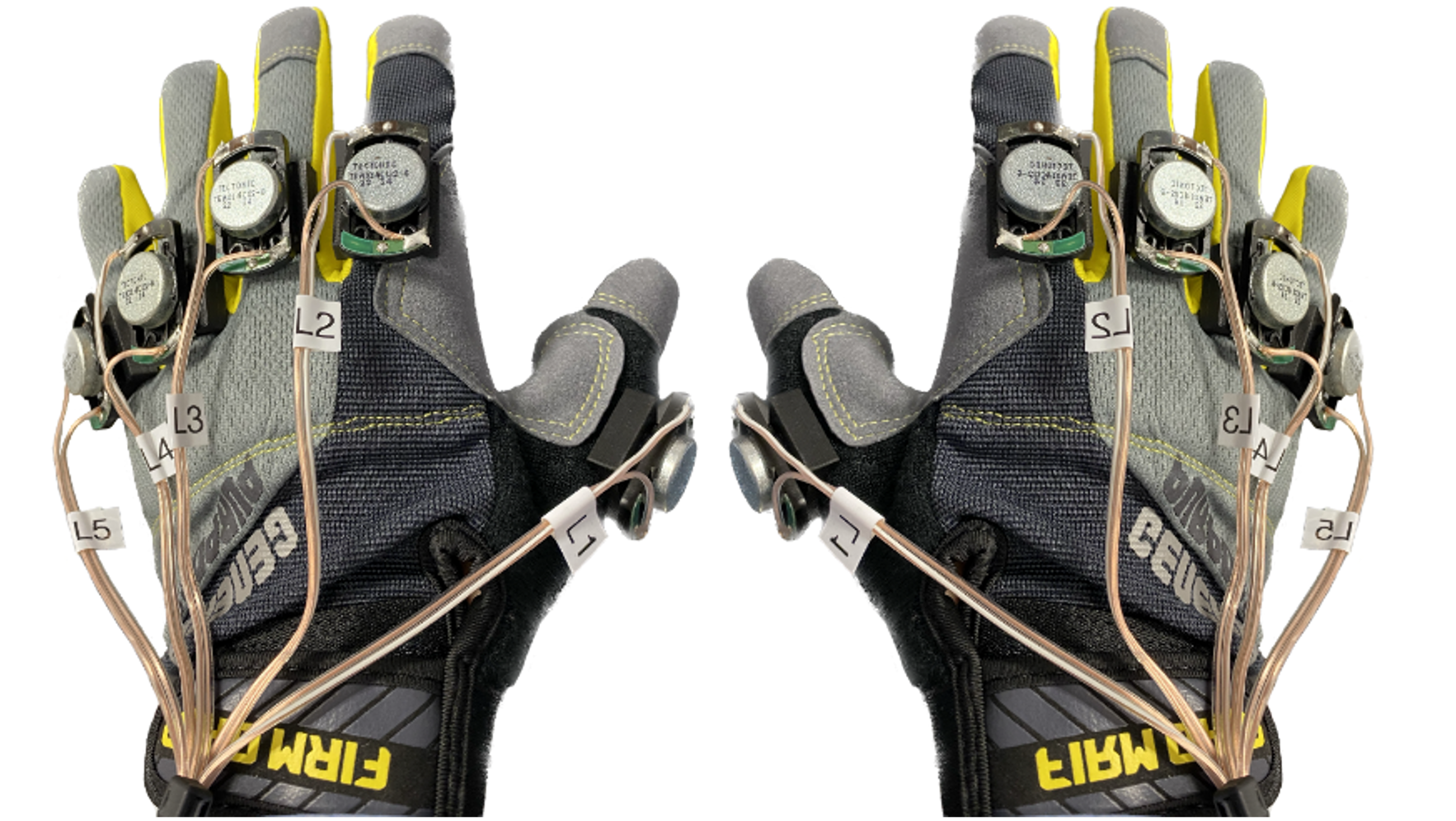
Have you ever placed your hands on a loudspeaker? You can feel some acoustic features: rhythm, frequency, and even emotional content. So why not rely on another sense, such as touch, to help compensate for hearing difficulties? We therefore equipped a glove equipped with electrodynamic actuators (sorts of loudspeakers without a real membrane). The resulting vibrotactile glove enabled us to further study this open question: to what extent can acoustic information be perceived through vibration. Such vibrotactile concept is already familiar within the Deaf community, where loudspeakers are sometimes placed on the floor at high volume so music can be experienced through vibrations felt throughout the body. Despite this, very few technologies currently leverage tactile cues to enhance auditory perception. Our early studies.10-11,19 with vibrotactile glove prototypes explored how individuals with different auditory and musical backgrounds perceive music through touch. These studies showed that musicians are particularly good at discriminating vibrotactile frequencies and identifying complex emotions conveyed by music through vibrations alone.10-11 Deaf individuals also perceived frequency information through vibrotactile stimulation and showed greater accuracy in identifying simple musical emotions, such as happiness.19 Building on these initial findings, a second-generation prototype was developed in collaboration with Professor Jérémie Voix from École de technologie supérieure20. This glove was designed to better transmit complex signals, such as speech and music, allowing us to investigate vibrotactile detection thresholds20, as well as the perception of timbre21 and timing information22. Key findings from our recent work21 showed that humans can reliably perceive both spectral and temporal acoustic changes through vibrotactile (VT) input. In addition, combined audio-tactile stimulation improved discrimination of temporal features, with attack time (time to reach peak amplitude after onset, a key cue to distinguish different sound sources, e.g. instruments or voices) being the most salient. In parallel, we also developed and validated an MRI‑compatible vibrotactile glove23, where the strong magnetic fields typically prohibit the use of conventional actuators. This new technology opens the door to advanced behavioral, cognitive, and neuroimaging studies of how the brain processes and integrates tactile sound information. We are now currently working on a more portable version of the prototype, designed to capture real‑world acoustic environments in real time for everyday use. The development of vibrotactile technologies is currently limited by gaps in our understanding of how tactile inputs can support auditory perception and how efficiently the brain integrates tactile and auditory information. Addressing these knowledge gaps is therefore essential. Our ongoing research focuses on vibrotactile perception to design tools that meet the needs of individuals with hearing loss while also providing immersive sensory experiences accessible to a broader population. Beyond rehabilitation, these technologies may also benefit musicians by supporting better synchronization and coordination when performing in noisy or acoustically challenging environments.
Emergence of new technologies in the field of hearing health
To support the translation of emerging sensory technologies into real-world applications, we developed an interdisciplinary framework to uncover their potential, facilitate discussion of challenges, and promote better design practices 24. By classifying technologies along shared continua, this framework enables comparisons across fields and provides concrete guidance for moving technologies, such as vibrotactile gloves, from the laboratory to everyday use. At the same time, artificial intelligence (AI) is becoming increasingly present in hearing healthcare, from diagnostic tools to signal processing in hearing aids. While this shift opens exciting possibilities, it also raises important questions. Patients and their relatives are often exposed to large amounts of online information of varying quality, and professionals may feel uncertain about how to use or explain AI-based tools in clinical practice. To better understand these challenges, we are working on several research projects examining how AI is discussed, perceived, and adopted in the hearing health field. In one recent project,25 we analyzed Reddit discussions to explore how patients, their relatives, and professionals discuss AI in hearing aids. Our findings suggest that social media platforms have strong potential as channels for patient information, but that current content on AI and hearing aids remains limited and sometimes incomplete. Educating patients about how to assess the quality of online information therefore represents a key challenge, especially given that healthcare professionals are not present in all online communities. Another project26 used a survey to examine hearing health professionals’ perceptions of AI integration and identify their training needs. Among professionals, those who already use AI‑based tools in their practice tend to have more positive attitudes toward AI and greater confidence in their ability to use these technologies effectively. Across the field, there is broad agreement on the need to develop dedicated training programs to support the responsible and effective integration of AI into hearing healthcare.
In conclusion, audiology is a rapidly evolving field, shaped by continuous technological innovation. Keeping pace with these advances is essential to deliver optimal care and improve patient outcomes. MAPLab aims to bridge the gap between fundamental research and clinical practice by advancing knowledge of auditory and multisensory perception, developing practical tools, and supporting clinicians in integrating new technologies. Although this is the beginning of a long journey, our goal is clear: to create tangible benefits for hearing health professionals and for people with hearing loss, in Canada and beyond.
References
- Bennett, R. J., Laplante-Lévesque, A., Meyer, C. J., & Eikelboom, R. H. (2018). Exploring hearing aid problems: Perspectives of hearing aid owners and clinicians. Ear and hearing, 39(1), 172-187. https://doi.org/10.1097/aud.0000000000000477
- McCormack, A., & Fortnum, H. (2013). Why do people fitted with hearing aids not wear them?. International journal of audiology, 52(5), 360-368. https://doi.org/10.3109/14992027.2013.769066
- Chasin, M., & Russo, F. A. (2004). Hearing aids and music. Trends in Amplification, 8(2), 35-47. https://doi.org/10.1177/108471380400800202
- Looi, V., Rutledge, K., & Prvan, T. (2019). Music appreciation of adult hearing aid users and the impact of different levels of hearing loss. Ear and hearing, 40(3), 529-544. https://doi.org/10.1097/aud.0000000000000632
- Greasley, A., Crook, H., & Fulford, R. (2020). Music listening and hearing aids: perspectives from audiologists and their patients. International Journal of Audiology, 59(9), 694-706. https://doi.org/10.1080/14992027.2020.1762126
- Chern, A., Denham, M. W., Leiderman, A. S., Sharma, R. K., Su, I. W., Ucci, A. J., ... & Lalwani, A. K. (2022). Hearing aids enhance music enjoyment in individuals with hearing loss. Otology & Neurotology, 43(8), 874-881. https://doi.org/10.1097/mao.0000000000003595
- Lesica, N. A. (2018). Why do hearing aids fail to restore normal auditory perception?. Trends in neurosciences, 41(4), 174-185. https://doi.org/10.1016/j.tins.2018.01.008
- Limb, C. J., & Roy, A. T. (2014). Technological, biological, and acoustical constraints to music perception in cochlear implant users. Hearing research, 308, 13-26. https://doi.org/10.1016/j.heares.2013.04.009
- Landry, S. P., Sharp, A., Pagé, S., & Champoux, F. (2017). Temporal and spectral audiotactile interactions in musicians. Experimental brain research, 235(2), 525-532.
- Sharp, A., Houde, M. S., Maheu, M., Ibrahim, I., & Champoux, F. (2019). Improved tactile frequency discrimination in musicians. Experimental brain research, 237(6), 1575-1580.
- Sharp, A., Houde, M. S., Bacon, B. A., & Champoux, F. (2019). Musicians show better auditory and tactile identification of emotions in music. Frontiers in psychology, 10, 1976.
- Paromov, D., Augereau, T., Maheu, M., Bacon, B. A., Sharp, A., & Champoux, F. (2025). Musical training shapes spatial cognition. Cortex.
- Chauvette, L., Whittom, A., Fecteau, A., Larouche-Gagnon, G., & Sharp, A. (2025). Musicianship modulates octave illusion perception differently across stimulation frequencies. Psychological Research, 89(2), 78.
- Zendel, B. R., & Alain, C. (2012). Musicians experience less age-related decline in central auditory processing. Psychology and aging, 27(2), 410.
- Grassi, M., Meneghetti, C., Toffalini, E., & Borella, E. (2017). Auditory and cognitive performance in elderly musicians and nonmusicians. PloS one, 12(11), e0187881.
- Maillard, E., Joyal, M., Murray, M. M., & Tremblay, P. (2023). Are musical activities associated with enhanced speech perception in noise in adults? A systematic review and meta-analysis. Current Research in Neurobiology, 4, 100083.
- Whittom, A., Chauvette, L., Bégin, A., Blanchette, I., Tremblay, P., & Sharp, A. (2025). Music perception in older adults with hearing loss: protective effect of musical experience. Ear and hearing, 46(3), 707-718.
- Grenier, A. S., Lafontaine, L., & Sharp, A. (2021). Use of music therapy as an audiological rehabilitation tool in the elderly population: A mini-review. Frontiers in neuroscience, 15, 662087.
- Sharp, A., Bacon, B. A., & Champoux, F. (2020). Enhanced tactile identification of musical emotion in the deaf. Experimental brain research, 238(5), 1229-1236.
- Chauvette, L., Leprohon, É., Perron-Houle, L. P., Pintat, V., Delnavaz, A., Voix, J., & Sharp, A. (2024). Multichannel vibrotactile glove: validation of a new device designed to sense vibrations. IEEE Transactions on Haptics, 17(4), 913-923.
- Chauvette, L., Sophie Grenier, A., Albouy, P., Coffey, E., Zatorre, R., & Sharp, A. (2025). Auditory and vibrotactile interactions in perception of timbre acoustic features. Scientific reports, 15(1), 38055.
- Thibault, N., Sharp, A., Albouy, P., & Grondin, S. (2025). Perception of short, but not long, time intervals is modality specific: EEG evidence using vibrotactile stimuli. Cerebral Cortex, 35(3), bhaf051.
- Sharp, A., Leprohon, É., Voix, J., Delnavaz, A., & Pintat, V. (2024). Methods and systems for imparting tactile sensations having acoustic traits to tactile regions of a user’s hand or hands (WO Patent No. WO2024207114). WIPO. https://patentscope.wipo.int/search/en/WO2024207114
- Sharp, A. (2023). Understanding future human cybernetic integration: A framework to map enhancement technologies. Computers in Human Behavior: Artificial Humans, 1(2), 100029.
- Ferland, J., Guitton, M.J., et Sharp, A. (2025). The intelligent ear: AI and hearing aids information seeking and users’ discussion on social media. Patient Education and Counseling [Under Review].
- Ferland, J., Guitton, M. J., & Sharp, A. (2026). Hearing health professionals’ attitudes and perceived skills toward artificial intelligence. BMC Medical Education.