
From Knowledge to Action: Implementing a Group Intervention for First-Time Hearing Aid Users in Québec through a Clinical Research Partnership


Alexandra Tessier1,2, Élodie Latreille1,2, Mireille Tardif2,3, Caroline Lafontaine2,3, Mathieu Hotton4,5, Claire Croteau1,2, & Victoria Duda1,2
1École d’orthophonie et d’audiologie, Faculty of Medicine, Université de Montréal
2Centre for Interdisciplinary Research in Rehabilitation of Greater Montreal (CRIR)
3Centre de réadaptation en déficience physique Raymond-Dewar
4Département de réadaptation, Faculté de médecine, Université de Laval
5Centre for interdisciplinary research in rehabilitation and social integration (Cirris)
Context: Hearing Aid Use And The Québec Gap
Against a backdrop of limited healthcare capacity, growing service demands, and persistent workforce shortages in Québec, particularly since the COVID-19 pandemic, structured post-fitting support programs are crucial to help first-time hearing-aid users successfully adapt to amplification and navigate an otherwise fragmented continuum of care. Nearly 4 in 10 Canadian adults aged 20–79 experience hearing impairment (Statistics Canada, 2021). However, Quebecers who begin to suspect a decline in their hearing often embark on a complex and fragmented pathway toward better hearing health. Service delivery is divided between audiologists and hearing aid specialists, as well as between private and public sectors, resulting in multiple steps for users and complicating continuity of care and support. As a result, users must interact with different professionals for hearing assessment, device provision and fitting, and rehabilitation services. Audiological evaluations may take place in hospitals or private clinics, while hearing aids are dispensed solely by hearing aid specialists in private practice. Rehabilitation services, on the other hand, are optional and provided within the public system when needed. This fragmentation creates a gap in early rehabilitation and continuity of care delivered in Québec.
Ongoing support for first-time hearing aid users is essential to promote consistent device use. While hearing aids provide clear benefits such as improved communication, reduced effort, and better quality of life, their effectiveness depends on more than an appropriate fitting. Successful adaptation is shaped by the user, their family, and other social factors (Hickson et al., 2014) and despite clinical support, 14–30% of hearing aid owners do not use their devices (Dillon et al., 2020). This can often be due to attitudinal barriers, limited practical training, or insufficient support (Desjardins & Doherty, 2018; Handscomb et al., 2017). Audiologists therefore have a key role in promoting sustained hearing aid use.
To address the need for technical and psychosocial support related to hearing aid use, two audiologists (MT and CL) from the Raymond-Dewar Rehabilitation Center (CRDP) sought to develop an intervention to support first-time users. To support the development and evaluation of this intervention, the CRDP team partnered with Victoria Duda, professor and researcher at the Université de Montréal. She assembled a multidisciplinary research team comprising two audiologists (MT and CL), three academic researchers (MH, CC, VD), one clinical professor, and a research coordinator (AT). After funding was secured, the project was initiated. Collectively, the team brought together expertise in group interventions, program evaluation, adult education, clinical audiology, and experiential knowledge. This article describes and reflects on the steps this team took to develop and pilot a group intervention for first-time hearing aid users.
Developing The First-Time Hearing Aid User Program
The audiologists on the clinical team (MT, CL) identified group intervention as a promising solution based on the scientific literature. Group interventions have been shown to enhance device use, strategy adoption, and satisfaction, particularly when family and friends are included (Bennett et al., 2018), as social support strongly correlates with hearing aid use (Singh et al., 2015). The team aimed to develop an intervention inspired by existing programs, such as the Active Communication Education (ACE) program (Hickson & Worrall, 2003), which has demonstrated effectiveness in other countries.
To develop the group intervention, two audiologists (MT, CL) and a psychoeducator[1] worked closely with the project coordinator (AT) to prepare an intervention plan, which was subsequently reviewed by the research team. The plan was based on the current scientific literature on the rehabilitation process of hearing aid use, andragogy-based principles (Knowles et al., 2015), and the team’s clinical experience. The intervention plan, the visual support materials, and the final version of the intervention were reviewed and validated by the team of researchers. The program was thus co-constructed through an iterative process that integrated scientific evidence, clinical expertise, and team member feedback.
The clinical team named the intervention the First-Time Hearing Aid User Program[2] (FTP). A key feature of this intervention is its integration of technical training and psychosocial support within an interprofessional, group-based format. The main goal of the FTP was to support first-time hearing aid users in adapting to and using their hearing devices following their initial programming. It aimed to bring the individual wearing the hearing aid to 1) feel more confident in handling their devices for daily use, 2) feel capable of managing their hearing loss, and 3) be aware of the available resources to support issues related to their hearing. In addition, after the FTP, it was expected that the participants’ partners would be better equipped to support the management of their hearing impairment.
The group intervention consisted of two 1.5-hour sessions, one week apart, led by an audiologist and a psychoeducator. The intervention primarily involved presenting theoretical content on hearing aids, daily adaptation processes, and communication strategies. The workshops covered a range of topics, including information on the benefits and limitations of hearing aids, communication strategies to mitigate these limitations, and the various stages of the adaptation process for wearing hearing aids. Additionally, the workshops aimed to enhance self-efficacy in managing hearing aids by covering technical aspects, including device manipulation, cleaning, remote control use, and hearing aid programming. Particular focus was placed on problem-solving techniques and fostering a sense of confidence and autonomy through the use of their devices. Hands-on practice sessions provided participants with the opportunity to change batteries, replace wax guards, and manipulate volume control and hearing aid program buttons. Topics related to psychosocial counselling were also addressed, such as the impact of hearing loss on quality of life, issues around self-image, stigma, developing a new identity, and the various effects of hearing loss on family members.
Results Of Our Pilot Study On The First-Time Hearing Aid User Program
A key step in the implementation process was the evaluation of the intervention. This component was particularly important for assessing the intervention’s effects and determining whether long-term implementation of the service should be considered. The team conducted two pilot groups, each with 9 participants, divided into two cohorts.
To evaluate whether the intervention met its objectives, participants completed two questionnaires at three time points: before the intervention, immediately after, and at a 3-month follow-up. Results of this pilot study suggest positive trends: participants reported improved communication and emotional acceptance of hearing impairment, reflected in statistically significant increases in the French version of the Communication and Acceptance Scale scores (Öberg et al., 2021; Tessier et al., 2026) (Figure 1), alongside statistically significant gains in self-efficacy as measured by the French version of the Measure of Audiologic Rehabilitation Self-Efficacy for Hearing Aids (Vincent et al., 2017; West & Smith, 2007) (Figure 2). Feedback from participants was uniformly positive, indicating overall appreciation for this approach. Across all measures, the pilot demonstrated feasibility, acceptability, and promising preliminary effectiveness.
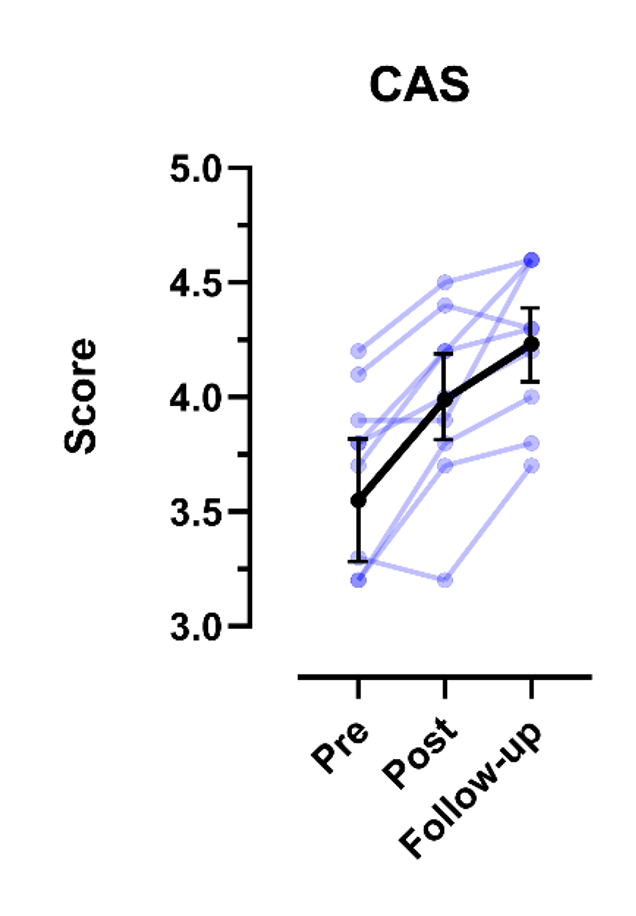
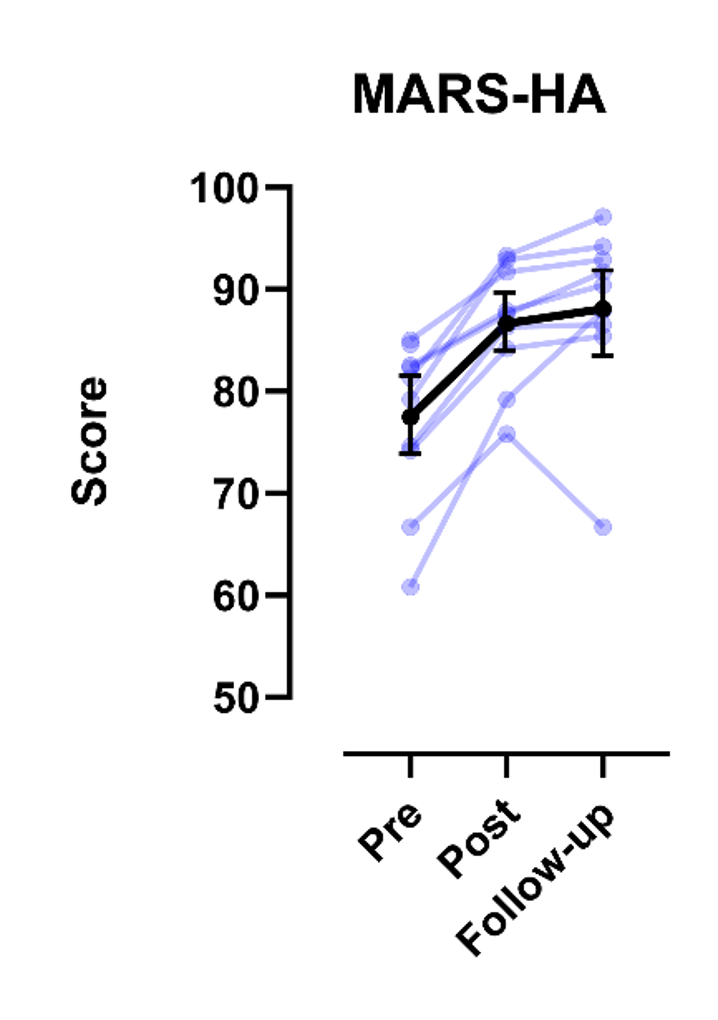
The sustained improvements observed here align with evidence from group-based programs such as the ACE and its adaptations (Hickson et al., 2007; Öberg, 2017; Öberg et al., 2014; Rivera et al., 2020), though the FTP intervention was much shorter (3 h vs. 10 h). This suggests that brief, targeted programs may be a cost-effective and scalable option for supporting communication and device use. Comparable initiatives such as Living Well with Hearing Loss (Marrone & Harris, 2012), Oyendo Bien (Coco et al., 2019), and Self-Efficacy Training in Group (Roberts & Delich, 2020) similarly emphasize psychosocial support, but generally require a greater time commitment. The brevity of the FTP may therefore enhance clinical feasibility. The findings of our pilot study also contribute to the growing evidence for integrating psychosocial support into audiological rehabilitation. Given the promising results of the pilot project, the CRDP decided to include the FTP among its offered services.
Reflective Analysis: What Helped And What Hindered
The Knowledge-to-Action (KTA) framework (Graham et al., 2006) provides a useful lens for reflecting on the strengths and challenges encountered throughout this project, as it conceptualizes the knowledge creation and knowledge-to-action processes. While not explicitly used to guide the intervention development, the KTA cycle allows for a retrospective analysis of what facilitated and hindered implementation of the FTP.
A key strength of this project lies in its partnership-based approach. The close collaboration between clinicians and researchers enabled a true co-construction of the intervention, integrating scientific evidence, clinical expertise, and contextual knowledge. This alignment across expertise contributed to the development of an intervention that was both evidence-informed and highly feasible within the clinical setting.
However, our experience also highlights the importance of systematically assessing barriers earlier in the implementation process. In the KTA cycle, identifying and addressing barriers is a key step before implementation, yet this phase was not formally conducted in our project. As a result, several challenges emerged during the pilot phase. The most significant barrier was recruitment. First-time hearing aid users (0–6 months post-fitting) are not typically followed within the public system in Québec, as care is divided between audiologists and hearing aid specialists. This structural separation limited direct access to the target population and required extensive outreach efforts to private clinics. Despite these efforts, recruitment remained limited, with only 10 participants enrolled, including 1 who withdrew from the study before the second session. Additional barriers included logistical challenges related to participant mobility. Seasonal conditions, particularly during late fall and winter, made travel difficult for older adults, contributing to reduced or discontinued participation between sessions. Furthermore, although communication partners were invited, their participation remained low (3 significant others in total, including one with hearing loss) despite strong evidence supporting their role in successful hearing aid adaptation. This raises important questions about how best to engage family members or friends, including whether more direct outreach from clinicians may be needed to convince them of the importance of their role in facilitating hearing aid use, adopting communication strategies, and thus supporting overall communication quality.
Overall, this reflective analysis suggests that earlier application of the KTA cycle, particularly in assessing barriers and planning implementation strategies, could have strengthened the intervention’s reach and sustainability. Nevertheless, the project demonstrates the value of collaborative, evidence-informed approaches. It highlights the potential of the KTA cycle as a practical tool for clinicians, researchers, and managers seeking to implement evidence-based services.
Take-Away for Clinicians
The findings of this preliminary study have potential implications in clinical practice. They suggest that first-time hearing aid users appreciated their participation in a group intervention and reported that it helped them address factors that hinder long-term device usage. Such an approach could reduce the number of individuals requiring follow-up audiology services due to hearing aid abandonment or adaptation challenges. Therefore, integrating this program into services for new hearing-aid users may be beneficial. We recommend that this program be provided closely following the initial hearing aid fitting to ensure that adaptation to the devices is set with realistic expectations. The interdisciplinary nature of the group is, in our view, a key strength of the program, as it addresses both the technical and psychosocial factors that impede hearing aid use.
It could also be valuable to consider offering this program virtually, enabling access for individuals in remote areas and overcoming participation exclusion due to time and weather. Recent research has demonstrated that online group interventions for hearing aid users can effectively reduce perceived difficulties and enhance the use of communication strategies (Malmberg et al., 2023). Moreover, delivering the interventions online could facilitate participation of older adults, who are often first-time users but may face challenges with travel due to mobility or other constraints (Dabelko-Schoeny et al., 2021). Although internet use remains lower among older adults than among younger populations (Cole et al., 2016), most older adults report using the internet (Anderson & Perrin, 2017). Moreover, digital technology use among this demographic increased during the COVID-19 pandemic (Sixsmith et al., 2022), suggesting that current internet usage is likely even higher. As such, hands-on training in the FTP could be delivered online, with participants invited to handle their hearing aids on screen while receiving remote guidance and feedback. Additionally, the online format could improve accessibility to communication by incorporating auto-generated subtitles during sessions.
Considerations For Policy Makers
The experience of implementing the FTP program highlights system-level challenges in the current service delivery pathway in Québec, particularly regarding access to early rehabilitation for individuals with hearing loss. Existing care trajectories often delay audiologist involvement, thereby limiting opportunities for early intervention and patient-centered support at a critical stage of adaptation. Findings from this pilot suggest that integrating audiologists earlier in the care continuum can enhance not only functional outcomes, but also patients’ reported communication strategies, understanding, and acceptance of deafness. From a policy perspective, these results underscore the need to revisit current referral pathways to facilitate more timely access to audiological rehabilitation services. In addition, increased funding for early-stage rehabilitation could support broader implementation of similar programs and help reduce the long-term burden on the healthcare system. For example, providing group interventions on hearing aid adaptation may reduce the need for follow-up appointments related to device use and adjustment. Furthermore, better communication outcomes, social participation, and overall well-being associated with successful hearing aid use may contribute to improved health outcomes and reduced healthcare utilization over time.
Better social outcomes associated with wearing their hearing aids could have an indirect effect on well-being and the need to use the healthcare system. Expanding audiologists’ scope of practice, particularly in counseling, education, and rehabilitation, may further optimize service delivery. Overall, this pilot initiative demonstrates what is possible when audiologists are empowered to practice to their full potential within an integrated model of care, offering a compelling case for policy reforms to improve early intervention and continuity of care.
National Relevance: How Other Provinces Can Help
While this pilot study was conducted in Québec, its implications extend beyond provincial boundaries and contribute to a broader national conversation on modernizing audiology care. Across Canada, variations in the scope of practice and service delivery models in the public and private sectors shape how individuals with hearing loss access rehabilitation services. Québec’s model, in which audiologists and hearing aid specialists often share and segment aspects of care, illustrates potential discontinuities in the rehabilitation pathway. This situation is not unique to Québec, and highlights the need to critically examine how professional roles are defined and coordinated across jurisdictions.
Other provinces may benefit from reflecting on how their own regulatory and clinical frameworks either support or hinder continuity of care and early access to rehabilitation. Expanding or optimizing audiologists’ scope of practice, particularly in early intervention and follow-up care, may improve patient outcomes and service efficiency. In parallel, national professional organizations such as Speech-Language & Audiology Canada (SAC) are well positioned to support greater harmonization of practice standards, promote evidence-informed models of care, and facilitate interprovincial dialogue.
By engaging in a coordinated national effort, provinces can share best practices, reduce fragmentation, and move toward more integrated, patient-centered models of audiology care. The Québec experience should therefore be viewed not as an exception, but as an opportunity to inform a pan-Canadian approach to improving access, continuity, and quality in hearing healthcare.
Final Reflections
The primary strength of this project lies in the establishment of a research–practice partnership from the outset. The clinicians’ initiative to engage a researcher yielded tangible benefits for both the intervention’s development and evaluation. This collaboration enabled the creation of a program that is both relevant and well adapted to the local context. As such, this promising intervention has the potential to help address Québec’s service gap for first-time hearing aid users.
At the same time, our experience highlights opportunities for improvement. A more explicit use of the Knowledge-to-Action framework could have further strengthened our approach, particularly by supporting the early identification of implementation barriers and the planning of strategies to address them. Looking ahead, sustaining and scaling the FTP program will require targeted efforts to improve access to first-time hearing aid users. Future initiatives could explore alternative delivery formats, such as online or hybrid models, and foster stronger collaborations with hearing aid specialists to facilitate referral pathways into rehabilitation services.
In conclusion, we encourage clinicians and researchers to work collaboratively in the co-development and implementation of evidence-informed interventions. The Knowledge to Action framework is a valuable tool for structuring such efforts and is not limited to researchers alone. It can be mobilized by any stakeholder seeking to translate knowledge into practice. Ultimately, interprofessional collaboration and co-construction processes are essential to advancing audiological services and ensuring they remain responsive to individuals’ needs. Still, bridging the service gap in Québec will require not only innovative interventions, but also new ways of working across professional and systemic boundaries.
Acknowledgements
The authors would like to thank Santé Québec and the Institut universitaire sur la réadaptation en déficience physique de Montréal (IURDPM) for their support throughout all stages of this project. We also wish to thank Ronald Choquette for his valuable advice during the project's development and implementation. Finally, we gratefully acknowledge the financial support of the Social Sciences and Humanities Research Council of Canada.
Data Availability
For more information on the materials used for the FTP group intervention, please contact Mireille Tardif (mireille.tardif.ccsmtl@ssss.gouv.qc.ca) or Caroline Lafontaine (caroline.lafontaine.ccsmtl@ssss.gouv.qc.ca).
References
- Bennett, R. J., Laplante-Lévesque, A., Meyer, C. J., & Eikelboom, R. H. (2018). Exploring Hearing Aid Problems: Perspectives of Hearing Aid Owners and Clinicians. Ear & Hearing, 39(1), 172–187. https://doi.org/10.1097/AUD.0000000000000477
- Coco, L., Ingram, M., & Marrone, N. (2019). Qualitative research methods to investigate communication within a group aural rehabilitation interv.
- Desjardins, J. L., & Doherty, K. A. (2018). Do Experienced Hearing Aid Users Know How to Use Their Hearing Aids Correctly? [Research-article]. American Speech-Language-Hearing AssociationRockville, MD. (Rockville, MD). ASHA Wire. https://pubs.asha.org/doi/epdf/10.1044/1059-0889%282009/08-0022%29
- Dillon, H., Day ,John, Bant ,Sarah, & and Munro, K. J. (2020). Adoption, use and non-use of hearing aids: A robust estimate based on Welsh national survey statistics. International Journal of Audiology, 59(8), 567–573. https://doi.org/10.1080/14992027.2020.1773550
- Graham, I. D., Logan, J., Harrison, M. B., Straus, S. E., Tetroe, J., Caswell, W., & Robinson, N. (2006). Lost in knowledge translation: Time for a map? Journal of Continuing Education in the Health Professions, 26(1), 13. https://doi.org/10.1002/chp.47
- Handscomb, L., Saunders, G. H., & Hoare, D. J. (2017). Self-Management of Hearing Impairment. In Promoting Self-Management of Chronic Health Conditions: Theories and Practice. Oxford University Press.
- Hickson, L., Meyer, C., Lovelock, K., Lampert, M., & Khan, A. (2014). Factors associated with success with hearing aids in older adults. International Journal of Audiology, 53(sup1), S18–S27. https://doi.org/10.3109/14992027.2013.860488
- Hickson, L., & Worrall, L. (2003). Beyond hearing aid fitting: Improving communication for older adults. International Journal of Audiology, 42(sup2), 84–91. https://doi.org/10.3109/14992020309074649
- Hickson, L., Worrall, L., & Scarinci, N. (2007). A Randomized Controlled Trial Evaluating the Active Communication Education Program for Older People with Hearing Impairment. Ear and Hearing, 28(2), 212. https://doi.org/10.1097/AUD.0b013e31803126c8
- Knowles, M. S. (1970). The modern practice of adult education (Cambridge Adult Education).
- Knowles, M. S., Holton, E. F., & Swanson, R. A. (2015). Andragogy in practice: Expanding the usefulness of the andragogical model. In The Adult Learner (8th ed.). Routledge.
- Marrone, N., & Harris, F. (2012). A Multifaceted Living Well Approach to the Management of Hearing Loss With Adults and Their Frequent Communication Partners. Perspectives on Aural Rehabilitation and Its Instrumentation, 19(1), 5–14.
- Öberg, M. (2017). A multicentre study evaluating the effects of the Swedish ACE programme. International Journal of Audiology, 56(11), 876–886. https://doi.org/10.1080/14992027.2017.1346304
- Öberg, M., Björling, I., & De Haan, L. (2021). Development of the Communication and Acceptance Scale (CAS) for group aural rehabilitation. International Journal of Audiology, 60(11), 867–874. https://doi.org/10.1080/14992027.2020.1846087
- Öberg, M., Bohn, T., & Larsson, U. (2014). Short- and Long-Term Effects of the Modified Swedish Version of the Active Communication Education (ACE) Program for Adults with Hearing Loss. Journal of the American Academy of Audiology, 25(9), 848–858. https://doi.org/10.3766/jaaa.25.9.7
- Rivera, S., Marcotti, A., Fuente, A., Fuentes-López, E., & Hickson, L. (2020). Adaptation of the “active communication education” programme into Spanish for older adults with hearing loss. International Journal of Audiology, 59(9), 719–725. https://doi.org/10.1080/14992027.2020.1740801
- Roberts, S. D., & Delich, N. A. (2020). Application Of Self-Efficacy Training in Group Aural Rehabilitation: An Interprofessional Collaborative Model. JADARA, 53(3), 23–49.
- Singh, G., Lau, S.-T., & Pichora-Fuller, M. K. (2015). Social Support Predicts Hearing Aid Satisfaction. Ear & Hearing, 36(6), 664–676. https://doi.org/10.1097/AUD.0000000000000182
- Statistics Canada. (2021). Hearing health of Canadian adults. https://www150.statcan.gc.ca/n1/en/pub/11-627-m/11-627-m2021077-eng.pdf?st=tJSc08ao
- Tessier, A., Lafontaine, C., Tardif, M., McMahon-Morin, P., Verduyckt, I., Hotton, M., Croteau, C., & Duda, V. (2026). Échelle de communication et d’acceptation: Version franco-québécoise du Communication and Acceptance Scale (CAS) . Santé Québec Centre-Sud-de-l'Île-de-Montréal - Universitaire.
- Vincent, C., Gagne, J.-P., Leroux, T., Clothier, A., Lariviere, M., Dumont, F. S., & Gendron, M. (2017). French-Canadian translation and validation of four questionnaires assessing hearing impairment and handicap.
- West, R. L., & Smith, S. L. (2007). Development of a hearing aid self-efficacy questionnaire. International Journal of Audiology, 46(12), 759–771. https://doi.org/10.1080/14992020701545898
[1] Psychoeducators are graduate-level professionals who work with individuals of all ages experiencing adaptation and adjustment challenges.
[2] Original name in French was “Programme Premiers Porteurs”