
Clinical Significance of Interaural Asymmetry in Childhood Hearing Loss


Udit Saxena1, Anu Nair2 and Srikanta K. Mishra3
- Department of Audiology & Speech Language Pathology, GMERS Medical College & Hospital, Ahmedabad, India.
- Department of Communication Sciences and Disorders, University of South Dakota, Vermillion, South Dakota, USA.
- Department of Speech, Language and Hearing Sciences, The University of Texas at Austin, Austin, Texas, USA; Email: Srikanta.Mishra@austin.utexas.edu
Minimal to mild hearing loss, defined as thresholds between 16 and 40 dB HL at single or multiple frequencies in one or both ears, in children deserves greater clinical attention because its consequences may extend beyond reduced audibility. Compared with severe hearing loss, these smaller threshold elevations have received less research attention, and their effects on auditory development remain incompletely understood. Management often follows a “wait and watch” approach, particularly when hearing loss is slight and families report no obvious difficulty. Our study1 challenges the assumption that small audiometric changes are necessarily inconsequential and examined perceptual processing. Its central finding is that differences in hearing sensitivity between ears, rather than average hearing thresholds alone, were associated with poorer detection of frequency modulation, a basic auditory task relevant for listening in noisy environments.
Why Minimal Hearing Loss Can Be Overlooked
Minimal hearing loss may escape detection because screening procedures and definitions vary2 . Some children with small threshold elevations pass newborn or school hearing screening, while others are identified but do not immediately receive intervention. Definitions also differ in the frequencies averaged, the thresholds considered abnormal, and whether one or both ears must be affected. Consequently, the same child may be classified differently across studies or services. This uncertainty has limited a consistent clinical response to slight hearing loss.
One reason this work matters is that a developmental hearing assessment asks a broader question than an adult threshold measurement alone. Children are acquiring the skills used to interpret sound at the same time that they depend on hearing for instruction and communication. A small reduction in the quality or balance of auditory experience may therefore deserve attention even when speech remains audible. The study does not demonstrate a developmental consequence for every affected child, but it identifies an aspect of auditory experience that warrants closer investigation.
Why Modulation Detection Matters
Speech contains continuous fluctuations in amplitude and frequency. Amplitude modulation describes changes in sound level over time and contributes to speech’s temporal envelope. Frequency modulation describes changes in instantaneous frequency and provides information relevant to pitch and other dynamic acoustic features. Detecting these fluctuations helps listeners extract and organize information from complex sounds. The importance of amplitude cues for speech intelligibility and frequency modulation sensitivity for pitch perception and speech recognition in noise has been recognized. These abilities are clinically relevant because children rarely listen under ideal conditions. In classrooms, they must follow a teacher while other children talk, chairs move, and room reverberation blurs the signal. Sensitivity to dynamic acoustic information contributes to the perceptual resources available for this task. However, modulation detection is a laboratory measure of a component ability and it is not interchangeable with a speech perception test.
What We Measured and the Principal Outcomes
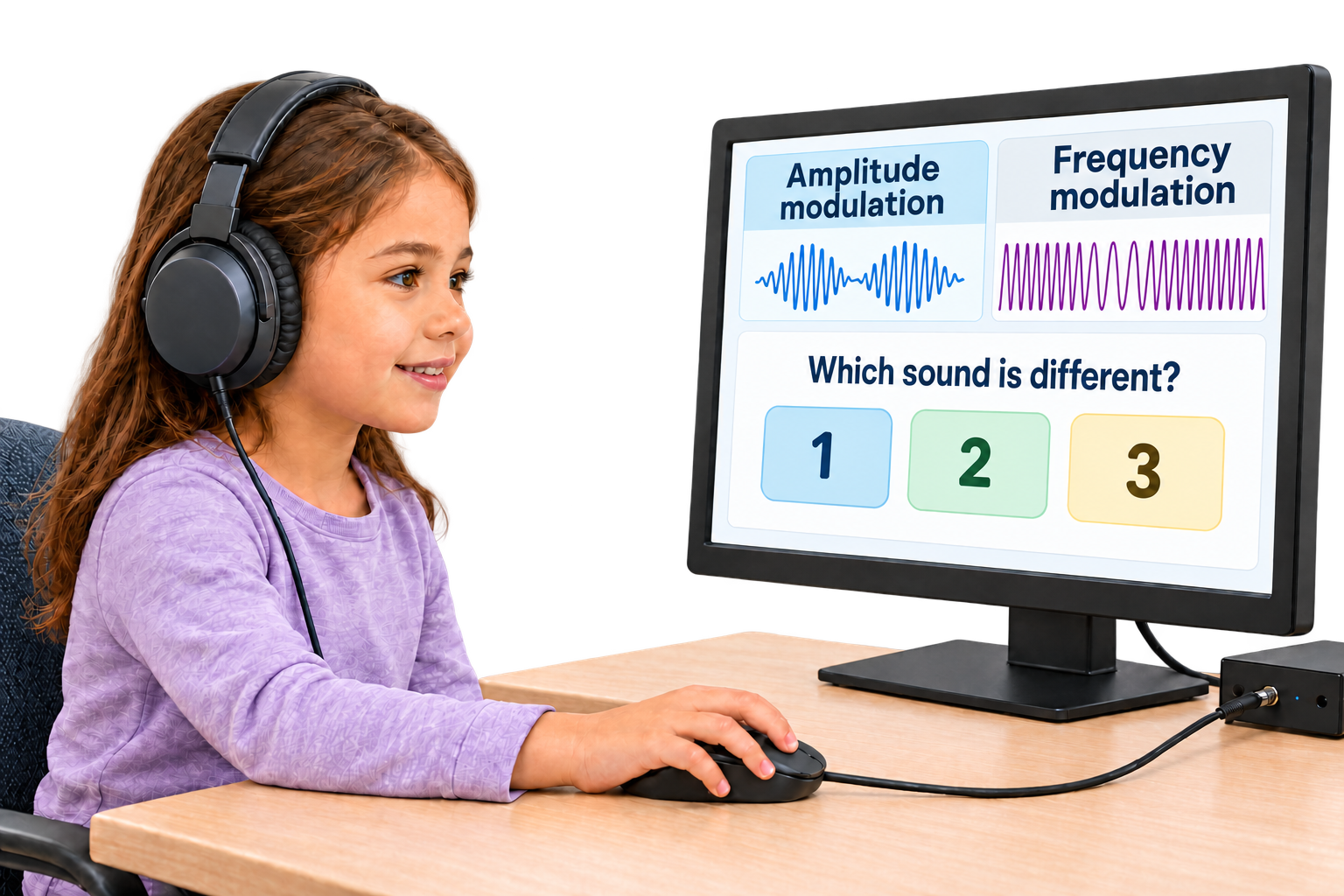
The study included 121 children aged 4–12 years. Children were classified as having normal hearing, unilateral hearing loss, or bilateral hearing loss using separate averages for lower and higher frequencies. A threshold average between 16 and 40 dB HL in either frequency range identified hearing loss in the relevant ear. Children completed adaptive tasks for amplitude and frequency modulations in which they identified which of three sounds differed from the others (Figure 1).
Children with unilateral or bilateral hearing loss did not differ clearly from children with normal hearing in individual group comparisons of amplitude or frequency modulation sensitivity. These findings argue against assuming that minimal to mild hearing loss produces a generalized deficit across all temporal processing abilities under the conditions tested. A different picture emerged when interaural asymmetry was examined as a continuous measure. Greater interaural differences were associated with poorer frequency modulation detection after accounting for age and average hearing thresholds. Within the combined hearing loss group, average asymmetry was about 5 dB, with a maximum of 15 dB. Thus, the relationship was observed in a sample with relatively modest ear differences. Amplitude modulation detection was not associated with interaural asymmetry. Older children generally performed better on frequency modulation tasks, consistent with continuing development of this ability.
How To Interpret the Asymmetry Finding
The finding does not establish 5 dB as a diagnostic threshold or an indication for amplification. That value describes the average asymmetry within the hearing loss group, rather than a boundary separating affected and unaffected children. Likewise, the association does not mean that every child with a small ear difference has impaired temporal processing. Its importance is that a continuous audiogram feature revealed a relationship that broad hearing loss categories did not clearly capture. For clinicians, this supports examining the pattern across ears rather than relying exclusively on pure-tone average or the minimal hearing loss category. Two children with similar overall thresholds may have different distributions of hearing sensitivity and potentially different perceptual profiles due to differences in interaural asymmetry. The association was evident within the hearing loss group but not within the normal hearing group. Interpretation should therefore remain tied to the population studied.
We think that unequal input during development may affect how the auditory system combines information from the two ears. Hearing is supported by pathways that adapt to the timing, strength, and reliability of incoming signals. Persistent imbalance could alter those adaptations even when the individual thresholds appear only slightly elevated. Frequency modulation detection may be particularly sensitive to such imbalance because listening with two ears can offer an advantage over listening with one. Unequal inputs might reduce that advantage.
What This Means for Assessment and Management
The findings strengthen the rationale for taking slight hearing loss seriously, but they do not supply a universal clinical rule. The practical message is to pay attention to the differences in thresholds between ears or between frequency regions. The study’s findings encourage clinicians to consider whether the threshold configuration adds information when a child’s reported listening experience seems disproportionate to the apparent degree of loss. Its strongest contribution is to show why a minimal or mild audiometric label should not end the investigation of a child’s difficulties.
The results raise questions about passive observation when a child has minimal hearing loss or asymmetric thresholds. Waiting for a larger loss or more obvious difficulty could overlook a period during which auditory skills are developing. A reasonable interpretation is that observation should be active and purposeful. For children already under clinical care, monitoring can consider changes in thresholds, consistency of asymmetry, listening concerns, and functional demands, not only whether the hearing loss has crossed a category boundary.
Families may find the terms “minimal” and “mild” reassuring, but these terms describe audiometric degree rather than the full effect on listening. Counseling can explain that small threshold changes do not necessarily predict major or immediate difficulty, while also acknowledging that ear balance may matter. A child can respond readily to familiar speech in quiet and still encounter greater demands in a noisy group setting. Our study1 offers a reason to investigate those concerns rather than dismiss them based on a small threshold elevation.
References
- Mishra, S.K., Nair, A. & Saxena, U. Ear Hear. 47, 1457-1466 (2026).
- Patro, C. & Mishra, S.K. Lang. Speech Hear. Serv. Sch. 55, 1002–1022 (2024).