
From Physician to Patient: Reflections on Hearing, Longevity, and Successful Ageing


A Conversation with a 92-Year-Old Geriatrician
By Emilie Vos, BHSc (Honors) AuD., REG Caslpo
Doctor of Audiology at Hearing Solutions
Editor’s Note: I would like to thank Dr. Vos for this enlightening conversation with retired geriatrician, Dr. Cyril Gryfe, MD. Among many things, it underscores that we are never just dealing with a pair of “ears”, but patients who are as complex in their makeup and they are complex in their everyday needs.
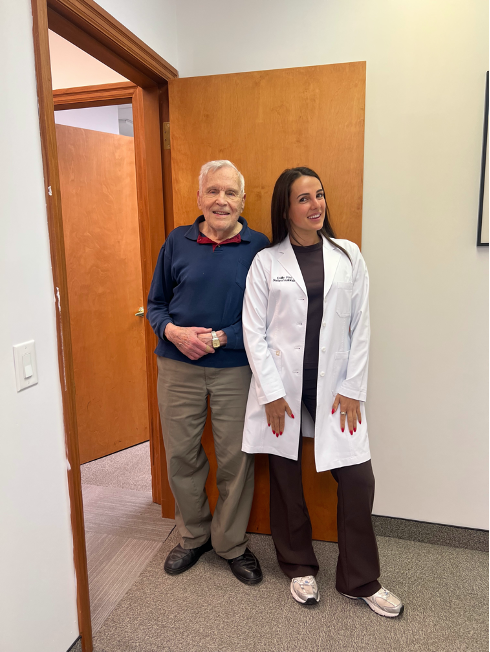
Dr. Cyril Gryfe, MD and Dr Emilie Vos, AuD
Introduction
As audiologists, we regularly counsel older adults on hearing loss, communication, and maintaining independence. However, many aspects of ageing—particularly the emotional and physical realities of it—are difficult to fully appreciate until they are personally experienced. Recently, I had the privilege of speaking with one of my longtime patients, Dr. Cyril Gryfe, a 92-year-old retired physician and geriatrician, about his reflections on ageing, hearing loss, energy, independence, and the transition from physician to patient.
Over our conversation, Dr. Gryfe reflected on longevity, the underestimated role of hearing in successful aging, and the profound changes that accompany later life. His insights offer valuable lessons not only for older adults, but also for the clinicians caring for them.
Longevity: What We Can—and Cannot—Control
When asked what he believes contributes most to longevity, Dr. Gryfe emphasized simplicity over novelty.
“The key things to longevity… are to eat properly, keep active, and don’t take risks that you know are going to reduce your likelihood of surviving.”
While these principles are familiar to most clinicians, Dr. Gryfe highlighted that they represent some of the few aspects of ageing that remain within our control. Many realities of ageing, he noted, only become fully understood once they are personally experienced.
Did a Career in Geriatrics Prepare Him for Ageing?
Despite decades spent caring for older adults, Dr. Gryfe admitted that his professional background did not truly prepare him for his own experience with ageing.
“I really did not think about it at all… it only became a reality very suddenly. It was literally like hitting a brick wall.”
He described maintaining a consistent exercise program for more than 20 years, only to realize in his early 80s that the same routine began leaving him fatigued for the remainder of the day. This marked his first awareness of what he describes as a loss of energy reserve, a concept he feels is often underestimated by younger clinicians.
From Physician to Patient: A Profound Shift
One of the most striking parts of the conversation centered on Dr. Gryfe’s transition from physician to patient.
“The biggest challenge… is whether my doctor is hearing me in the same way that I tried to hear my patients.”
He explained that activities once considered effortless—such as walking a few city blocks—now require conscious planning, energy budgeting, and risk assessment. Each step is accompanied by an awareness of fatigue, balance, and fall risk, a perspective he admits he never fully grasped as a practicing physician.
This insight underscores the importance of listening carefully to older patients, whose concerns may not always align neatly with objective measures but nonetheless profoundly affect quality of life.
Hearing Loss: Awareness Often Comes Late
Dr. Gryfe began wearing hearing aids approximately 20 years ago. Reflecting on his initial awareness of hearing loss, he noted that, like many patients, he could not identify a single defining moment that prompted him to seek care. However, once he began using hearing aids, the benefits became immediately apparent.
“I remember telling my colleagues at my medical school reunion what a difference hearing aids made.”
During his years practicing geriatrics, he encountered countless patients with untreated hearing loss, including one experience that left a lasting impression. While practicing in Bermuda, he met a patient who owned hearing aids but didn’t use them because he couldn’t afford the batteries. This encounter crystallized for Dr. Gryfe the social and economic barriers that often prevent older adults from accessing effective hearing care.
Hearing, Cognition, and Independence
At 92, Dr. Gryfe remains clear that hearing health is foundational to successful aging.
“Clear hearing is absolutely essential to function socially.”
He also reflected on the growing body of research linking untreated hearing loss to cognitive decline.
“The risk of dementia has certainly been shown to be heightened by poor hearing.”
Dr. Gryfe emphasized that healthcare often underestimates hearing loss, partly because clinicians who have not personally experienced it may not fully appreciate its impact.
“You’ve got to experience things in order to fully understand things.”
This sentiment closely parallels what many audiologists observe clinically: patients often do not recognize the extent of their hearing difficulties until communication is restored.
Social Connection and Purpose in Later Life
When asked about the importance of social connection, Dr. Gryfe’s response was unequivocal.
“The hazards of isolation are so great… it’s one of the major failings in the life process.”
He credits much of his continued engagement and resilience to his wife, a retired nutritionist, and emphasizes the importance of partnership in aging well.
“Choose your life partner carefully. You get a choice.”
Regarding purpose, Dr. Gryfe acknowledged that meaning in later life is deeply personal and shaped by health, relationships, faith, and reflection.
Technology, Attention, and Modern Life
Despite being an early adopter of electronic medical records, Dr. Gryfe deliberately gave up his cell phone upon retirement.
“I did not want to be available 24/7.”
He expressed concern that modern technology, while valuable, may erode attention, presence, and meaningful social connection.
“The damage it’s doing to the normal social process… developed over all of human evolution.”
This perspective resonated deeply as we discussed how reduced attention spans and constant digital engagement may affect both younger and older generations.
Advice for Audiologists and Healthcare Providers
When asked what guidance he would offer audiologists caring for patients in their 90s and beyond, Dr. Gryfe offered a simple but powerful recommendation:
“Structure your working day so that you have the time to talk to them and fully understand what they’re trying to tell you.”
His closing reflections emphasized the importance of creating space for older adults to speak openly about ageing—not only hearing loss, but the full spectrum of physical, sensory, and environmental changes that accompany later life.
Conclusion
Dr. Gryfe’s reflections remind us that aging is not always a gradual, predictable process, but often a sudden shift in capacity, awareness, and vulnerability. Hearing health plays a central role in maintaining communication, independence, and social connection, yet it remains underestimated in many healthcare settings.
As audiologists, we are uniquely positioned to support not only hearing, but also dignity, participation, and quality of life in older adults. Listening—truly listening—to our patients’ lived experiences may be one of our most important clinical tools.
The perspectives shared in this article reflect one individual’s lived experience with ageing and hearing loss.
Written informed consent was obtained from Dr. Cyril Gryfe for publication of this interview and accompanying reflections.