
Amplification


Amplification
Coordinated by audiologist Calvin Staples, Amplification is a new column in CanadianAudiologist.ca, … and it’s about Amplification. In this and future Amplification columns relevant information from the peer reviewed literature and the clinic will be shared that has a direct bearing on what we do and see in our clinical practices.
The A2 Hearing Aid Evolution
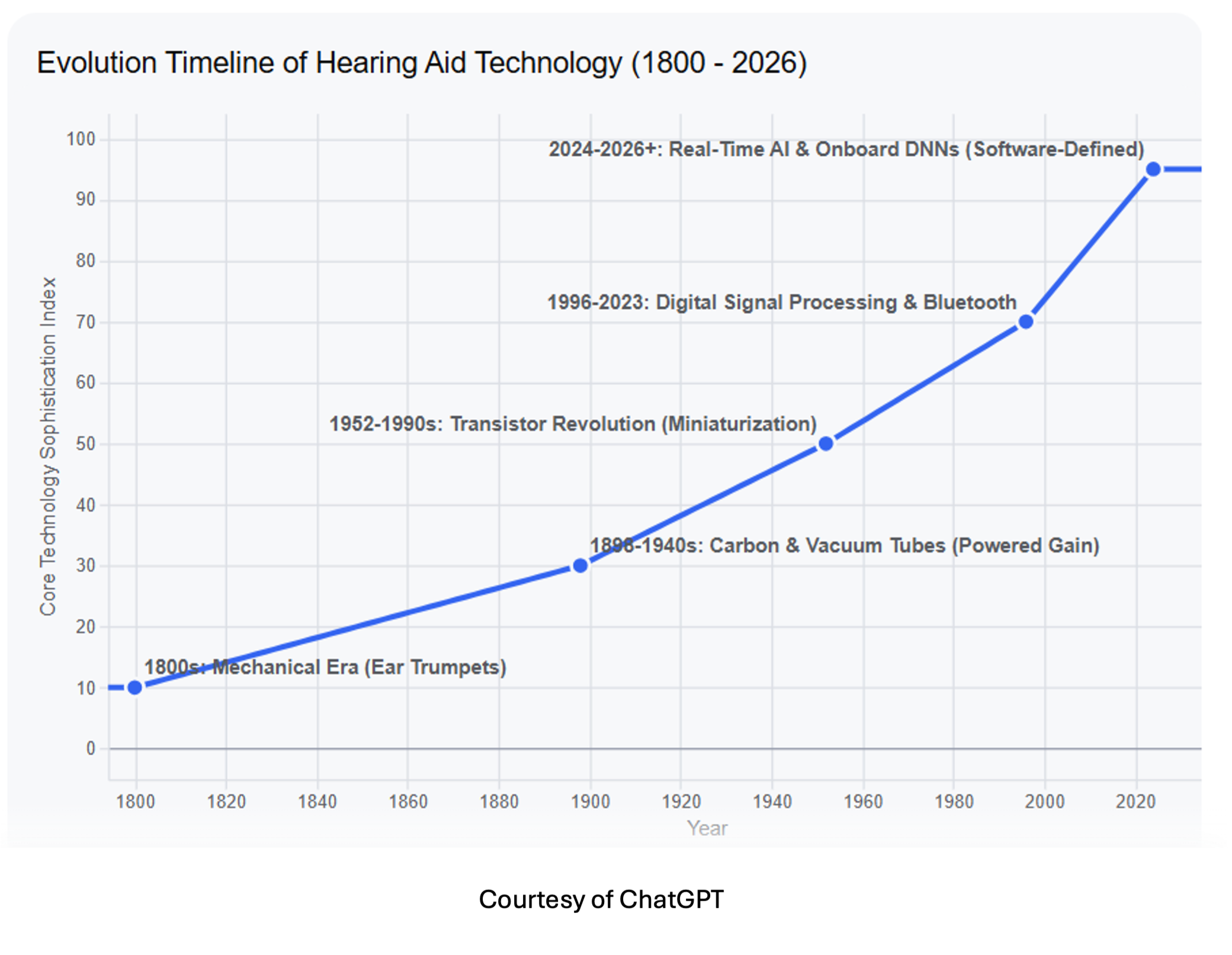
The hearing aid industry is entering the next era of hearing aid evolution- its third significant evolution, which I will refer to as the A2 evolution – Access and Artificial Intelligence (AI). Arguably, the miniaturization and digital eras are the most significant changes in hearing aid/amplification in the twentieth century, and Access and AI are set to change the hearing aid market for the future.
The Miniaturization Era
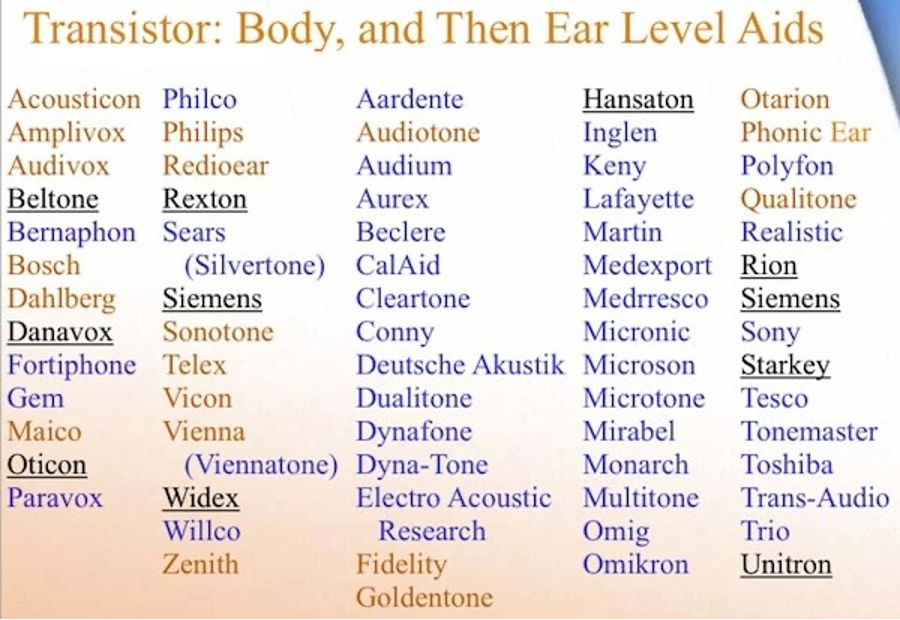
Miniaturization responded to the “make it smaller” mandate. Advances in integrated circuits and transistors in the 1950s made it possible, and the US military conceptually predated this by 20 years because it needed smaller walkie-talkies (Killion; Staab 2014; Staab 2017). Major contributors to integrated circuits and miniaturization were improved, smaller battery designs. Integrated circuits are tiny microchips that house all the components required for hearing aid technology to function and was developed by Texas Instruments (Staab 2014). Transistors were smaller than vacuum tubes and didn’t require a larger battery (Staab 2014). The table below represents the companies that used transistors in their hearing aids. Interestingly, when reviewing the table – so many of the companies are still present in some form or fashion today. It’s too bad CalAid doesn’t still exist – iykyk (Figure 2). As Staab notes, at the time of its publication, those in blue were no longer in business.
The Digital Era
The next major development was digital hearing aids – it would be unfair and potentially inaccurate to neglect the importance hearing aid compression technology has had on fitting hearing aids within the reduced patient dynamic range. It was used in analog hearing aids and continues in digital hearing aids today. However, the goal of this column was to limit this to three major developments … miniaturization, digital processing, and AI were chosen. Hearing health care providers regularly note that nearly every major hearing aid company claims to have the first digital hearing aid. Bell Labs played a significant role in the development of digital technology, which again linked back to World War II – known as “Project X” (Levitt, 2007). The project began because of the need for a secure telephone link between London and Washington, which led to the use of binary digits (Levitt, 2007). Decades later, moving hearing aids from analog to digital allowed for far more fine-tuning, automation, and flexibility. The progression and use of digital technology represents decades of improvements. Helping people with hearing loss hear better in noise was one of the key features of some of the first commercially available hearing aids, with Intellitech’s Zeta Blocker developing a noise-reduction filter (Levitt 2007). One of the most significant improvements from digital hearing aid programming was the adaptive feedback cancellation system. Without proper feedback cancellation open-fit hearing aids would not exist. What made digital hearing aids so exciting was the control the clinician gained to help those with hearing aids – the development process took years to truly realize its benefit. Clinicians and manufacturers alike, were excited to share this breakthrough with patients; improved feedback cancellation, digital noise reduction, adaptive directionality, environment classification/steering, and frequency lowering technology are just some of the improvements designed to help patients hear in more challenging environments – the key benefit of this era – remember analog hearing aids worked very well in environments with stable background noises.
The Access and Artificial Intelligence Era
Access and Artificial Intelligence is here. British Columbia (BC), followed by Ontario, became the first provinces to approve over–the–counter hearing aids, with the goal of increasing access and recognizing and treating hearing loss earlier in life (Ministry of Health BC 2026; Barnes 2026). The BC government identifies 5 major benefits with OTC hearing aids:
- enhance the accessibility of hearing supports
- provide more choice for adults managing mild to moderate hearing loss
- help reduce barriers for people without extended health benefits or coverage
- encourage earlier recognition and action on hearing changes
- support greater awareness and normalization of hearing health
Simply – the OTC legislation is about access – Canadian Audiologists have a position statement the paradox OTCs create: while yes Audiologists support notion of access for OTC devices, they warn about the potential harmful impact of non-prescriptive/non-verified devices which produce significant Maximum Power Outputs (MPO). Documented MPO levels for commercially available OTC hearing aids reach 111dB SPL for linear hearing aids and 117 dB SPL for compression hearing aids (FDA 2022). A recent paper noted that the MPO decibel level in the ear canal can exceed the document levels once the RECD is incorporated into the measurement (Chung 2026). In previous work, Chung and Zeng (2024) noted in their analysis the ability for an OTC hearing aid to fit a flat 80dB hearing loss monaurally – thus well beyond the intended use. The National Center of Audiology previously demonstrated, in at least one sample case, MPO outcomes supporting Chung's analysis (Parsa et al. 2018). So yes, at present we have access – but access does not necessarily mean the hearing loss is address and is safe for the patient. The labelling concerns and requests identified in the Canadian Academy of Audiology position statement are not only necessarily but vital to safeguard patients and protect hearing (MacDonald 2026).
The AI world is arguably in its infancy, or has been around in some form for two decades. In terms of real-world improvement for patients and clinicians’ infancy is most likely the answer. The digital era has accomplished many tasks that have significantly helped patients enjoy hearing life. However, impact on the greatest area of concern still requires work – patients want to hear better in background noise. At present, the key work appears to lie in Deep Neural Networks (DNNs), which are now common. In general, the goal of DNNs in hearing aids is to separate speech from noise, helping in the most challenging and important listening environments. Unfortunately, independent evidence to support these intended outcomes is currently lacking. A full-scale review is beyond the scope of this column, but benefits were seen in a bimodal study of 11 Cochlear Implant patients with hearing aid placed on the non-implanted ear – demonstrated the largest improvements in the DNN program (Kloberg et al. 2025). This study's sample size was limited, and most other studies appear manufacturer-sponsored. Data from regular hearing aid patients is limited, but this suggests hearing aid technology is on the cusp of finally making hearing in noise possible. The notion of being able to selective attend, filter out, process separately, and react to wearer input (subconsciously or consciously) gives hope to the next wave of hearing aid technology.
The A2 era is just beginning in Canada, and the hearing health care landscape will likely change. Initially, patient experience will determine the benefits and changes, but over time the service delivery model could look nothing like it does today.
References
- Barnes L. (2026) Ontario Enabling Access to Over-the-Counter Hearing Aids -Province giving Ontarians more options to connect to convenient care faster. https://news.ontario.ca/en/release/1008165/ontario-enabling-access-to-over-the-counter-hearing-aids
- Chung K. Extremely High Fitting Range and Dangerous Levels Permitted by the Current FDA Guidelines for OTC Hearing Aids and the Need to Consider RECDs. Audiol Res. 2026 Aug 25;16(5):124. doi: 10.3390/audiolres16050124. PMID: 42776766; PMCID: PMC13600033.
- FDA Medical Devices; Ear, Nose, and Throat Devices; Establishing Over-the-Counter Hearing Aids. [(accessed on 7 August 2025)];2022 Available online: https://www.federalregister.gov/documents/2022/08/17/2022-17230/medical-devices-ear-nose-and-throat-devices-establishing-over-the-counter-hearing-aids
- Killion, M.C.; Van Halteren, A.; Stenfelt, S.; Warren, D.M. Hearing Aid Transducers; Springer: Berlin, Germany, 2016; pp. 59–92
- Kolberg, C., Holbert, S. O., Bogle, J. M., & Saoji, A. A. (2025). DNN-Based Noise Reduction Significantly Improves Bimodal Benefit in Background Noise for Cochlear Implant Users. Journal of Clinical Medicine, 14(15), 5302. https://doi.org/10.3390/jcm14155302
- Levitt H. A historical perspective on digital hearing AIDS: how digital technology has changed modern hearing AIDS. Trends Amplification. 2007 Mar;11(1):7-24. doi: 10.1177/1084713806298000. PMID: 17301334; PMCID: PMC4111501.
- Levitt H. Digital Hearing Aids: Wheelbarrows to Ear Inserts The ASHA Leader. 2007 Dec;12(17) ; 28-30
- MacDonald, L. Access Points: When “Accessible” Isn’t the Same as “Safe”: What Canada Should Know Before Over-the-Counter Hearing Aids Arrive. Canadian Audiologist. 2026 13(5).
- Parsa V.J., Sheel M., Scollie, S. Putting Direct-to-Consumer Hearing Devices Through Verification Paces. Canadian Audiologist. 2018 5(6).
- Staab (2014) https://hearinghealthmatters.org/waynesworld/2014/hearing-aid-technology-evolution/
- Staab (2017) https://canadianaudiologist.ca/stories-from-our-past/