
Audiologists as Gatekeepers: A Two-Year Audit Supporting Direct ENT Referral Pathways in Canada


Purushothaman Ganesan, MASLP, Audiologist, SoundEar Audiology, Saskatoon, Saskatchewan, Canada.
Swapna Simham, DNB in Otorhinolaryngology, MBBS, Clinical Manager, Audiology Assistant, SoundEar Audiology, Saskatoon, Saskatchewan, Canada.
Introduction
In Canada, access to otolaryngology (ENT) services varies significantly by jurisdiction, and most provinces already permit direct audiologist-to-ENT referral models. However, physician-mediated referral pathways remain mandatory in British Columbia, Ontario, and Saskatchewan, which can delay timely specialist assessment, particularly for patients presenting with urgent auditory or vestibular concerns. Audiologists are often the first regulated health professionals to assess these patients and are well positioned to identify conditions that warrant medical evaluation. The Canadian Academy of Audiology is working toward complete pan-Canadian harmonization (with active working groups in Ontario and British Columbia and a formal request submitted to the government of Saskatchewan). However, while this is still in process, the restrictions on direct referral can lead to unnecessary additional appointments, system inefficiencies, and potential negative impacts on patient outcomes.
Allied health primary contact models, in which practitioners operate within defined protocols to extend scope, have been implemented internationally to improve efficiency and reduce wait times.1-3 For example, Australian audiology-led clinics for children with middle ear concerns demonstrate faster assessment and earlier ENT intervention.4 Other allied health professions, including physiotherapy and occupational therapy, have similarly optimized specialist access through primary contact models.2,5 These experiences suggest that enabling audiologist-led referrals could enhance access to care and system efficiency within Canadian audiology practice.
This two-year audit from a Canadian audiology clinic reports on the indications of patients referred for ENT assessment, providing supporting evidence that audiologists can function as clinical gatekeepers while managing most hearing concerns independently.
Clinical Audit from A Canadian Audiology Practice
A two-year retrospective review of routine clinical activity was conducted at SoundEar Audiology, Saskatoon, Saskatchewan, Canada. The clinic provides comprehensive audiological services for both adult and pediatric populations. Data were aggregated and de-identified as part of a quality improvement initiative to evaluate referral patterns and alignment with established clinical guidelines.
The reviewed assessments reflected the range of services typically encountered in a Canadian audiology practice. These included diagnostic hearing evaluations, cerumen management visits (where a comprehensive assessment was completed if hearing concerns persisted), employment-related hearing evaluations for organizations such as the Royal Canadian Mounted Police, Correctional Services, Aviation Medical, and Canadian National Railways, as well as industrial, vestibular, and pediatric assessments.
For all individuals, the audiologist conducted comprehensive audiological assessments as clinically indicated. These routinely included otoscopy, tympanometry, ipsilateral acoustic reflexes, otoacoustic emissions, pure-tone audiometry, speech audiometry, and speech-in-noise testing (QuickSIN). This test battery supported the identification of audiological red flags and informed evidence-based clinical decision-making and referral recommendations.
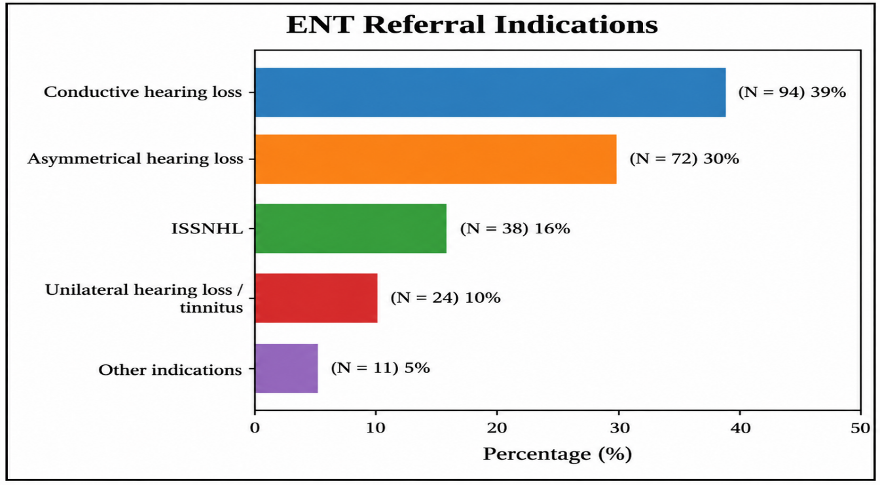
Between January 2024 and January 2026, the clinic completed assessments for 996 patients. Of these, 239 patients (24%) were identified as requiring ENT evaluation. To account for varying clinical risk profiles across the caseload, referral rates were analyzed by specific visit type (Table 1). Diagnostic assessments (n=148/466: 31.8%) and pediatric evaluations (n=68/169; 40.2%) demonstrated substantially higher medical triage rates. In contrast, routine clinical presentations such as cerumen management (n=17/303; 5.6%) and employment tests (n=6/58; 10.3%) generated predictably low referral rates, consistent with their lower-risk nature. Referrals were based on established clinical indicators,6-8 including conductive hearing loss, asymmetrical hearing loss, idiopathic sudden sensorineural hearing loss (ISSNHL), and unilateral hearing loss/tinnitus. Other referral indications included suspected Ménière’s disease, foreign body removal, and external otitis. Figure 1 illustrates the distribution of these ENT referral indications. ISSNHL cases were defined based on patient-reported acute onset and audiometric findings at presentation; long-standing unilateral losses were categorized separately where clinically appropriate. This distribution is consistent with established clinical guidance for ENT referral. Overall, these findings are consistent with the role of audiologists as clinical gatekeepers, identifying patients who require medical assessment while managing most hearing-related concerns independently.
Table 1. Patient Volume and ENT Referral Rates across Audiological Visit Types (N) = 996.
| Visit type | Total patients (n) | ENT referrals (n) | Referral rate (%) |
| Diagnostic (adult/vestibular) | 466 | 148 | 31.8 |
| Pediatric assessment | 169 | 68 | 40.2 |
| Cerumen removal | 303 | 17 | 5.6 |
| Pre-employment test | 58 | 6 | 10.3 |
| Overall total | 996 | 239 | 24.0 |
Because direct audiologist to ENT referral pathways are restricted under current provincial regulations in Saskatchewan, these 239 patients had to navigate physician-mediated or informal channels. Of the 38 urgent ISSNHL cases identified, a subset was accommodated directly by local ENT clinics through ad hoc, same-day scheduling when specialist availability permitted. When immediate specialist slots were unavailable, patients were directed to hospital emergency departments to secure time-sensitive medical evaluation and initiate treatment. Crucially, a 100% referral completion rate was achieved for this urgent cohort; all 38 identified ISSNHL cases successfully secured medical evaluation, and complete clinical follow-up was confirmed for every patient. The remaining 201 non-emergent cases were routed back to primary care physician (PCP) or walk-in clinics to enter the routine specialist wait pool. Notably, local clinical practice shows that attaching comprehensive audiological test results accelerates triage within the ENT pool compared with unstructured primary care referrals.
Improving Access To ENT Care and Reducing Delays
Current physician-mediated referral pathways can delay and complicate patient care. Requiring a referral from a PCP often slows timely ENT assessment, particularly for patients without immediate access to a family physician. This can increase patient burden with extra appointments, duplicate services, and disrupted continuity of care. Time-sensitive conditions, such as ISSNHL, require urgent specialist attention, yet in Saskatchewan, audiologists cannot currently refer these patients directly. Even brief delays can negatively affect outcomes, including the risk of permanent hearing loss. Other conditions, such as middle ear disease, keratosis obturans, or suspected Meniere’s disease, can also face unnecessary delays under physician-mediated pathways.
Streamlined referral pathways may encourage patients to present directly to audiology clinics for sudden hearing changes or unilateral tinnitus, potentially reducing delays associated with PCP access. This model is supported by trends in our own practice, which show increasing utilization of audiology services for cerumen management. This pattern indicates that patients are already proactively seeking more direct access care when appropriate.
Considering these trends, audiologist-led direct referral pathways could help address these inefficiencies and offer multiple benefits, including reduced time to specialist assessment, decreased patient burden from multiple appointments, improved continuity of care, and more efficient use of specialist services. By enabling earlier and more streamlined access to specialists, these pathways can improve patient outcomes and reduce stress for both patients and providers. Early identification and management of hearing loss, particularly in children with middle ear effusion, supports speech development while mitigating long-term negative language and academic outcomes.,9,10 Audiologists are also well-positioned to differentiate causes of episodic vertigo, ensuring timely specialist involvement when needed.
Enhancing System Efficiency and Resource Utilization
Reducing unnecessary steps in the patient journey is key to improving healthcare efficiency. Currently, physician-mediated referral pathways remain mandatory in only three jurisdictions, whereas the remaining seven provinces permit direct-access models. Extending these direct-referral pathways to the remaining provinces would establish a uniform national standard of care and confirm their operational feasibility across the entire Canadian healthcare system.
Our clinic’s review of nearly 1,000 assessments over two years found that only about 24% required ENT referral. However, when isolating symptomatic diagnostic populations, the clinical gatekeeping rate increases to 31.8% for general diagnostics and 40.2% for pediatric cohorts. In a physician-mediated system, these cases require an additional primary care visit, introducing systemic delays before specialist evaluation. Implementing direct referral pathways removes this unnecessary step, ensuring timely care for this patient cohort while protecting limited health resources. This streamlined pathway is especially critical given that 5.9 million Canadians lack a family physician, nurse practitioner, or primary care provider11 Overall, audiologist-led referrals improve system efficiency, prioritize urgent care, and align with the profession’s scope of practice.
Interprofessional Collaboration
Audiologists and otolaryngologists work synergistically, integrating diagnostic, rehabilitative, and medical expertise to optimize hearing healthcare outcomes.12 Audiologist-led primary contact models strengthen this collaboration by enabling audiologists to safely assess, triage, and refer patients within established protocols. Standardized referral criteria, documentation, and communication processes ensure appropriate specialist involvement and maintain patient safety.
International experiences, particularly in Australia and Ireland, demonstrate that similar approaches improve access to assessment, ensure timely medical care, and make ENT services more efficient.4,13 These examples, alongside established protocols already utilized within the Canadian healthcare system, highlight that interprofessional collaboration combined with primary contact models allows audiologist-led referral pathways to be implemented safely and effectively.
Policy and Practice Implications
Practice-based audits provide valuable insight into real-world clinical decision-making and patient flow. This two-year review shows that the clinical indicators audiologists use to identify patients who require medical assessment align directly with established protocols. Policy considerations informed by this evidence include:
- Adopting or adapting existing provincial protocols for audiologist-led direct-referral pathways in British Columbia, Ontario, and Saskatchewan
- Development of standardized referral criteria
- Ongoing data collection to evaluate patient outcomes and system impact
Expanding these pathways to the remaining provinces supported by the national advocacy of the Canadian Academy of Audiology could establish a uniform standard of care, ensuring timely access to ENT services nationwide while maintaining patient safety and clinical consistency. This structural alignment would support equitable, efficient, and patient-centred hearing healthcare throughout Canada by closing the regulatory gap between jurisdictions.
Conclusion
Audiologists are often the first point of contact for patients with auditory and vestibular concerns and possess the diagnostic expertise to identify red-flag conditions requiring medical evaluation. This two-year clinical review shows that, while most cases can be managed independently by audiologists, medical triage rates were substantial among core clinical cohorts, with 31.8% of adult diagnostic cases and 40.2% of pediatric assessments requiring otolaryngology referral (24% of the overall caseload). These referrals were primarily driven by conductive hearing loss, asymmetrical hearing loss, or ISSNHL. Formalizing direct referral pathways could reduce delays, improve patient access to ENT services, and enhance healthcare system efficiency. Aligning audiology practice with these demonstrated clinical responsibilities supports a more timely, efficient, and patient-centred model of hearing healthcare. It strengthens the case for expanding audiologist-led referral pathways to Saskatchewan and the remaining provinces.
References
- Walsh, T. P., Pilkington, D. C., Wong, E. J., Brown, C. H., & Mercer, G. E. (2014). Orthopaedic triaging by podiatrists: a prospective study of patient satisfaction and service efficiency. Aust Health Rev, 38(4), 406-411.
- Stute, M., Moretto, N., Raymer, M., Banks, M., Buttrum, P., Sam, S., ... & Comans, T. (2018). Process to establish 11 primary contact allied health pathways in a public health service. Australian Health Review, 42(3), 258-265.
- Payten, C. L., Eakin, J., Smith, T., Stewart, V., Madill, C. J., & Weir, K. A. (2020). Outcomes of a multidisciplinary ear, nose and throat allied health primary contact outpatient assessment service. Clinical otolaryngology, 45(6), 904-913.
- Pokorny, M. A., Thorne, P. R., Whitfield, B. C., Lee, A. C., & Wilson, W. J. (2021). Can an advanced audiology‐led service reduce waiting times for paediatric ear nose and throat outpatient services? Journal of paediatrics and child health, 57(2), 268-272.
- Stute, M., Moretto, N., Waters, R., Raymer, M., Sam, S., Bhagwat, M., ... & Buttrum, P. (2020). Allied health primary contact services: results of a 2-year follow-up study of clinical effectiveness, safety, wait times and impact on medical specialist out-patient waitlists. Australian health review, 45(3), 344-352.
- Alberta College of Speech-Language Pathologists and Audiologists (2019). Protocol for Audiological Referral to Otolaryngology.
- American Academy of Otolaryngology – Head and Neck Surgery (2025). Position Statement: Red Flags-Warning of Ear Disease.
- College of Audiologists and Speech - Language Pathologists of Manitoba. (2023, November 25). Audiologists referral to otolaryngology guidelines. https://caslpm.ca/wp-content/uploads/AUD-Guidelines-Referral-to-ENT_251123.pdf
- Roberts, J., Hunter, L., Gravel, J., Rosenfeld, R., Berman, S., Haggard, M., ... & Wallace, I. (2004). Otitis media, hearing loss, and language learning: controversies and current research. Journal of Developmental & Behavioral Pediatrics, 25(2), 110-122.
- Bell, M. F., Lima, F., Lehmann, D., Glauert, R., Moore, H. C., & Brennan-Jones, C. G. (2021). Children with secondary care episodes for otitis media have poor literacy and numeracy outcomes: A data linkage study. International journal of environmental research and public health, 18(20), 10822.
- Is Canada’s primary Care System Measuring Up? Insights from the 2025 OurCare National Survey, Toronto, Canada. MAP centre for urban health solutions, 2025.
- Ganesan, P., Schmiedge, J., & Swapna, S. (2016). Synergy Between ENT Surgeons, Audiologists. The Hearing Journal, 69(12), 26.
- Katiri, R., Sivan, N., Noone, A., Farrell, E., McLoughlin, L., Lang, B., ... & Kieran, S. M. (2023). Outcomes from 7 years of a direct to audiology referral pathway. Irish Journal of Medical Science (1971-), 192(3), 1341-1347.