
Sound Business Sense



Strategic Business Planning Part V
The Strategic Business Planning series has covered 50% of the topics needed to develop a formal business plan. The next area is Competitive Analysis, arguably the most important component in predicting a business’s success or failure.
- Executive Summary
- Table of Contents
- Mission & Vision
- Practice Overview
- Market Assessment
- Competition Analysis
- Personnel/Human Resources
- Operational Plan
- Financial Components
Appendix
Harvard’s Michael Porter’s writings suggest that differentiating a new practice from its competitors is essential toboth short- and long-term success. Potential investors expect a thorough assessment of the Competitive landscape within the target market, including marketing
strategies, market share, and economic and industry trends that could affect the practice. A business plan is, therefore, incomplete without a detailed, objective competitive analysis of the market in which the practice will operate. A competitive analysis should go beyond a mere description of the competitors. It must examine the broader market and the specific strengths and weaknesses of businesses that will compete with the new audiology practice. The plan should demonstrate to stakeholders that the entrepreneur understands the competitive rivalry in the proposed target market and how to attract patients and referral sources amid competitive traffic.
Independent audiology practices are increasingly competing directly by providing the same products and diagnostic/rehabilitative services outlined in the business plan. Moreover, competition is now formidable from otolaryngology practices, big box stores (COSTCO, Sam’s Club/Walmart, etc.), government audiology clinics (Veteran’s Administration), insurance companies, hearing aid manufacturer-owned stores and clinics, Internet hearing aid sales, direct-to-consumer sales, and hearing aid dispensers. These are all companies that publicize to the same consumers as the new practice or expansion being considered.
Indirect competition further complicates the competitive landscape. These competitors offer different products and services than the new or expanded practice but target the same consumers. Consider any alternative means target consumers could use to address their audiological issues as indirect competition, such as over-the-counter (OTC) hearing aids, cochlear implants, or internet tinnitus treatments that may offer alternative solutions to the problems the practice or expansion is addressing.
For an entrepreneur to best present their knowledge of the competition within the target market, specific competitors must be listed with an estimate of their market share. Also include examples of their advertising across media, including their website, search engines, Facebook page, etc., and explain how the new or expanded practice will challenge each avenue. Each of the competitors should be characterized by their clinical offerings, qualifications of the practice providers, and a candid, unbiased assessment of their strengths and weaknesses.
Specific Considerations in the Evaluation of a Market
Traynor & Glaser (2006) first proposed a model for evaluating competition in an audiology business target market. Initially used to review competitive strategies in existing businesses, it has been modified over the years to include business planning. The current version (Traynor, 2026a) provides a simple overview of considerations for either an existing competitive strategy or the competitive section of a new or expanded practice business plan. This model is offered in Figure 1.
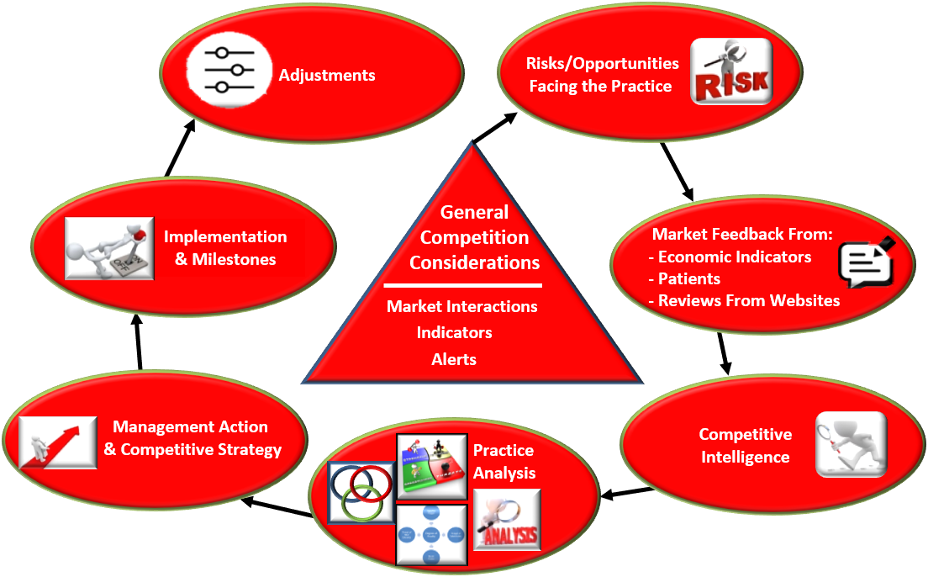
Within the model, the central triangle considers competition through interactions, indicators, and alerts. Market dynamics include sources such as community feedback, news reports, online resources, and the entrepreneur’s independent research. This evaluation may uncover previously unrecognized risks or opportunities from economic conditions such as approaching recessions, leading and lagging economic indicators, concerns among prospective patients and referral sources, and deficiencies in the availability or quality of local audiological services.
Following Figure 1, the next block is competitive intelligence. A competitive market assessment must go beyond identifying local competitors. It should involve systematic collection and analysis of information regarding products, patients, competitors, and broader environmental factors that reduce risks and support strategic decision-making. Gilad (2004) called this process Competitive Intelligence. A former Israeli military intelligence officer and Harvard MBA graduate, Gilad advocated applying disciplined intelligence-gathering methods in the business environment. Although the term “intelligence” may evoke images of corporate espionage, competitive intelligence is an ethical, legitimate, and essential business practice, with most of the information derived from publicly available sources. In discussing the benefits of competitive intelligence, Tyson (2010) indicates that this process transforms random bits and pieces of data into strategic knowledge such as:
- Competitors’ current competitive position and probable future plans.
- The driving forces within the marketplace.
- Specific competitive products and technology.
- The economic, political, and demographic influences that affect the market.
Gaining this knowledge involves continuously monitoring competitors, consumers, suppliers, and other market forces, such as new product categories, so the practice is never surprised by the competition’s actions or reactions. Competitive intelligence involves more than studying competitors; it is the process of studying anything that helps the practice stay competitive. It enables practitioners to develop a comprehensive focus on the local marketplace, recognize competitive vulnerabilities, and identify potential strategic opportunities. Since audiologists depend heavily on referrals from physicians, chiropractors, dentists, nurses, and other healthcare professionals, competitive research should include discussions with these referral sources regarding their satisfaction with existing services and the factors that influence their referral decisions. These insights can help a new or expanding practice differentiate itself by addressing unmet community needs.
When analyzing the competition, emphasize how the practice differs and why patients would choose this new or expanded practice over existing competition.
Since the new startup or the practice expansion does not want to be the same as the competition, ensure the inclusion within the business plan as to how this practice, with its focus toward audiological products and services, is different than the competition. Differences could include credentials, location, expertise, itemized pricing, new and innovative procedures, vestibular services, or other factors that will persuade patients to choose the practice over the competition. Incorporating competitive intelligence into a business plan also shows stakeholders that the practice has a structured approach to monitoring current and emerging competitors and responding effectively to marketplace changes.
Practice Analysis Methods
Practice analysis is the next essential block in a business plan. For an expansion plan, it can provide valuable information about a current practice’s success and support future success. For a new practice, components of a practice analysis are included within the plan to demonstrate the limitations of various competitors.
Practice analysis may use several procedures to generate the information needed to modify business strategy or include in a business plan for expansion. Although there is not enough space here to discuss practice analysis in detail, Traynor (2026b) offers three useful techniques: SWOT Analysis, Porter’s Five Forces (Porter, 1980), and/or the Three Circle Analysis (Urbany & Davis, 2011). These techniques review a market’s competition by identifying potential vulnerabilities to competitive forces. Within a business plan, these data support the entrepreneur’s vision.
The SWOT Analysis
The SWOT (Strengths, Weaknesses, Opportunities, and Threats) analysis is a cursory look at current business’s strengths and weaknesses It allows the entrepreneur to review a competitor’s weaknesses and exploit those for the benefit of the business plan. Additionally, SWOT can examine how competitors failed to seize opportunities, as well as the threats the new practice will face in the marketplace.
Porter’s Five Forces
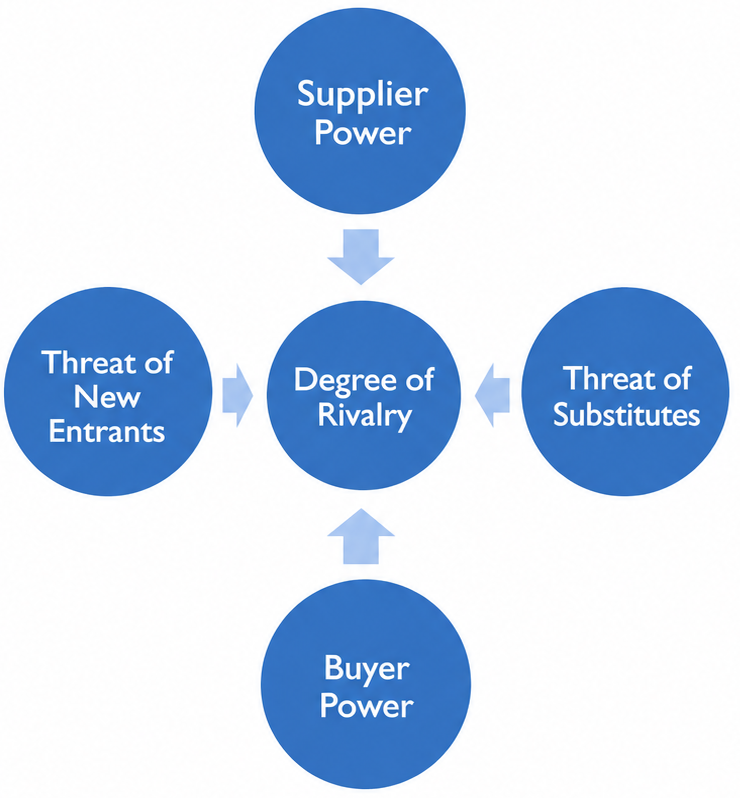
Porter’s Five Forces reviews overall rivalry within the marketplace and the threat of new competitors or substitute products entering the market. A Porter review can offer insight regarding if the market is controlled by consumers, or if the provider has control over the market. These points are extremely helpful as an entrepreneur amplifies their vision to capture market share in a competitive environment.
Three Circle Analysis

For the competitive businesses that appear to be major competitors in the marketplace, the Three Circle Analysis uses a Venn Diagram approach to compare each competitor’s new or expanding practice.
Summary
The results of a thorough competitive intelligence effort and a distant practice analysis of competitors should be included within the plan. Include this information throughout the competitive section of the plan to assure stakeholders that the entrepreneur has in-depth knowledge of the competitive landscape in the target market. While competition can be a source of stress and anxiety for audiologists considering a new or expanded practice, in a free-market system it also provides a tremendous opportunity for entrepreneurs to offer new methods, more choices, and more value to consumers.
The balance of the blocks within the model are part of our discussions for a future issue. Next time our Sound Business Sense topic will be the critical Human Resources section and how to present it in a business plan.
References
- Gilad, B. (2004). Early Warning. New York, NY: American Management Association.
- Porter, M. (1980). Competitive Strategy. New York, NY: Simon & Schuster.
- Porter, M. (2008) On Competition: Updated and Expanded Edition. Boston, MA: Harvard Business School Publishing.
- Traynor, R & Glaser, R (2006). Audiology Practice Business Workshop, Sonic Innovations, Phoenix, AZ.
- Traynor, R. (2026a). Chapter 3- Strategic Business Planning. In Strategic Practice Management, 4th Edition, (Traynor, RM & Taylor B., Eds.) San Diego, CA: Plural Publishing.
- Traynor, R. (2026b). Chapter 5. Analysis of the Audiology Practice. In Strategic Practice Management, 4th Edition, (Traynor, RM & Taylor B., Eds.) San Diego, CA: Plural Publishing.
- Tyson, K. (2010). The Complete Guide to Competitive Intelligence (5th Edition), Merced, CA: Leading Edge Publications.
- Urbany, J & Davis, J (2011. Grow by Focusing on What Matters: Competitive Strategy in 3 Circles. New York, NY: Business Expert Press.