
Early Development of Measurement Microphones, the Audiometer and its use in Sound Evaluation, the Decibel, and the Sound Level Meter


In the late 1800s and early 1900s, much effort went into devising an accurate and portable means of measuring sound. This included the transducer or microphone and the metric. Along the way, one of these efforts resulted in the accidental invention of the audiometer which was later then used for comparative listening evaluation of sound before sound level meters became available. A more complete history of this effort, extending to around 1960, is included in two earlier papers by the authors.1,2 This paper will concentrate on measurement microphones, the audiometer, the decibel, and the sound level meter.
Measurement Microphones
Much or the early effort on microphones was dedicated to the telephone transmitter. However, those inexpensive devices lacked the stability and frequency response required for measurements. “Condenser,” “dynamic,” and piezoelectric microphones were used in early instruments, each with advantages, until the limitations of the early condenser microphone were overcome.
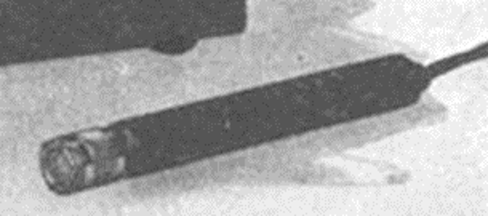
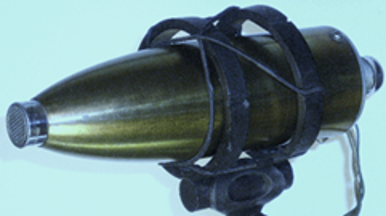
The condenser microphone was first conceived by A. E. Dolbear in 1881.3 However, the signal was too weak without amplification. By 1916, with the then-available vacuum tube amplifier, E. C. Wente of the Western Electric Engineering Department developed a practical condenser microphone, or, as Bell insisted, “condenser transmitter.”4 It had the best stability, frequency response, and noise floor then available, but required strong amplification and was expensive. In 1917, an improvement extended the frequency range above 15,000 Hz and in 1922 the sensitivity was increased 100-fold. At first, Western Electric offered use of the condenser microphone only on a rental basis, accompanied by a Western Electric engineer. Further improvements were made in 1924 and 1926 with the 1926 model offered for sale. These microphones were in a relatively large box or cylinder, with amplification connected by a short cable to additional amplification. By 1932, Bell Laboratories had developed two improved condenser microphones for measurement. A small 0.6-inch-diameter microphone5 was very similar to later measurement microphones but still required a large amplifier box with a short cable to it (Figure 1). This proved too difficult to manufacture. Instead, they offered a similar, larger one-inch model, the 640A, for sale. After testing showed that temperature and humidity influenced the 640A6,7 in the early 1940s, an improved model 640AA (Figure 2) was introduced, changing the diaphragm from aluminum to steel. Advances in electronics enabled more amplification to be packed into a larger, bullet-shaped microphone cylinder, allowing a longer cable to the control box built into a carrying case. The main remaining issues for the condenser microphone were the need to remove the grid for measurements and the size of the preamplifier. These issues were resolved by Bruel & Kjaer in 1956.
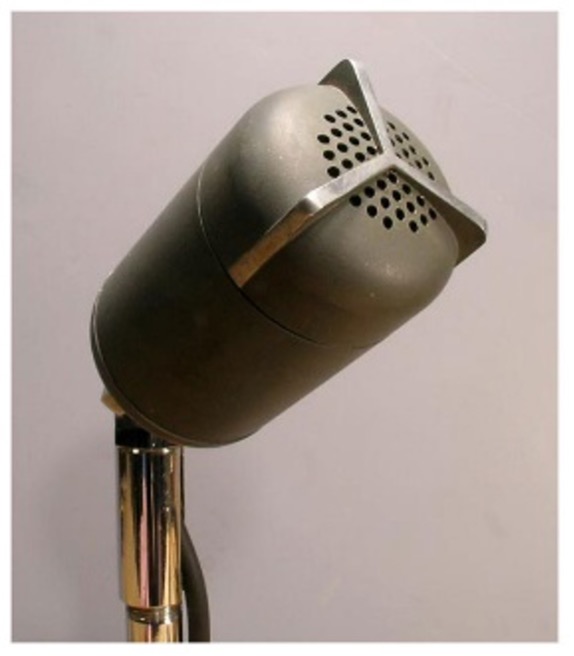
Antonio Meucci, in 1856 in New York, conceived the moving-coil transducer. E. W. Siemens improved on this and received a patent in 1874. This became the basis of “dynamic” microphones. The Bell telephone receiver was modified to use a moving armature. Some used this as a measurement microphone, though its sensitivity was low. Wente and Thuras, recognizing the shortcomings of early condenser microphones, developed the WE Model 618A dynamic microphone introduced in 1931.8 Compared to the condenser, it was about 10 dB more sensitive, did not require a polarizing voltage, and did not require an amplifier close to the microphone, making it especially useful for measurements remote from instrumentation. The improved 633 “saltshaker” microphone of 1937 (Figure 3) was widely used in both broadcasting and measurements into the 1950s.
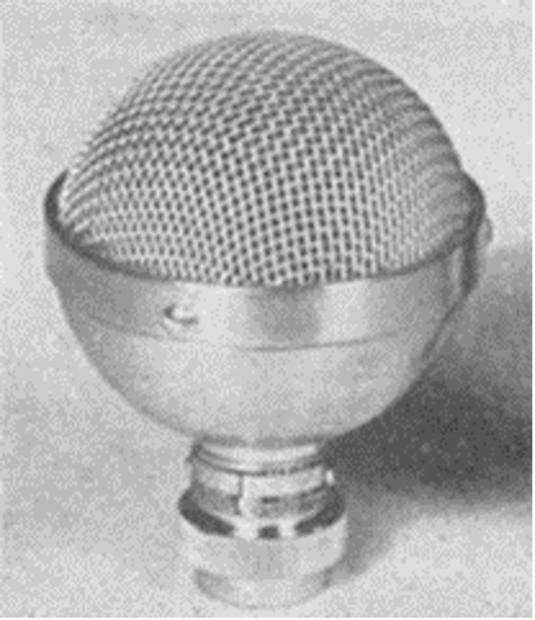
Jacques and Pierre Curie discovered the piezoelectric effect in 1880, and Langevin applied it to underwater ultrasonic effects in 1917. However, Alexander Nicholson at Western Electric in 1919 was the first to demonstrate the effect of transducing airborne sound into an electrical signal. In the 1920s, the Brush Development Company developed Rochelle salt microphones, then sold them and licensed their designs to other manufacturers, who sold the Rochelle salt microphones. The Brush and later the Shure 98-98 (Figure 4), used by General Radio and others, was the most widely used measurement microphone from the 1930s to the 1950s. The crystal was sensitive to temperature and humidity and could fail at high temperatures. The primary advantage was low cost.
The Audiometer and Its Use in Sound Evaluation
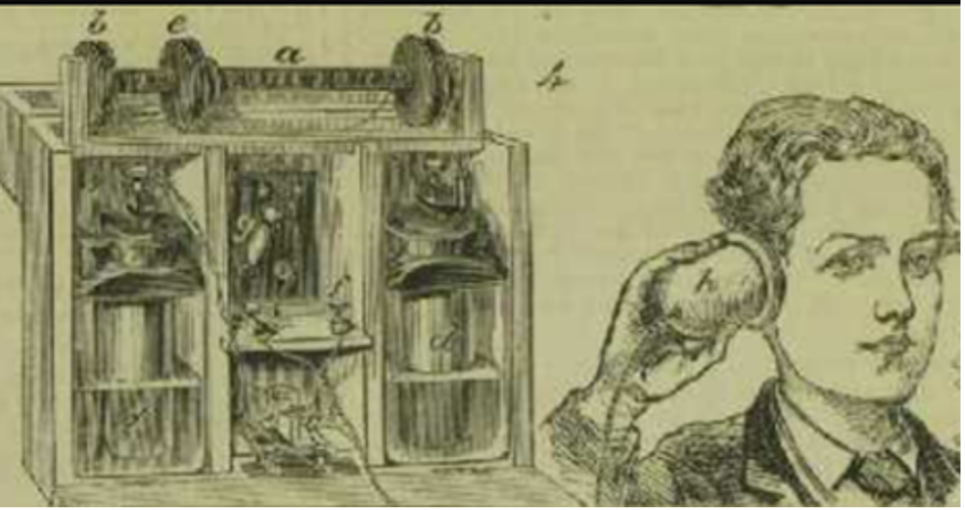
David Edward Hughes attempted to build a sound-measuring instrument using induction coils. His concept was that the microphone's sound signal would cause a coil to move along a graduated bar between two other coils, with the coil’s motion indicating the sound’s strength. However, he discovered that he could produce a controlled output of sound from the microphone by manually moving the coil along the bar. Hughes10 reported this in 1879 and did not further pursue sound measurement. A friend, Benjamin Ward Richardson, noted that his device could be used to evaluate hearing, coined the inappropriate name “audiometer,” and published hearing research using it, which was then commercially produced. Hughes did produce another device, called a Sonometer, to evaluate the properties of metals. Both were discussed in an 1879 newspaper article,11 Figure 5.
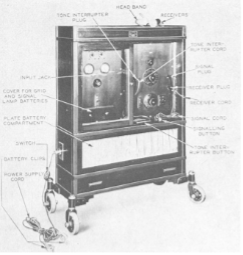
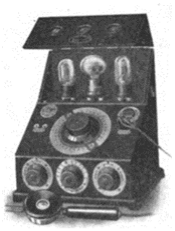
In 1914, Western Electric built the vacuum tube 1-A audiometer shown in Figure 6. Though the best of its time, it was a large cabinet that was not easily portable. Before 1921, Schwarzkoff in Germany introduced a compact, portable vacuum-tube audiometer, the Otaudion (Figure 7), discussed by Griessmann.12 By 1923, Harvey Fletcher, researching hearing at Western Electric, developed the 2-A portable audiometer (Figure 8).
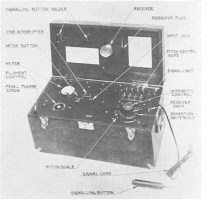
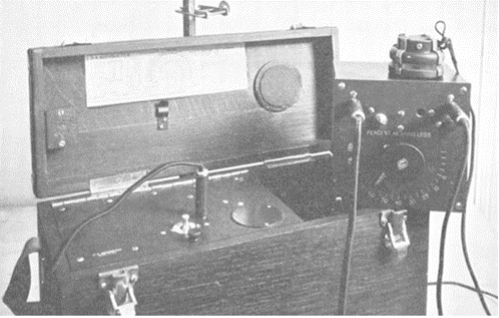
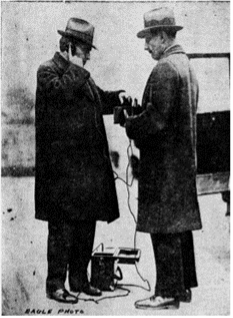
In the mid-1920s, there was demand for a way to measure sound or noise outside the laboratory, but no suitable instrument was commercially available. Dr. Edward Elway Free, a well-known soil scientist, popular-science writer, and editor of Scientific American, had moved to New York and was disturbed by the city’s noise. By the time Bell Laboratories was founded in 1925, he had consulted Fletcher. Fletcher, by then 14, had developed a 3-A audiometer that Bell engineers had used to evaluate the sound of automobiles, Figure 9. It was simplified to produce a broadband sound rather than a series of tones, and a spacer was provided to hold the earpiece away from the ear. The noise was evaluated by a masking comparison method with the sound from the audiometer. Free and Fletcher developed a plan to survey city noise with the audiometer in 1925 and issued a report in January 1926. Free was interviewed by newspapers 15, and his measurements were published in newspapers 16 (Figure 10). Free became very involved in acoustics and discussed the method in JASA in 1930.17 In Germany, Barkhausen introduced a portable audiometer in 1926 that he characterized as a sound meter and proposed could be used to measure sound. This was made commercially by Siemens Halske starting in 1927. Montano19 reports that between 1925 and 1930, many surveys were conducted in cities around the world using audiometers, and the first graphical recordings of city noise were made in Australia in 1928.
The Decibel
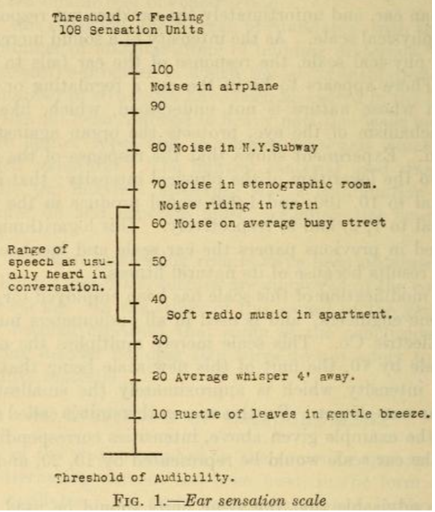
Initially sound was quantified by its pressure in dynes/cm2. In the early 1900s Max Wien developed a scale with units of “Wiens” similar to today’s “sone” scale. In the early 1920s Fletcher20 found that a 12% increase in pressure or a 25% increase in intensity was a just noticeable increase as a step function for a careful listener. He found that 10 log 1.25 or 20 log 1.12 was about unity and called this a “sensation unit.” A change of 5 sensation units was clearly noticeable and was used as the primary steps on the audiometer. Barkhausen likewise found that he could use base-2 logarithms to produce a scale in which each unit corresponded to a doubling of perceived loudness.18 He called this a “phon” but that term was later redefined. The use of sensation units in audiometers led to their broader use in expressing the perceived loudness of sound. An NBS paper21 in 1928 included a “sound thermometer” in sensation units (Figure 11), attributed to Wallace Waterfall, who discussed it in a paper22 the following year.
A more concise term than “sensation unit” was desired. The AT&T Long Lines transmission group had earlier quantified cable power loss by “miles of standard cable.” Then, in 1924, W. H. Martin23 found that 10 log the ratio of that power loss over a mile was approximately 1 and called this a “transmission unit.” In 1925, Bell Telephone Laboratories was formed by merging the engineering departments of Western Electric (WE) and AT&T Long Lines. Fletcher and Martin talked and realized that the transmission unit and sensation unit were essentially the same. They agreed to pursue naming units for both uses after Bell. Both France and Germany objected due to confusion with words in those languages. Fletcher and Martin realized that their unit, one-tenth of the logarithmic ratio, could be called the “decibel,” with a different pronunciation and the parent “bel” unit not commonly used. Martin and the Transmission Department took the lead and, internally in 1928 and publicly in 192924, declared that the basic unit in everyday use representing transmission units would be the “decibel.” The acoustics community in the United States very quickly followed suit for sound. While Germany adopted the metric, it used the name “phon” for many years for both subjective and objective measurements.
Direct Electronic Sound Measuring Instruments
George Washington Pierce, a Professor at Harvard, in papers published in 190725 and 190926 found he could use various crystals as rectifiers. He then developed a measurement system using a telephone receiver in reverse as a microphone and a galvanometer for readout.27 The signal from the receiver used as a microphone was so weak that he had to tune his circuitry to be in resonance with the frequency of the signal to be able to measure it. Thus, the system was useful only for narrowband sounds and tones.
With the condenser microphone and vacuum tubes, Wente assembled a sound measurement system in his laboratory in 1917. This used the condenser microphone, vacuum tubes for both amplification and rectification, and a galvanometer for readout. He and staff also developed a pistonphone for low frequencies and a thermophone for higher frequency calibration (Ref. 4). Little else is known except that it was large, what would be considered a “mainframe” system in computer terminology, and not easily portable.
Though Wente and others had used vacuum tubes for rectification to measure sound, E. B. Moullin of Cambridge University is credited with inventing the vacuum tube AC voltmeter in 1922. The instrument was put into production in England by Cambridge Instruments and then in the US by Weston.
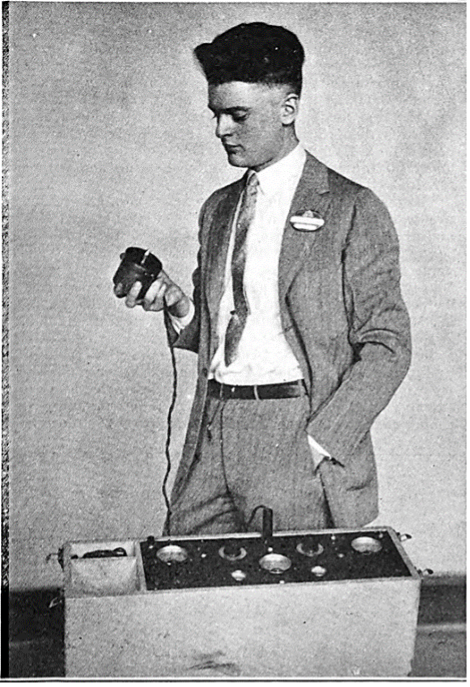
With these tools, but still without the decibel, young Floyd Firestone, as a research assistant at the University of Michigan in 1925, produced the first portable sound and vibration meter at a meeting of the Society of Automotive Engineers.28 It failed to be a sound level meter only because he did not have the decibel. His meter read sound in dynes/cm2. The Firestone work was sponsored by the Timken Roller Bearing Company, looking for a way to evaluate bearing quality on the assembly line. Firestone assembled a box containing a battery, an amplifier, attenuators for range control, and a galvanometer calibrated to read sound pressure in dynes/cm2. He borrowed a condenser microphone from Western Electric for best results, but the box was set up to accept a dynamic microphone as well. It did not include any weighting network to simulate the ear response, though Firestone knew that such a network was desirable. After many successful experiments measuring sound and evaluating bearings, a microphone or amplification component failed in November 1923. While waiting on replacements, Firestone realized that vibration might be a better indicator of the bearings’ condition. No vibration transducers were available, so he made his own. Figure 12 is a photograph of Firestone, age 26 with the instrument as demonstrated. Timken successfully implemented vibration technology with a central power source and readouts at each workstation. The prototype meter was the only one built in that form. Timken owned the technology and chose not to sell rights.
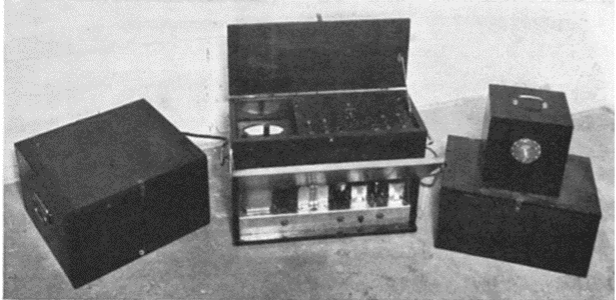
In the late 1920s, there was demand for a portable, direct-reading instrument for sound measurement that did not depend on the ear. With the coming of the decibel, there was now a convenient unit to express what would become known as the sound pressure level in decibels. E. E. Free asked R. F. “Pat” Norris (head of research for Burgess Battery Company and co-originator of the Norris-Eyring equation) to develop such a meter. On April 3, 1929, Norris gave a presentation to the New York Electrical Society29 where he demonstrated the new meter, which he called an “Electric Ear”17 and an “Audimeter.” The meter itself is the middle box in Figure 13, with the left box containing the batteries and the right boxes containing the condenser microphone resting on its amplifier, for a total weight of 110 pounds. The meter included a frequency-weighting network similar to what became A-weighting, but with greater low-frequency attenuation. Importantly, the indicating meter showed the sound pressure level or weighted sound level in decibels. Thus, it can be called the first “sound level meter.” Free began using this meter, in addition to audiometers, in New York City surveys in 1929.
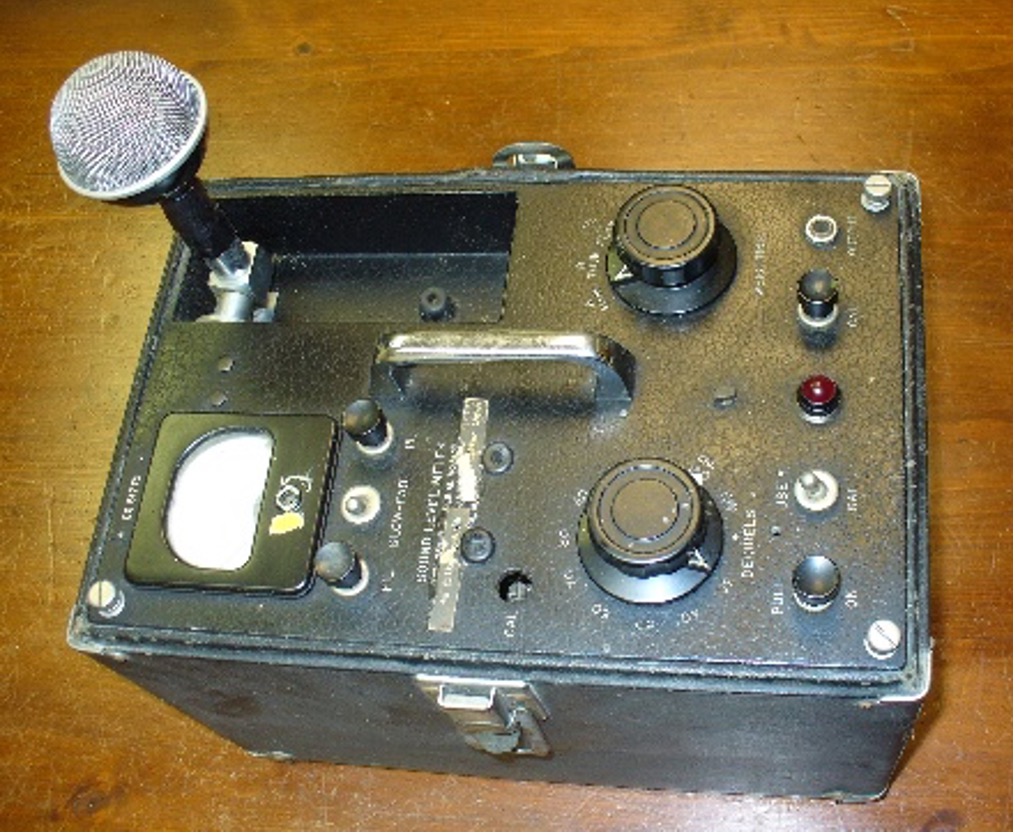
Other non-standardized meters were developed over the next few years, and the Acoustical Society of America identified the need for acoustical standards, including standards for sound level meters. The first “tentative” standard was published in JASA in 193630 but is not available online. General Radio company quickly released a new model 759 sound level meter claiming it met the tentative standard. The designer H. H. Scott used licenses of AT&T patents (explaining lack of other competition). It was equipped with a Rochelle salt microphone without a diaphragm. This was on a fold-up stalk that also served as the on-off switch, but could be removed and connected via a cable. The labeling of the meter dynamics as “Slow” and “Fast” originated the terminology, though “Slow” was not standardized. The A and B weighting curves were also designated as 40 and 70 dB, respectively. The meter weighed 22 pounds and sold for $195, $4500 in 2025 dollars. (See www.ietlabs.com for extensive documentation of General Radio products.) This with a few improvements, was the dominant meter in the US for the next 15 years. It was redesignated 759-A in 1939 with an optional 25 ft microphone cable. In 1942 it became the 759-B, Fig. 14, with the change to a Shure 98-98 Rochelle salt microphone that included a diaphragm, a calibration system for the electronics that required AC power or an external oscillator signal, and optional AC power supply and vibration pickup.
References
- N. D. Stewart and W. Montano, “Before the decibel, acoustical measurements – physical, aural, electrical,” Proc. Mtgs. Acoust., vol. 56, issue 1, May 2025
- N. D. Stewart and W. Montano, “The decibel and beyond, acoustical measurements to the precision age,” POMA, vol. 56, issue 1, May 2025
- A. E. Dolbear, “A new system of telephony,” Scientific American, p. 388, June 18, 1881
- E. C. Wente, “The condenser transmitter as a uniformly sensitive instrument for the absolute measurement of sound density,” Physical Review 10, pp. 39-63, 1917
- H. G. Harrison and P. B. Flanders, “An efficient miniature condenser microphone system,” Bell System Technical Journal, vol. XI, pp. 451-461, July 1932
- M. S. Hawley, “The condenser microphone as an acoustic standard,” Bell Laboratories Record, vol. 33, no. 1, pp. 6-10, January 1955
- G. W. Elko, “The WE 640AA Condenser Microphone,” J. Acoust. Soc. Am., vol. 136, p 2130, October 2014, https://doi.org/10.1121/1.4899681
- E. C. Wente and A. L. Thuras, “Moving coil telephone receivers and microphones,” J. Acoust. Soc. Am., vol. 3, pp. 44–55 (1931) https://doi.org/10.1121/1.1915544
- B. B. Bauer, “Microphones for sound level meters,” J. Acoust. Soc. Am., vol. 29, no. 12, pp. 1333-1334, December 1957 https://doi.org/10.1121/1.1908790
- D. E. Hughes, “On an induction-currents balance, and experimental researches made therewith,” Proceedings of the Royal Society of London, Volume 29, pp. 56-65E, 1879
- “Hughes’s electric sonometer and balance, and audiometer,” Illustrated London News (London, England), p. 463, 15 November 1879
- Griessmann B., “Neue methoden zur hörprüfung,” Beiträge zur Anatomie, Physiologie, Pathologie, und Therapie des Ohres, der Nase und des Halses, Passow-Schaefer, vol. 16, pp. 47-55, 1921
- F. W. Kranz, “Audiometer: principles and history,” Sound: Its Uses and Control (an ASA publication), vol. 2, no. 2, pp. 20–32, 1963
- H. Fletcher, “New methods and apparatus for testing hearing,” Transactions of the thirtieth annual meeting of the American Academy of Ophthalmology and Otolaryngology, Chicago, October 1925
- “Seek noise? It’s noisiest at 6th Ave. and 34th St.,” New York Daily News, p. 4, 15 January 1926
- “Audiometer shows Brooklyn has quieter sections than Manhattan; also noisy spots,” The Brooklyn Daily Eagle, p. 1 cont. p. 4, 21 January 1926
- E. E. Free, “Practical methods of noise measurement,” J. Acoust. Soc. Am. 2, pp. 18–29, 1930
- H. Barkhausen, “Ein neuer Schallmesser für die Praxis,” Journal for Technical Physics, Leipzig, vol 7, issue 12, pp. 599–601, 1926
- W. Montano, “Public concern and measurements of noise in the city,” Noise News Int. January 2022
- H. Fletcher, “Physical measurements of audition and their bearing on the theory of hearing,” Bell System Technical Journal, vol II, pp. 145-180, October 1923. (First presented at the Franklin Institute, March 1923)
- V. L. Chrisler and W. F. Snyder, “Transmission of sound through wall and floor structures,” Bureau of Standards Journal of Research, vol. 2(3) p. 541. Research Paper 48 (RP48). October 25, 1928
- W. Waterfall, “A loudness scale - how the audiometer scale can be applied to problems of practical acoustics in building,” Engineering News-Record, vol. 102(2) January 10, 1929
- W. H. Martin, “The transmission unit and telephone transmission reference systems,” Bell System Technical Journal, vol. III, pp. 400-408, July 1924
- W. H. Martin, “Decibel — the name for the transmission unit,” Bell System Technical Journal, vol. VIII, pp. 1-2, January 1929
- G. W. Pierce, “Crystal rectifiers for electric currents and electric oscillations. Part I. carborundum,” Physical Review (Series I) 25, pp. 31-60, July 1907
- G. W. Pierce, “Crystal rectifiers for electric currents and electric oscillations. II. carborundum, molybdenite, anatase, brookite,” Proceedings of the American Academy of Arts and Sciences, Vol. 44, No. 12, pp. 317-349, March 1909
- G. W. Pierce, “A simple method of measuring the intensity of sound,” Proceedings of the American Academy of Arts and Sciences, Vol. 43, No. 13, pp. 375-395, February 1908
- Firestone describes noise evaluator,” Journal of the SAE, Vol XVI, No. 2, pp. 120-121, February 1925
- “Scientist exhibits the ‘Electric Ear,’” New York Times, p. 13, April 4, 1929
- “American tentative standards for sound level meters Z24.3-1936,” J. Acoust. Soc. Am., vol. 8, pp. 147-152, October 1936