
Ontario’s Workers’ Safety and Insurance Board (WSIB) Policy Change-What They Got Right and What They Got Wrong…


After a public request for comments, the Province of Ontario recently updated its Workers’ Safety and Insurance Board (WSIB) policy on occupational noise exposure. The Canadian Academy of Audiology submitted a detailed response on several issues that would bring the Ontario policy in line with current research literature, not just anecdotes. Three areas were responded to, of which only one was addressed appropriately by the Province of Ontario: (1) Age correction for those workers over the age of 60, (2) Audiometric notch, and (3) The extension of occupational hearing loss to musicians. Only the removal of the age correction was correctly acted upon.
1. Removal of the −0.5 dB/year Correction for Those Workers Over Age 60
The Canadian Academy of Audiology supports removing the −0.5 dB/year correction for workers over age 60. In the old policy, 0.5 dB for each year over age 60 was subtracted from the 500 Hz, 1000 Hz, 2000 Hz, and 3000 Hz average. No significant data have ever supported this assumption, despite this topic being on the agenda of almost every National Hearing Conservation Association (NHCA) conference and every Acoustical Society meeting since the 1980s. Rosenhall et al. (1990) clearly identified that while presbycusis is certainly a factor in hearing loss for those over the age of 60, the effects of presbycusis become much more dominant and by age 79, the measured hearing loss is similar to their age-matched peers who have never been exposed to occupational sources of noise. Rosenhall and his colleagues showed that over the years, ISO R. 1999 (R. 2013)- a large international model- predicts a “toughening” of the hearing mechanism where exposures early in a worker’s career contribute more to permanent hearing loss than if the same exposure was later in their career (shown in Figure 1).
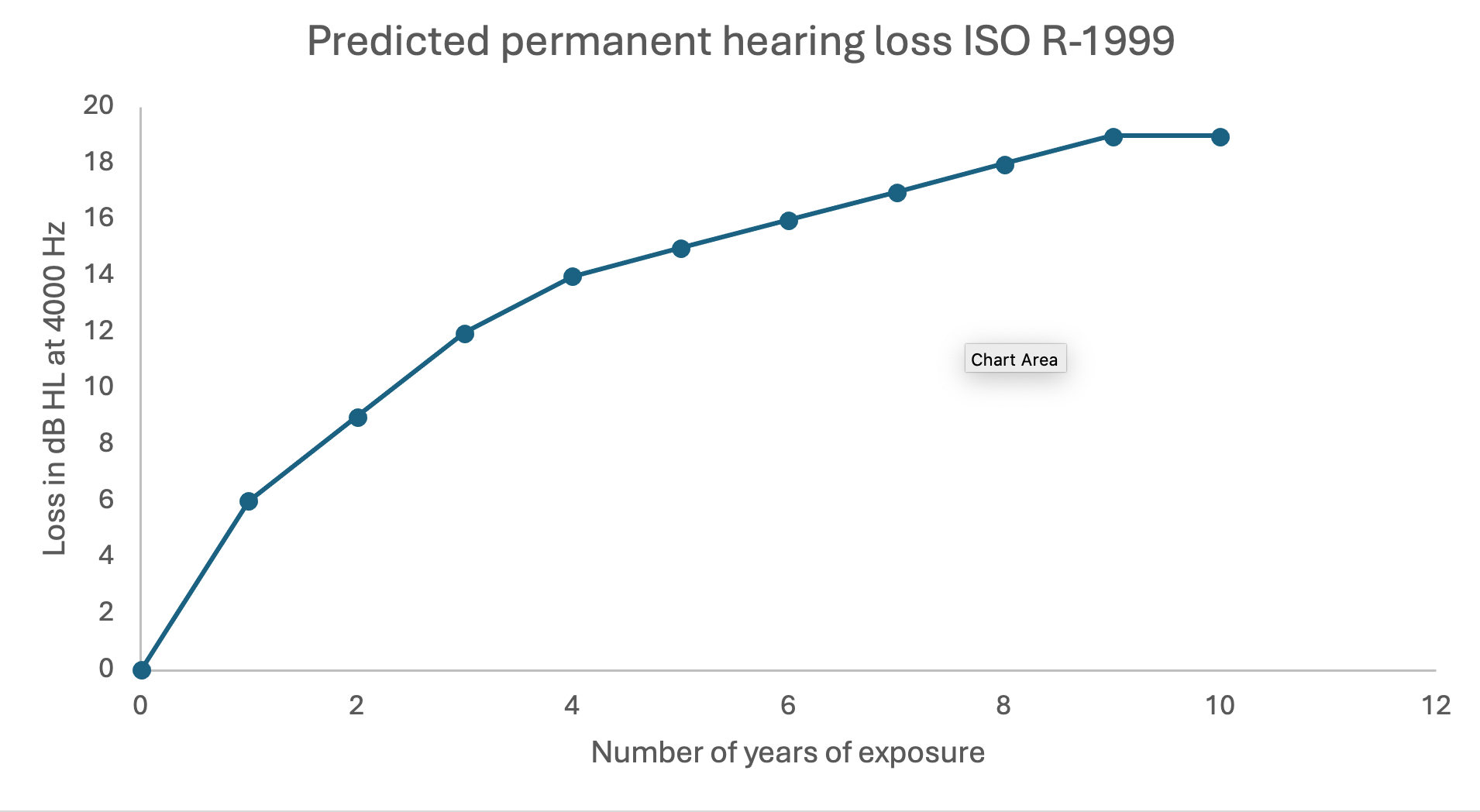
It is “metaphorically” as if the cochlea becomes toughened over time- while there is no histologic data to support this, many references go back to the mid-1980s that refer to this “auditory toughening”. Regardless of the neuro-physiology involved, ultimately as the years pass, presbycusis as a primary source of hearing loss, becomes a much more dominant factor. This gradual flattening of hearing loss progression is predicted by ISO R. 1999 (R. 2013). An age correction for someone who is over 60 and has just begun their occupational career may make sense, but given that most industrial workers have already reached this “flattening” part of the ISO curve by the time they reach age 60 (or even less), it makes no sense to include an age correction.
Removing the 0.5 dB correction for every year over age 60 is a “linear” correction that is the same for all age groups, but as shown in Figure 1, this correction is anything but linear. One cannot model non-linear behavior with a simplistic linear equation. The Canadian Academy of Audiology supports this long-overdue removal.
2. Audiometric “Notch” and the “Consistency” of Audiometric Pattern with NIHL:
There is very little evidence that a notch or a dip pattern is consistent (or even necessary) for a compensable hearing loss caused by noise exposure. Only one other jurisdiction in the world comments (or requires) a notch in the audiogram in the 3000-6000 Hz region and that is the Province of Alberta (https://www.wcb.ab.ca/assets/pdfs/providers/HCP_Hearing_loss.pdf). In the new Ontario Policy, while this is not a strict requirement, a notch is mentioned as an example of the “configuration being consistent with noise exposure.” (p. 5).
Barrs et al. (1994) point out that only about 37% of noise-exposed individuals had such a “notch” in their audiometric configuration. Nondahl et al. (2009) found that “among participants with a notched audiogram, almost one third did not have a history of occupational noise exposure … and results were more variable with woman”. Lie et al. (2015), analyzing the results of over 12,000 railway workers, found that 61% of those who were noise-exposed had notches… but 51% of workers who were not exposed… also had notches. They state that “Audiometric notches commonly occur among both noise-exposed and those not exposed to noise in railway personnel. The usefulness of audiometric notches in the diagnosis of NIHL is therefore limited”.
None of the other jurisdictions in the world (correctly) require the “configuration to be consistent with noise exposure, such as an audiometric “notch” criterion. This is the case in the United States (e.g., Occupational Safety and Health Administration, OSHA) or the European Union (e.g., ISO R. 1999 (R. 2013)). This criterion is an unfounded uniquely Ontario suggestion and an Alberta requirement.
3. Occupational Hearing Loss with Music as the Noise Source
Since 1993 in Ontario, and more recently in British Columbia, the relevant worker’s compensation boards have accepted claims from professional musicians as well as their industrial colleagues. This is well supported in the literature, and Ontario has a policy document from its Ministry of Labor (1993) on this. Figure 2 (based on Russo et al., 2013, 2017) shows a comparison of the permanent hearing loss from classical musicians at Canada’s National Ballet compared with the predicted hearing loss from the large international standard ISO R. 1999- used by the European Union and which serves as the basis for most other regulatory agencies worldwide.
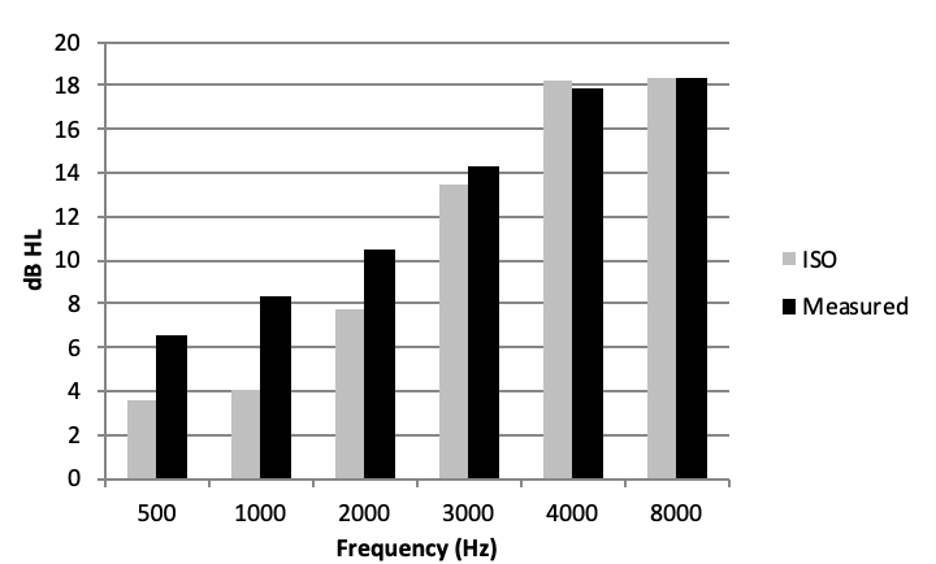
Given these data, the Canadian Academy of Audiology is concerned about both the vagueness of the WSIB NIHL new policy and the lack of mention of non-industrial, yet “occupational,” sources of noise-related hearing loss such as music. In institutions such as professional musical groups and high school music teachers, the environment is well defined, with noise surveys conducted by qualified personnel that meet all requirements of the Workers’ Safety and Insurance Act (WSIA) regulations and the Ministry of Labor noise regulations in Ontario. Ontario also has a specific regulation from the Ministry of Labour for those in the performing arts industry (Ontario Ministry of Labour, 1993), which echoes the effects of noise and music being similar to ISO R. 1999 (R. 2013) and that of U.S. National Institute for Occupational Safety and Health (NIOSH) and Lempert and Henderson (1973) in the United States, whose data underlays the U.S. Environment Protection Agency’s findings.
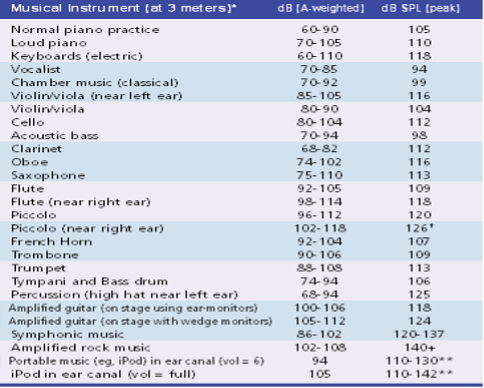
Table I is from Chasin (2006) and shows the range of exposure of over 1000 musicians measured from 3 meters away while playing at an “average” mezzo-forte level. While there is some variability, most musicians consistently play (and are subject to) levels far above 85 dBA.
Concluding Remarks
The Canadian Academy of Audiology supports the removal of the age correction term in the evaluation of occupational noise-induced hearing loss which brings their new policy in line with the research literature, but is concerned about a mention or requirement of an audiometric notch as a fulfilling requirement to establish the audiometric configuration of long-term noise exposure, and also the vagueness of the eligibility of professional musicians to access the Ontario Worker’s Safety and Insurance Board program of care- a policy extending back more than 30 years in Ontario.
References
- Barrs, D.M., Althoff, L.K., Krueger, W.W., & Olsson, J.E. (1994). Work-related noise induced hearing loss: evaluation including evoked potential audiometry. Otolaryngology- Head and Neck Surgery, 110(2), 177-184.
- International Organization for Standardization. R. 1999, R. 2013). (1990). Acoustics- Determination of occupational noise exposure and estimation of noise-induced hearing impairment. 2nd edition, International Standards Organization (ISO). Geneva, Switzerland: Author.
- Lempert, B.L., & Henderson, T.L. (1973). NIOSH survey of occupational noise and hearing: 1968-1972. U.S. Department of Health, Education and Welfare, National Institute for Occupational Safety and Health, TR 86.
- Lie, A., Skogstad, M., Johnsen, T.S., Engdahl, B., & Tambs, K. (2015). The prevalence of notched audiograms in a cross-sectional study of 12,055 railway workers, Ear and Hearing, May-Jun;36(3): e86-92. doi: 10.1097/AUD.0000000000000129.
- Nondahl, D.M., Shi, X., Cruickshanks, K.J., Dalton, D.S., Tweed, T.S., Wiley, T.L. & Carmichael, L.L. (2009). Ear Hear. December; 30(6): 696–703 doi:10.1097/AUD.0b013e3181b1d418.
- Ontario Ministry of Labour. (1993). Safety Guidelines for the Live Performance Industry, First edition.
- Rosenhall, U., Pedersen, K., & Svanborg, A. (1990). Presbycusis and noise-induced hearing loss, Ear and Hearing, 11(4), 257-263.
- Russo, F., Behar, A. Chasin, M., & Mosher, S. (2013). “Noise exposure and Hearing loss in classical orchestral musicians”. International Journal of Industrial Ergonomics, 43.
- Russo, F.A., Behar, A., Chasin, M., & Mosher, S. (2017). Noise exposure and hearing loss in classical orchestra musicians. International Journal of Industrial Ergonomics, 43, 6, Pages 474-478. doi.org/10.1016/j.ergon.2012.11.001.