
What we’re learning about sound localization during the use of hearing protection devices, and how we might be able to use it to improve hearing conservation


Introduction
Noise exposure is a major cause of permanent hearing loss and tinnitus and an increasingly recognized risk factor for subclinical listening difficulties. Whereas damaging sound levels are relatively rare in the natural soundscapes our ears were built for, the modern environments in which people live, work and recreate feature a variety of static and dynamic noise sources that can lead to cumulative or acute hearing injury. Despite the widespread availability of hearing protection devices (HPDs) that can substantially reduce realized noise exposure levels, and despite the advent of organizational hearing conservation programs that promote effective HPD use, noise-induced hearing loss remains a major public health challenge that exerts multibillion-dollar impacts on healthcare and economic systems around the world. From the audiologist’s perspective, occupational and recreational noise exposure produces a steady flow of patients presenting with serious hearing problems that are only partially addressable with existing tools and technologies. Adding insult to injury, many or most of these cases could have been prevented with different resources and/or decision-making.
Important advances in the field of hearing conservation – including the development of more capable and more comfortable HPDs and increased standardization and organizational uptake of HPD fit-testing programs – promise to improve hearing conservation outcomes for many HPD users. However, a persistent and fundamental barrier to the impact of such advances is the disuse or non-use of HPDs in spite of their availability. Inconsistent HPD use is a problem that extends across occupational and recreational contexts. Although worker surveys, interviews and case reports suggest a wide variety of reasons for irregular use – assuredly highlighting the importance of interprofessional strategies to promote hearing hygiene – a portion of non-compliance appears attributable to the tension between auditory protection and auditory perception itself: Even subtle changes to the quality of the sound reaching the ear can affect a listener’s ability to make judgments about the source. Depending on the context, prospective users may find these side-effects unacceptable and cause enough to forgo HPD use. Among known perceptual side-effects of HPDs, one that has received substantial attention from auditory scientists working at the intersection of hearing protection and perception is the apparently profound impact of HPDs on sound source localization ability.
Sound Source Localization
Sound source localization is typically a multisensory process involving (depending on the context) the integration of auditory, visual, and proprioceptive information, subject to refinement by prior knowledge (e.g., auditory spatial cues notwithstanding, we generally do not look toward the ground when we hear an airplane, or up into the trees when we hear approaching footsteps). However, auditory cues alone normally enable listeners to detect and orient toward most sound sources with considerable accuracy. Combinations of acoustic features – including differences in signal level and timing between the two ears and direction-dependent filtering of the sound via the complex geometry of the pinna/head/upper body – vary systematically with the horizontal and vertical position of the sound source. This correspondence is learned through experience to enable accurate source localization in most individuals with audiometrically typical hearing, scaffolding communication, navigation, and personal safety. Auditory localization is an especially valuable capacity in settings with low visibility (darkness, fog, smoke), visual clutter, or contexts in which important sound sources may be outside the field of view altogether (e.g., sources off in the distance or located behind the listener).
HPDs significantly distort spatial acoustic features, with the largest impacts on the direction-dependent filtering action of the pinna: Earplugs partially occlude the pinnae, and earmuffs cover them entirely. The result – reproduced across dozens of laboratory studies spanning approximately five decades – is that listeners wearing HPDs frequently confuse forward and rearward sounds, and struggle to perceive source elevation (e.g., to accurately locate sounds overhead). Measurements obtained in reductive laboratory paradigms come with a host of caveats, but field studies support the fundamental observation that degraded access to auditory spatial information leads to functional losses in performance. Particularly in occupational contexts where situational awareness can be critical (e.g., military service), the acute trade-off between auditory protection and auditory spatial perception may be unacceptable and may, for some users, directly contribute to disuse: Personal safety and/or perceptual acuity may be intermittently or routinely chosen over long-term hearing health. Even from a hearing conservation perspective, it feels disingenuous to fault this choice, and surely convincing workers who are concerned about situational awareness and safety to wear HPDs at all costs is a potentially dangerous strategy. So what can be done?
When It Comes to Localization, Not All HPDs Are Created Equal
While the effect of HPDs on auditory localization has been recognized for decades, so has the observation that different devices produce different impacts: A study participant may localize sound reasonably well with one style of hearing protector, but may exhibit a marked increase in errors with a different HPD style. The nature of the errors can also vary across devices. However, methods to evaluate hearing protector impacts have varied widely across studies, and study sample sizes have often been small, making it difficult to distill generalizable predictors of HPD spatial impacts or to develop effective recommendations re: HPD selection and/or design. The only broadly standardized measure of HPD performance is the Noise Reduction Rating (NRR, or analogous measures developed and applied internationally), which simply (and coarsely) indexes the attenuation provided by the device, doing little to predict potential impacts on auditory perceptual capacities such as sound localization. Organizational and consumer selection of specific HPDs is often based on precedent, pragmatic factors such as cost, or guesswork that may be influenced by manufacturer marketing materials, and there is scant evidence-based guidance available to tailor HPD selections to specific use cases or perceptual considerations.
One significant development within the past decade was the formalization of a set of standard test methods to guide the evaluation of HPD and other head-worn device impacts on auditory localization – ANSI/ASA S3.71 from the American National Standards Institute. While an important step forward, the introduced test methods provide for measurements in the horizontal plane only, despite a large body of evidence that HPDs particularly disrupt localization in the vertical plane. The standard is also fully dependent on human behavioral testing, which constrains the feasibility of application across the immense inventory of commercially available HPDs, and certainly constrains application within test and evaluation pipelines in research and development settings, including iterative design and prototyping processes. Higher-throughput evaluation tools could offer significant value.
Roughly a decade ago, as a postdoctoral fellow at the University of Colorado School of Medicine studying binaural and spatial hearing, I worked on my first project in the area of hearing protection [1]. Together with colleagues Drs. Nate Greene and Dan Tollin and Brianne Beemer (an AuD student at the time) and scientists at a company working to develop protective equipment and other defense-oriented technologies (Drs. Ted Argo and Doug Meegan at Applied Research Associates, Inc.), we evaluated performance in a group of listeners wearing HPDs during a series of perceptual tests, including sound source localization (measured in azimuth only, emphasizing the evaluation of front-back reversals). Subsequently, the same HPDs were fitted on an acoustic manikin so that each device’s impact on transmitted spatial acoustic cues could be directly quantified. The rationale was that acoustic measures of spatial cue disruption, especially changes in pinna-related cues, might be used to predict behavioral performance. A simple acoustic metric related directly to pinna cue distortion showed a promising correlation with behavioral error incidence. However, the study was limited to a small sample of subjects (a dozen listeners) and a few earplug-style HPDs. Published literature had already made clear that different HPDs netted different spatial acoustic impacts, and a correlation between acoustic and behavioral impacts made intuitive sense – but in order to distill usable predictors in the face of the substantial intersubject variability in baseline sound localization and widely varied HPD attributes, we would need more listeners and more HPDs.
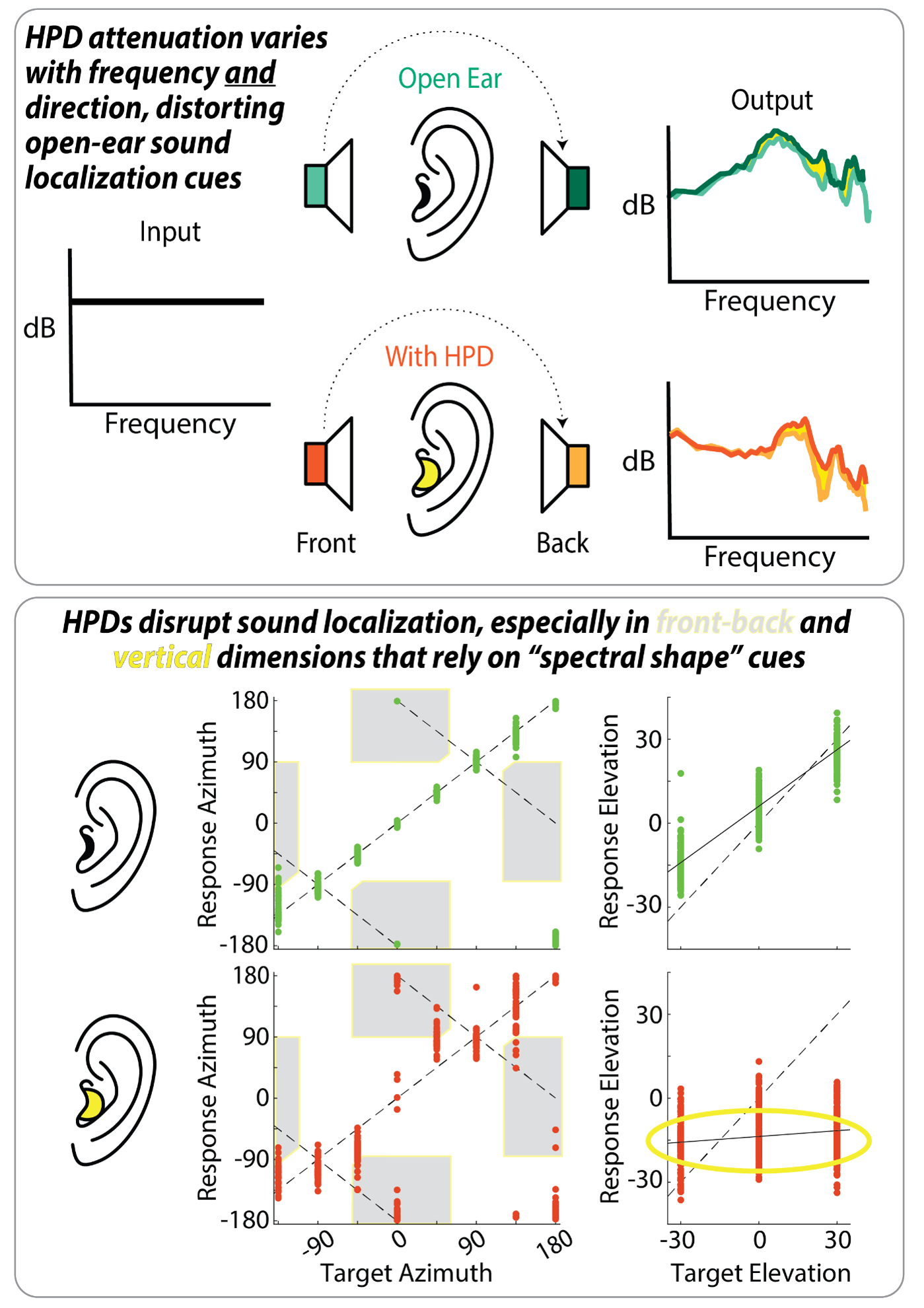
The result was a multi-year multi-site study [2], which launched shortly after I joined the faculty at the University of Washington. Together with Dr. Nate Greene (University of Colorado School of Medicine), Dr. Dave Anderson (an acoustical engineer at the University of Minnesota-Duluth), Dr. Ted Argo (still at Applied Research Associates, Inc.), and a team of contributors across sites (including Dr. DJ Audet, an AuD and PhD student in my laboratory at the time), we endeavored to identify acoustic measures that could more fully predict sound localization during the use of HPDs. Study participants were asked to orient to sounds that varied in horizontal and vertical location while wearing a variety of commercially available HPD styles, with orientation accuracy measured using wireless sensors. Those same HPDs were then fitted on acoustic manikins, and changes in transmitted acoustic features were quantified across spatial location. After no small amount of iteration and refinement, we arrived at a core set of acoustic variables that captured much of the variance across HPDs in group-level sound localization performance: Distortions of the spectral contrast between forward and rearward sources, disruption of the spectral variance associated with vertical source location changes, disruption of binaural timing and level differences, and insertion loss magnitude. These variables were combined to form a normalized predictor of sound localization, the “electroacoustic sound localization” (eSL) score. The eSL score as derived offered a prospective high-efficiency tool to guide and supplement future behavioral measurements, or even to replace behavioral measurements in selected research and development contexts (i.e., early iteration on new HPD designs).
The Path Forward
The hearing protection-versus-perception problem is multifaceted and far from solved. Even in the narrow context of sound source localization, there is much more work to be done – but there are further developments ongoing or on the horizon that give us cause for optimism. The eSL concept has garnered academic and professional interest, and we are hopeful that other auditory scientists and engineers will further evaluate and contribute data to refine the metric and methods for its measurement. Though our initial development efforts were substantial, there are surely additional protector styles, features, and facets of the localization process that could drive important updates. An ideal outcome would be convergence on a consensus standard measurement approach that, perhaps together with ANSI S3.71 or future instantiations thereof (including uptake by the International Organization for Standardization), could lead to the derivation of a labeled measure available to hearing conservation professionals and consumers alike – a simple but meaningful number akin to a device “localization rating.” My colleagues at Applied Research Associates, Inc. have prepared a draft standard along these lines, which could be taken up by cognizant interdisciplinary working groups in the near future.
In the interim, a multi-institutional group led by Dr. Ted Argo and his team (see Acknowledgements) is working to develop a data-driven hearing protector selection tool for use across hearing conservation contexts. The tool, showcased at last autumn’s Acoustical Society of America Meeting [3], would aggregate available empirical HPD measurements, including localization measurements and also speech transmission scores [4] and other data, weighted by a suite of user inputs, to suggest suitable HPDs for given use cases. Data-driven HPD selection would empower organizational HPD procurement / hearing conservation personnel and consumers / end users to obtain better and more suitable devices than precedent or guesswork are likely to provide.
Finally, it bears mentioning that adverse perceptual impacts of HPDs appear to be worst at first usage, and a growing body of laboratory evidence suggests that user training may provide a path to significantly reduce the magnitude of perceptual disruption in some contexts. At least for a limited set of tested devices, the incidence of localization errors (particularly large errors such as front-back reversals) decreases with task exposure and especially with explicit task feedback in many users [5, 6], suggesting that perceptual accommodation / auditory spatial plasticity may partially mitigate HPD-induced spatial cue distortions. It might be further inferred that users who diligently and reproducibly wear HPDs over a period of days-to-weeks might recover localization ability after a period of initial impairment. However, field measurements to support this inference are presently sparse, and some HPDs yield measurably different insertion loss profiles each time they are donned, which could act to defeat known adaptation processes. Even for best-case HPDs permitting eventual full recovery of performance, interim days or weeks of degraded perception may be untenable in critical occupational contexts. For this reason, while continuing to study the fascinating topics of spatial hearing and auditory plasticity in the setting of hearing conservation, my colleagues and I are betting that new and improved HPD designs that more fully restore or even augment perception will be necessary to realize the kind of improvements in hearing conservation outcomes we’re all hoping to see. But that’s a topic for another article.
Acknowledgements
The work described in this article reflects collaborative efforts across a large set of colleagues and research organizations over a period of several years, including (a non-exhaustive list) Dr. Ted Argo and colleagues at Applied Research Associates (Alexandria Podolski, Tino Cozza, Greg Rule, Dr. Ryan Lowe, Dr. Doug Meegan), Dr. Nate Greene – now also at Applied Research Associates – and colleagues at the University of Colorado School of Medicine (Mallory Butler, Dr. Carol Sammeth, Dr. Daniel Tollin), Dr. Dave Anderson at the University of Minnesota-Duluth, and a long list of talented trainees working in my own laboratory at the University of Washington (including Dr. DJ Audet, Aoi Hunsaker, William Gray, Lani Curry, and Dr. Sanghmitra Arvindekar).
Further reading
- Brown, A.D., Beemer, B.T., Greene, N.T., Argo, T., Meegan, G.D., Tollin, D.J. (2015). “Effects of active and passive hearing protection devices on sound source localization, speech recognition, and tone detection,” PLOS One 10, e0136568.
- Audet, D.J. Jr, Hunsaker, A.A., Butler, M., Sammeth, C., Podolski, A., Argo, T.F., Anderson, D.A., Greene, N.T., Brown, A.D. (2026). “Two-dimensional sound localization during hearing protector use: Human performance and acoustic prediction,” J Acoust Soc Am 159, 3130-3147.
- Lowe, R., Cozza, S., Reeser, K.A., Podolski, A., Mattson, C., Rule, G.T., Brown, A.D., Greene, N., Anderson, D.A., Argo, T.F. (2025). “Data-driven hearing protection device selection to optimize domain specific use cases,” J Acoust Soc Am 158, A295–A296.
- Butler, M., Audet D.J., Sammeth, C., Hunsaker A.A., Reeser, K., Podolski, A., Argo, T.F., Anderson, D.A., Brown, A.D., Greene, N.T. (2026). Speech-in-noise recognition during hearing protector use: Human performance and acoustic prediction. Hear Res. 479, 109725.
- Casali, J. G., & Robinette, M. B. (2015). “Effects of user training with electronically-modulated sound transmission hearing protectors and the open ear on horizontal localization ability,” Int J Audiol, 54, S37–S45.
- Audet Jr., D.J., Gray, W.O., and Brown, A.D. (2022). “Audiovisual training rapidly reduces potentially hazardous perceptual errors caused by earplugs,” Hear Res 414, 108394.